
Unplanned Urban Growth Leaves Bangladesh’s Cities Increasingly Vulnerable
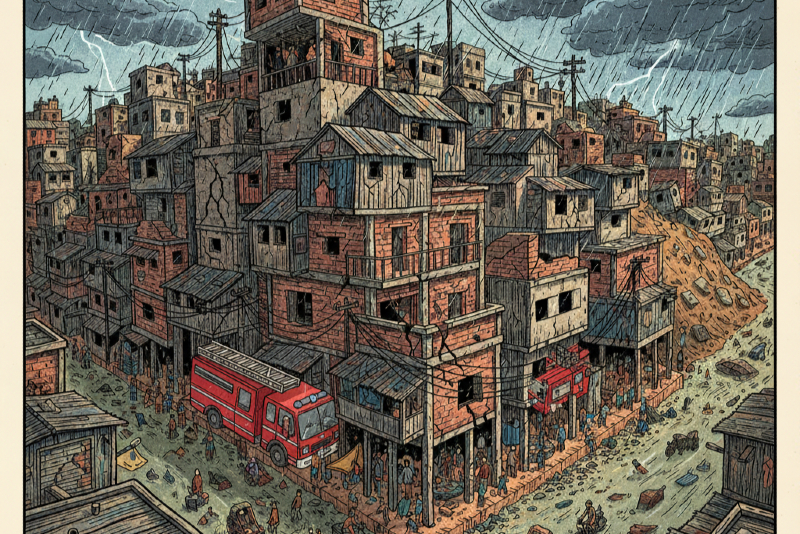
Dhaka, Feb, 2026: A magnitude 3.2 earthquake struck 10.5 kilometres east of Mirzapur in Bangladesh’s Dhaka Division on Sunday evening, shaking parts of the capital and surrounding areas and renewing concerns over urban safety. The tremor occurred at 6:30 pm (GMT+6), adding to a recent pattern of seismic activity felt across central Bangladesh.
Although no immediate damage was reported, the quake has once again drawn attention to Dhaka’s growing vulnerability, as rapid and largely unplanned urbanisation continues to outpace safety regulations, leaving millions exposed to potential disaster.
The recent wave of earthquakes felt in and around Dhaka has renewed deep concerns about the capital’s readiness to withstand a major seismic event. Experts warn that rapid and poorly regulated urban growth has made Bangladesh’s cities far more fragile than they appear.
Dhaka, one of the most densely populated megacities in the world, is already strained by overcrowding, traffic congestion and aging infrastructure. The latest tremors have highlighted how unplanned construction, weak enforcement of building regulations and limited emergency access could turn a strong earthquake into a large-scale urban disaster.
Repeated Tremors Raise Alarm
Over the past two weeks, at least four earthquakes—many originating near the Narsingdi area—have been recorded. Seismologists believe this pattern may signal renewed geological movement that could affect Dhaka, Gazipur and nearby urban centres. While the tremors have been moderate, their frequency has heightened public anxiety and expert concern.
Why Cities Are Growing More Dangerous
Urban planners say Bangladesh’s major cities have expanded faster than safety systems can keep up. Several factors are contributing to increased risk:
Streets that are too narrow for emergency vehicles
Widespread construction without proper engineering approval
Poor monitoring of building code compliance
Extremely high population density, particularly in older neighbourhoods
Together, these conditions could severely limit rescue and evacuation efforts during a major earthquake.
Old Dhaka Faces Severe Risk
A study conducted by researchers Yousuf Reja and Md. from Bangladesh University of Engineering and Technology (BUET) highlights the extreme vulnerability of Old Dhaka. Their research found dense clusters of non-engineered buildings, tightly packed along narrow alleys with almost no open space for evacuation.
Using geographic information systems (GIS), field surveys and spatial modelling, the study proposed evacuation routes and emergency access plans. However, the researchers cautioned that without urgent updates to urban planning policies and disaster-response strategies, such plans may remain ineffective in practice.
Official Figures vs Independent Estimates
Following recent tremors, Rajuk Chairman Riazul Islam confirmed that about 300 buildings in Dhaka have been officially identified as vulnerable. Independent experts, however, paint a far more troubling picture.
Dhaka has more than 2.1 million buildings, and specialists estimate that over 800,000 could be at risk of collapse during a powerful earthquake. So far, only a small fraction—just over 3,200 buildings in Dhaka and Gazipur combined—has been formally assessed.
Urban experts argue that responsibility lies both with authorities and property owners. While many buildings violate existing regulations, enforcement agencies often lack the capacity or authority to halt unsafe construction.
Calls for Immediate Action
Housing and environmental advisers are urging swift intervention, including retrofitting high-risk structures, strictly enforcing modern building codes and empowering regulators to take action against illegal developments.
Public concern is also growing. Residents say repeated tremors have exposed the dangers of living in poorly built structures. Taposh Debnath, a resident of Vatara, said unsafe buildings should be addressed immediately, adding that approving new construction under outdated rules is deeply concerning.
Former multinational executive Jane Alam echoed these concerns, saying Dhaka’s urban conditions are unusually fragile by international standards. She noted that less crowded rural areas may now be safer than densely built city neighbourhoods.
A Preventable Disaster in the Making
Home to nearly 20 million people, Dhaka is considered one of South Asia’s most earthquake-prone capitals. With signs that the nearby Madhupur Fault may be reactivating, experts warn that a major quake is no longer a distant possibility.
Areas built on unstable soil, filled with non-engineered structures and lacking clear evacuation routes face the greatest danger. A 5.7 magnitude earthquake on 21 November, followed by additional tremors, has only increased the urgency.
Without coordinated and immediate measures—ranging from safer construction and urban redesign to emergency planning and public awareness—Bangladesh risks turning a foreseeable natural event into a man-made humanitarian crisis.