
BPC Sets Daily Fuel Purchase Limits for Vehicles Amid Supply Concerns
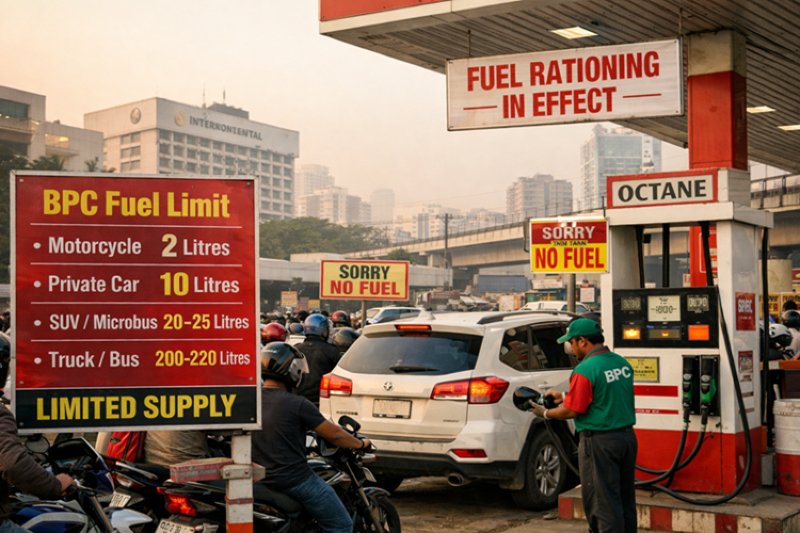
The Bangladesh Petroleum Corporation (BPC) has imposed limits on the amount of fuel that vehicles can purchase from filling stations each day, as authorities attempt to control panic buying triggered by fears of a potential global fuel shortage.
The directive, issued on Friday, comes amid rising public concern over fuel supply following escalating tensions in the Middle East. Long queues were reported at many fuel stations across the capital as motorists rushed to buy petrol and diesel in larger quantities than usual.
Daily Fuel Purchase Limits Announced
According to the BPC instruction, motorcycles will be allowed to purchase a maximum of 2 litres of petrol or octane per day. Private cars will be able to buy up to 10 litres daily.
Sports Utility Vehicles (SUVs), commonly referred to locally as jeeps, and microbuses will be permitted to purchase between 20 and 25 litres per day.
For larger vehicles, the limits are higher. Pickup trucks and local buses will be allowed to buy 70 to 80 litres of diesel daily, while long-distance buses, trucks, covered vans and container trucks will be able to collect 200 to 220 litres of fuel per day.
Panic Buying Behind the Decision
Officials say the measure was taken after unusual demand for fuel was observed at filling stations. Authorities believe some consumers and dealers have been trying to store extra fuel amid speculation about supply disruptions.
Bangladesh relies heavily on imported fuel, with about 95 percent of its petroleum demand met through foreign imports. According to BPC, global uncertainties occasionally cause delays in import schedules and shipping operations.
The agency said recent reports circulating in traditional media and on social media about fuel shortages have led to a surge in consumer demand. As a result, dealers have also been attempting to collect larger volumes of fuel from depots than usual.
There have also been reports that some consumers and dealers were trying to store excess fuel without authorization, prompting authorities to tighten monitoring.
Government Assures Supply Will Continue
Officials from the Energy and Mineral Resources Division said there is no immediate shortage of fuel in the country, adding that regular import shipments are continuing according to schedule.
To maintain supply across the country, petroleum products are being transported regularly from the main facilities to regional depots through rail wagons and fuel tankers. Authorities expect the country to build a stable buffer stock of fuel in the near future.
Receipt Required for Fuel Purchases
Under the new instruction, filling stations must issue a receipt mentioning the type, quantity and price of fuel supplied to each customer. Motorists will also need to show their previous receipt when purchasing fuel again.
Dealers have been instructed to distribute fuel strictly according to their allocation and to maintain records of sales and stock levels. Filling stations will be required to report their storage and distribution data to depots before receiving additional fuel supplies.
Authorities also warned that no dealer will be allowed to receive fuel beyond the officially approved allocation.
Long Queues at Fuel Stations in Dhaka
Despite the government’s assurances, heavy crowds were seen at several fuel stations across Dhaka on Friday, even though it was a public holiday.
At one point, a long line of motorcycles and private cars stretched from a filling station in Paribagh past the InterContinental Dhaka area to the Dhaka Metro Rail station near Shahbagh.
Witnesses said arguments broke out among motorists around midday as some drivers tried to move ahead in the queue. Minor scuffles were also reported during the rush.
Nazmul Hasan, a ride-sharing driver who works with Uber, said he waited about 50 minutes in line before getting fuel. Standing in the queue prevented him from accepting several ride requests, he added.
“Every day I need fuel worth around 400 to 500 taka to operate my vehicle. Other people might manage with less driving, but we cannot work without fuel,” he said.
Regional Conflict Raises Global Oil Concerns
Tensions in the Middle East have intensified after military strikes involving the United States and Israel against Iran since February 28. Iran has also launched retaliatory attacks, raising fears of a broader regional conflict.
The situation has created uncertainty in global energy markets, particularly after reports that Iran has closed the strategic Strait of Hormuz, a key shipping route for global oil supplies.
Officials in Bangladesh, however, insist that the country still has adequate fuel reserves and that there is no need for public panic.
Vehicle-wise Daily Fuel Purchase Limit (According to Bangladesh Petroleum Corporation)
| Vehicle Type | Maximum Fuel Allowed Per Day |
|---|---|
| Motorcycle | 2 litres (petrol or octane) |
| Private Car | 10 litres |
| SUV / Jeep | 20–25 litres |
| Microbus | 20–25 litres |
| Pickup / Local Bus | 70–80 litres (diesel) |
| Long-distance Bus | 200–220 litres |
| Truck | 200–220 litres |
| Covered Van | 200–220 litres |
| Container Truck | 200–220 litres |
These figures are based on the directive issued by Bangladesh Petroleum Corporation on 6 March 2026 to control panic buying of fuel.