
US Supreme Court Blocks Trump’s ‘Liberation Day’ Tariffs: A Constitutional Rebuke with Global Ripples
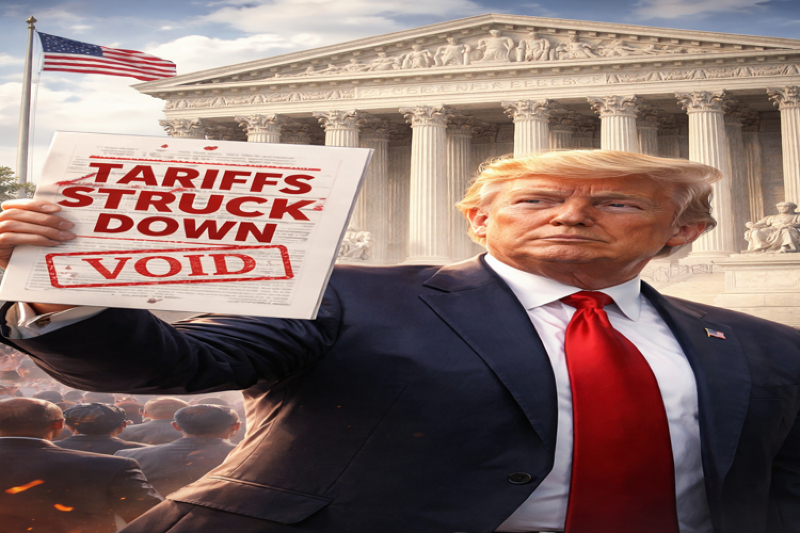
In a landmark 6–3 ruling, the Supreme Court of the United States has struck down President Donald Trump’s sweeping “Liberation Day” tariffs, declaring that he exceeded executive authority by invoking the International Emergency Economic Powers Act (IEEPA) to impose broad import taxes. The judgment is more than a trade-policy reversal—it is a constitutional line drawn in bold.
The Cardinal Points
1. Congress Holds the Taxing Power
The Court reaffirmed that the US Constitution vests the power to levy taxes—including tariffs—exclusively in Congress. Chief Justice John Roberts wrote that emergency economic powers do not authorize unbounded tariff regimes. The message: emergency statutes cannot be stretched into permanent trade weapons.
2. A Rare Institutional Check
At a time when presidential power has expanded through executive orders and emergency declarations, the ruling marks a rare and direct judicial restraint on executive trade policy. Even a conservative-majority bench rejected the legal scaffolding of the tariff program.
3. Not All Tariffs Are Gone
The decision invalidates tariffs imposed under IEEPA but leaves intact industry-specific duties enacted under other statutes, such as Section 232 of the Trade Expansion Act. This means steel, aluminium, and auto tariffs may remain unaffected—for now.
4. Market Relief, Business Uncertainty
Wall Street reacted positively, reflecting investor confidence that legal predictability may return. Yet uncertainty lingers: Will importers receive refunds for billions already paid? The Court did not address compensation mechanisms, potentially triggering another legal and administrative battle.
5. Political Fault Lines Deepen
Within the Republican Party, tariff policy has long been divisive—particularly among farm-state lawmakers hurt by retaliatory trade measures. The ruling may embolden free-trade conservatives while weakening economic nationalism ahead of future policy debates.
The News Behind the News
A Constitutional Reset in Trade Governance
For decades, Congress has gradually delegated trade authority to presidents, especially during crises. This ruling may signal judicial impatience with broad interpretations of “national emergency.” It revives the non-delegation debate: how far can Congress transfer its core fiscal powers?
A Strategic Setback—but Not the End
Trump has historically framed tariffs as both economic shield and geopolitical leverage. The Court has closed one legal door, but alternative trade statutes remain available—though often requiring investigations or congressional consultation. That means slower deployment and more scrutiny.
Global Implications
Allies and rivals alike had recalibrated supply chains around unpredictable US tariff swings. The decision introduces a new variable: judicial oversight as a constraint on unilateral trade escalation. For the European Union and Asian exporters, the ruling may stabilize transatlantic commerce—at least temporarily.
Refunds: The Next Battlefield
If courts or Congress move toward refunds, the fiscal impact could be substantial. Businesses argue they bore unlawful costs. The administration may resist broad repayment on budgetary grounds. This issue could shape the second phase of litigation.
What Comes Next?
Executive Response: The White House may seek alternative statutory routes to reimpose tariffs.
Congressional Action: Lawmakers could clarify emergency trade powers to prevent future ambiguity.
Business Claims: Importers may file for reimbursement, testing administrative capacity.
Political Narrative: The ruling reframes tariffs from economic doctrine to constitutional controversy.
In striking down the tariff regime, the Supreme Court has not merely ruled on trade—it has reasserted constitutional boundaries. Whether this becomes a lasting recalibration of executive power or a temporary pause in tariff politics will depend on the battles that follow in Congress, the courts, and the campaign trail.
Immediate Tariff Shift
At a White House briefing, Trump declared the ruling “deeply disappointing” and signaled that the United States would continue to impose duties on foreign goods. Using Section 122 of the 1974 Trade Act, which permits the president to levy tariffs of up to 15% for 150 days without congressional approval, Trump signed an executive order to institute a 10% global tariff effective immediately.
Trump emphasized that other previously imposed tariffs, such as those under Section 232 and Section 301, remain in effect. “I can destroy trade if I want, but apparently I can’t impose a small fee,” he said, criticizing the court’s reasoning.
Legal Uncertainty Looms
The Supreme Court did not address whether importers who paid the now-invalidated IEEPA tariffs are entitled to refunds. Trump acknowledged that this issue “has to get litigated for the next few years,” signaling prolonged uncertainty for businesses that collectively remitted over $130 billion in customs duties since the tariffs were first implemented.
Trade attorneys warn that while electronic claims could simplify refunds, the sheer scale may leave smaller firms struggling to recover their payments.
Mixed Reactions from Businesses
For many small and medium-sized enterprises, the ruling brought cautious relief. Jenelle Peterson, co-founder of Wild Life Outdoor Adventures, said her Canadian toy firm experienced a 25% hit in profits due to the previous tariffs.
“The court’s decision sends a clear message: unpredictable tariff swings are damaging for small businesses,” Peterson said. However, she remains wary of future tariff actions under alternative statutes.
Meanwhile, analysts note a silver lining: the new tariff framework requires investigations and notice periods, offering firms a predictable window to plan imports—something the abrupt IEEPA tariffs lacked.
Political and Economic Ripples
Vice-President JD Vance described the ruling as “lawlessness from the court,” warning that it could hinder the president’s ability to protect American industries. Within the Republican Party, the decision highlights growing divisions over economic nationalism versus free-trade approaches, particularly among lawmakers representing export-heavy or farm constituencies.
What Comes Next?
The immediate consequences include potential litigation over refunds and careful monitoring of Section 122 tariffs. Congress may face renewed pressure to clarify emergency trade powers, while businesses prepare for a complex landscape of overlapping tariffs.
Trump’s swift pivot to a new statutory route demonstrates his continued reliance on tariffs as a key economic and geopolitical tool. Yet, with courts, Congress, and businesses all poised to weigh in, the post-ruling period promises legal, political, and financial uncertainty—underscoring that the tariff saga is far from over.
➡️ Read more:
https://thereporter24.com/news/retroactivity-debate-can-trump-s-new-10-tariff-apply-to-the-past
https://thereporter24.com/news/trump-moves-to-bypass-supreme-court-ruling-with-fresh-10-global-tariff
https://thereporter24.com/news/legal-battles-ahead-challenges-loom-over-trump-s-new-10-global-tariff