

Retroactivity Debate: Can Trump’s New 10% Tariff Apply to the Past?
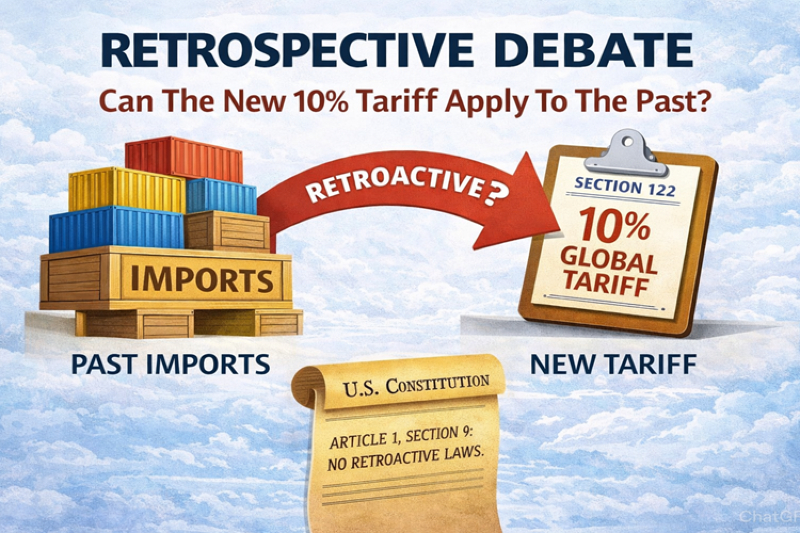
As President Donald Trump enforces a new 10% global tariff under Section 122 of the Trade Act of 1974, legal observers are raising a critical question: can the measure apply retrospectively to imports that entered the United States before the order was signed?
The issue is particularly sensitive because billions of dollars were collected under the now-invalidated IEEPA tariffs, and businesses are seeking clarity on whether the new levy could be used to offset or replace those prior duties.
The Presumption Against Retroactivity
Under U.S. legal principles, laws and executive actions are generally presumed to operate prospectively, not retrospectively, unless Congress clearly expresses an intention for retroactive effect. While the U.S. Constitution does not explicitly state that all laws must apply prospectively, several constitutional provisions reflect strong limits on retroactivity.
Article I, Section 9, Clause 3 prohibits Congress from passing ex post facto laws. Although this clause primarily applies to criminal legislation, it reinforces the broader constitutional tradition that individuals should not be penalized under rules created after the fact.
Similarly, the Due Process Clause of the Fifth Amendment has been interpreted by courts as limiting arbitrary retroactive economic legislation, particularly where it disrupts settled expectations.
In trade matters, courts have historically required clear statutory language if Congress intends retroactive application of duties or taxes.
Section 122 of the Trade Act contains no language authorizing retroactive tariffs. Instead, it permits the President to impose duties of up to 15% for a limited 150-day period—suggesting forward-looking economic adjustment rather than retrospective correction.
“Section 122 clearly gives the president temporary tariff authority, but that doesn’t make it immune from challenge,” said a Washington-based trade law analyst. “Courts will examine whether the administration follows procedural safeguards and respects the 150-day limit. Any attempt to stretch the measure beyond its statutory boundaries — or apply it retroactively — would likely trigger swift judicial scrutiny.”
Executive Authority and Timing
Unlike the invalidated tariffs imposed under the International Emergency Economic Powers Act (IEEPA), the new tariff relies on an explicit trade statute.
However, executive orders generally take effect from the date specified in the proclamation. Customs enforcement operates on entry dates—meaning goods are assessed duties based on the tariff schedule in force at the time of importation.
Applying a new tariff retroactively to goods already cleared through customs would raise serious legal concerns, including:
Due process challenges from importers who relied on existing tariff schedules
Claims of unlawful taxation without clear congressional authorization
Administrative law disputes under the Administrative Procedure Act
Legal scholars note that retroactive economic regulation is subject to heightened scrutiny, especially where it imposes unexpected financial burdens.
Refunds Remain Separate
Importantly, the new 10% tariff does not automatically cancel, offset, or “digest” the old IEEPA tariffs struck down by the Supreme Court.
Refund claims for previously paid duties would likely be handled through litigation in the U.S. Court of International Trade. The new tariff functions independently and prospectively, unless courts rule otherwise.
Practical Implications
If the administration attempted to apply the tariff retrospectively, it would almost certainly face immediate injunction requests.
Businesses argue that stable and predictable customs rules are essential for global supply chains. Investors are watching closely, as any retroactive application could create market volatility and expand legal exposure for the government.
In short, while Trump retains statutory authority to impose temporary tariffs under Section 122, constitutional principles, statutory silence on retroactivity, and long-standing judicial doctrine strongly suggest that the new 10% global tariff applies from the date of proclamation forward, not backward.
🔗 Read more:
https://thereporter24.com/news/legal-battles-ahead-challenges-loom-over-trump-s-new-10-global-tariff
https://thereporter24.com/news/trump-moves-to-bypass-supreme-court-ruling-with-fresh-10-global-tariff
https://thereporter24.com/news/us-supreme-court-blocks-trump-s-liberation-day-tariffs-a-constitutional-rebuke-with-global-ripples