
UK Detects Covert Russian Submarine Mission Targeting Sea Bed Infrastructure as World Focuses on Iran Conflict
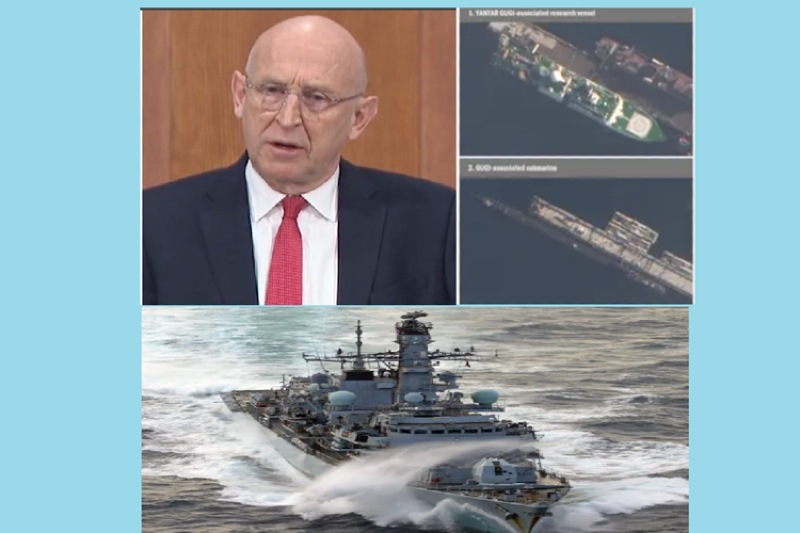
LONDON — In a direct challenge to the Kremlin, UK Defence Secretary John Healey has revealed that British and Norwegian forces successfully neutralized a month-long "covert" Russian submarine operation in the North Atlantic.
The mission, which targeted critical undersea cables and pipelines, was monitored around the clock by the Royal Navy and RAF to prevent a potential economic and security catastrophe.
The Operation: A Distraction and a Deep-Sea Threat
The Russian deployment featured a sophisticated "shell game" strategy. According to the Ministry of Defence, an Akula-class nuclear-powered attack submarine was used as a high-profile decoy to draw the attention of NATO sensors.
While Western forces tracked the Akula, two highly specialized vessels from Russia’s GUGI (Main Directorate of Deep-Sea Research)—the Kremlin’s secretive underwater intelligence unit—attempted to operate "covertly" over vital infrastructure.
The UK responded by deploying:
HMS St Albans: A Type 23 frigate equipped with advanced sonar.
RFA Tidespring: A fleet tanker providing logistical support.
Merlin Helicopters & P-8 Poseidon Aircraft: Utilized for specialized "submarine hunting" and 24/7 aerial surveillance.
Russia’s Objective: Why the Sea Bed?
Defence Secretary Healey emphasized that the sea bed is now a "prime target" for modern warfare. Russia’s presence over these specific coordinates was not random; the objective was likely twofold:
Economic Sabotage: Undersea pipelines provide 50% of the gas that heats British homes. Disrupting these would weaponize energy prices, directly impacting household bills.
Intelligence & Communications: Approximately 99% of international data and telecoms travel via undersea cables.
By loitering over these lines, GUGI vessels can potentially tap into data streams or prepare for "grey zone" warfare—cutting communications during a crisis to sow chaos.
"Our armed forces left them in no doubt that they were being monitored, that their movements were not covert, and that their attempted secret operation had been exposed," Healey stated during the Downing Street briefing.
A Message to the Kremlin
Prime Minister Keir Starmer, currently visiting the UAE, issued a stern warning, stating the UK "will not shy away from taking action" to protect national security.
The disclosure of this military operation is viewed by analysts as a strategic move to signal to President Putin that Russia’s "invisible" assets are, in fact, fully visible to NATO.
Healey concluded with a blunt warning: "We see you. Any attempt to damage our infrastructure will have serious consequences."
While the Russian vessels have now retreated north, the UK has announced a £100 million investment in new submarine-hunting technology and the launch of the Atlantic Bastion programme to further fortify the High North against future incursions.
Was Russian action linked to Iran war?
While Defence Secretary John Healey confirmed that the submarine operation took place simultaneously with the conflict in the Middle East, he described the link as a strategic distraction rather than a direct military coordination.
According to Healey's Downing Street briefing on April 9, 2026, here is how the two events are connected:
1. The "Distraction" Strategy
Healey explicitly stated that Vladimir Putin likely launched the "covert" operation in the North Atlantic because "the eyes of many were trained on the Middle East."
2. Geopolitical Overlap
The UK government highlighted a broader connection between the two theaters of conflict:
Military Support: UK officials pointed out that Russia has been providing Iran with drone components and other technical support during the current Middle East hostilities.
The "Main Threat" Reminder: Healey used the press conference to remind the public that despite the urgent crisis in the Middle East, Russia remains the "main threat" to the UK and its allies.
He stated, "We will not take our eyes off Putin."
3. Resource Management
During the conference, Healey addressed public concerns about why the UK hadn't deployed all its military assets to the Middle East. He argued that doing so would be against the national interest, as it would leave "unseen and silent" threats—like the GUGI submarines—unmonitored in British waters.
Summary Table: Regional Conflict Comparison
| Feature | Middle East (Iran War) | North Atlantic (Submarine Op) |
|---|---|---|
| Status | Active conflict / Teetering ceasefire | Operation concluded (Russians retreated) |
| UK Involvement | Defensive measures / Drone interceptions | 24/7 monitoring and deterrence |
| Primary Risk | Regional stability / Fuel prices | Data blackouts / National gas supply |
| Russia's Role | Supplier of Iranian technology | Direct "covert" antagonist |
In short, the submarine operation was not a part of the Iran war itself, but rather an attempt by Russia to exploit the global focus on that war to weaken the UK's domestic security.