
From ‘Stone Age’ to ‘Golden Age’: The Inside Story of the Midnight Deal That Saved a Civilization
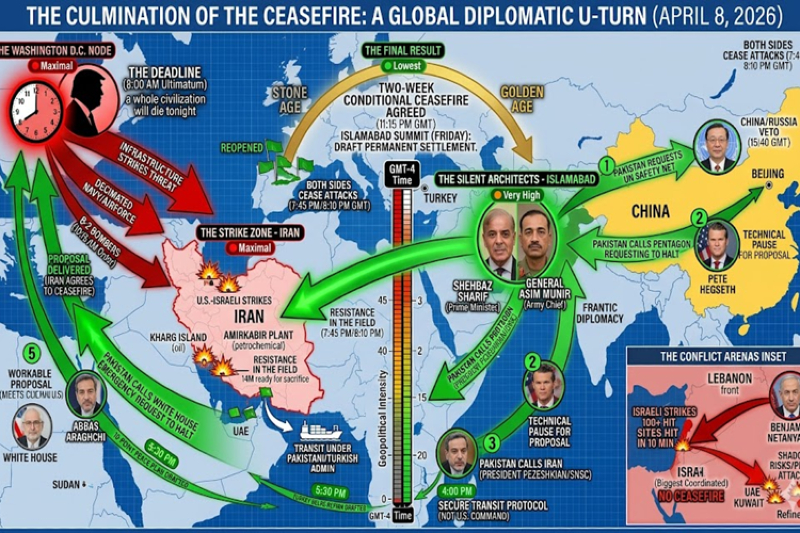
WASHINGTON D.C. / ISLAMABAD — At 8:00 PM on Tuesday, the world was bracing for an apocalypse. US President Donald Trump had issued a chilling ultimatum: reopen the Strait of Hormuz by the deadline, or "a whole civilization will die tonight."
Just 90 minutes before that clock struck zero, a dramatic diplomatic U-turn transformed a looming global catastrophe into a historic two-week ceasefire.
Here is the behind-the-scenes story of how frantic diplomacy and high-stakes threats shifted the Middle East from the brink of the "Stone Age" toward what Trump now calls a potential "Golden Age."
The Final Countdown: A Civilization on the Edge
The day began with the darkest rhetoric of the 38-day war. President Trump, utilizing his Truth Social platform, warned that U.S. forces were "locked and loaded" to incinerate Iran’s entire civilian infrastructure. "Every bridge will be decimated... every power plant will be out of business," he declared, framing the destruction of Iranian civilization as an imminent reality.
As the 8:00 PM (GMT-4) deadline approached, the military reality mirrored the verbal threats:
15:21 GMT: U.S. strikes targeted Kharg Island, Iran's primary oil hub.
20:41 GMT: A joint U.S.-Israeli air raid hit the Amirkabir Petrochemical Plant in southwest Iran, signaling that Washington was prepared to move from military targets to the heart of Iran’s economy.
The Pakistan Pivot: The Secret Mediators
While the world watched the skies for missiles, the real movement was happening in the corridors of power in Islamabad.
Prime Minister Shehbaz Sharif and Pakistan’s military chief, General Asim Munir, emerged as the "silent architects" of the truce. Acting as the primary bridge between a defiant Tehran and an aggressive Washington, Pakistani officials spent Tuesday engaged in what they described as "sensitive and critical" negotiations.
At 19:17 GMT, Sharif made a public, yet calculated, appeal to the White House. He formally requested a two-week extension to the deadline, citing "substantive results" in the diplomatic pipeline. Simultaneously, he urged Tehran to offer a "goodwill gesture" by reopening the Strait of Hormuz.
The U-Turn: A 10-Point Lifeline
The tension broke at 22:45 GMT. With less than an hour and a half remaining before the "civilization-ending" strikes were set to begin, President Trump stunned the global community by announcing a temporary ceasefire.
The catalyst for this sudden shift was a 10-point proposal submitted by Iran through Pakistani intermediaries. Trump, who had only hours earlier threatened to bomb Iran into the "Stone Age," suddenly described the proposal as "workable."
The Deal Structure:
Immediate Cessation: Both sides agreed to halt all kinetic attacks for 14 days.
Economic Flow: Iran agreed to immediately reopen the Strait of Hormuz to commercial shipping.
The Islamabad Summit: Delegations from both Washington and Tehran are scheduled to meet in Pakistan this Friday to begin drafting a permanent settlement.
The Aftermath: A Change in Tone
By Wednesday morning, the "apocalyptic" President had vanished, replaced by a leader preaching "World Peace." In his latest posts, Trump suggested that the Middle East could be entering a "Golden Age," a sharp contrast to his "genocidal" warnings from the day before.
In Tehran, the mood shifted from defiance to relief. Iranian Foreign Minister Abbas Araghchi confirmed the truce, while citizens gathered in Revolution Square to celebrate the pause in a war that had threatened their national existence.
The Bottom Line: While the ceasefire is fragile—and notably excludes Israeli operations in Lebanon—the "Midnight Deal" proved that even at the edge of total destruction, back-channel diplomacy fueled by the desperation of regional neighbors can rewrite the script of a global war.
Following the dramatic midnight breakthrough that averted the destruction of Iranian infrastructure, internal and geopolitical maneuvers have surfaced that reveal the complexity of the "10-Point Peace Plan" and the silent roles played by global powers.
The following sections delve into the internal Iranian leadership shift and the strategic roles of China, Russia, and Turkey in securing the ceasefire.
The Internal Shift: Iran’s ‘New Calculus’
Behind the scenes in Tehran, the initial defiance that saw President Masoud Pezeshkian and "14 million Iranians" ready for sacrifice was replaced by a pragmatic shift within the Supreme National Security Council (SNSC).
The Pragmatists Take Control: Following the death of the former Supreme Leader earlier in the conflict, a new cohort of military and political figures took the lead. Foreign Minister Seyed Abbas Araghchi and key members of the SNSC became the primary advocates for the 10-point proposal.
Convincing the Armed Forces: The turning point occurred when leadership convinced the Khatam al-Anbiya Central Headquarters—the body overseeing the Iranian military—that the "Strait of Hormuz strategy" had achieved its maximum leverage. They argued that continuing the blockade would lead to the total annihilation of Iran’s energy grid and petrochemical plants, as signaled by the precision strikes on the Amirkabir facility.
The ‘Massive Victory’ Narrative: To prevent domestic backlash and maintain military morale, the SNSC officially branded the ceasefire as a "massive victory," framing the U.S. pause as a concession forced by Iranian resilience rather than a surrender to Trump’s ultimatum.
The ‘Clean Mediators’: China’s Covert Influence
While Pakistan acted as the public face of diplomacy, China played a decisive "covert" role in nudging Tehran toward the negotiating table.
The Economic Chokepoint: As Iran’s largest trading partner, Beijing was deeply concerned about global energy security and the potential for a total closure of the Strait of Hormuz.
Backchannel Leverage: Anonymous officials have revealed that China worked through a network of intermediaries—including Pakistan, Turkey, and Egypt—to exert pressure on Tehran.
Beijing’s strategy was to provide Iran with a "diplomatic safety net" at the UN, including a key veto alongside Russia on Tuesday, while privately warning Iran that a war of total destruction would end Chinese economic support.
The Strategic ‘Gray Zone’: Russia and Turkey
Other regional powers adopted unique strategies to balance their interests while preventing a full-blown global conflict.
Russia’s ‘War of Attrition’ Strategy: Moscow preferred a "gray zone" policy.
While providing Iran with intelligence and satellite imagery of U.S. aircraft positions to improve defensive accuracy, Russia avoided direct military intervention. Their goal was to keep the U.S. "preoccupied and drained" in the Middle East without allowing the global economy to collapse entirely. Turkey’s Regional Stabilizer Role: Turkey acted as a critical secondary channel for the "Islamabad Track."
By maintaining open lines of communication with both the Trump administration and the SNSC, Ankara helped refine the technical details of the "secure transit protocol" for the Strait of Hormuz, which is a central pillar of the ceasefire.
The Roadmap to Islamabad
The story now moves to the Pakistani capital.
While the U.S. demands include the total removal of nuclear material, Iran’s plan seeks the lifting of all primary and secondary sanctions and the withdrawal of U.S. forces from regional bases.
The Final Count: 8:00 AM – 7:15 PM (GMT-4)
As President Trump’s self-imposed 8:00 PM deadline to "obliterate" Iran’s infrastructure loomed, rhetoric reached apocalyptic levels.
| Time | Actor | Action / Key Event | Geopolitical Intensity |
|---|---|---|---|
| 8:00 AM | Donald Trump (X/Truth Social) | The 'Genocidal' Ultimatum: Trump warns that if the Strait is not open by 8 PM, the U.S. will destroy Iran’s power grid, bridges, and oil ports. He adds, "a whole civilization will die tonight." | 🔴 Maximal |
| 10:15 AM | Pentagon (Hegseth/Caine) | The 'Locked & Loaded' Order: Defense Secretary Pete Hegseth confirms B-2 bombers and naval forces are targeting the Kharg Island and Amirkabir Petrochemical hubs. | 🔴 Maximal |
| 11:00 AM | Tehran (Pezeshkian/IRGC) | Defiance & Deterrence: President Masoud Pezeshkian tells the Supreme National Security Council (SNSC) that "14 million Iranians" are ready for sacrifice. The Khatam al-Anbiya command warns it will "deprive the region of oil and gas for years" if attacked. | 🟠 Very High |
The Pakistan Pivot: 12:30 PM – 6:15 PM (GMT-4)
Behind the explosive rhetoric, the true movement was happening via the "Islamabad Track." Pakistan’s leadership spent Tuesday engaged in a "critical, sensitive stage" of mediation.
| Time | Actor | Action / Key Event | Geopolitical Intensity |
|---|---|---|---|
| 12:30 PM | Islamabad (Shehbaz Sharif) | Step 1: The Call to Beijing. Sharif contacts the Chinese leadership, seeking support for an alternative diplomatic route and a UN Security Council safety net for Iran. | 🟡 Moderate |
| 2:15 PM | Islamabad (Gen. Asim Munir) | Step 2: The Call to the Pentagon. General Munir contacts Gen. Dan Caine, Chairman of the Joint Chiefs, offering Pakistan as a neutral mediator and requesting a pause in strikes to allow a technical proposal to be finalized. | 🟠 High |
| 4:00 PM | Islamabad (Sharif/Munir) | Step 3: The Call to Tehran. Sharif speaks with Araghchi and key SNSC officials. He presents the core of the U.S. demand (Hormuz reopening) but offers a path to save face: a Pakistani-administered "Secure Transit Protocol" rather than a U.S. command. | 🟠 High |
| 5:30 PM | Islamabad (Sharif/Munir) | Step 4: The 10-Point Proposal. Iran accepts the technical framework of the secure transit protocol. Working with Ankara (Turkey) to refine the technical data on shipping lane management, the Pakistani team drafts the definitive 10-Point Peace Plan. | 🟠 High |
The Midnight Miracle: 6:30 PM – Midnight (GMT-4)
In the final 90 minutes, frantic diplomacy in Islamabad collided with military escalation in the Persian Gulf.
| Time | Actor | Action / Key Event | Geopolitical Intensity |
|---|---|---|---|
| 6:30 PM | The Gulf (U.S. Navy/IRGC) | Naval Stand-Off: U.S. warships approach Iranian patrol boats near the Strait of Hormuz. The situation is described as "tinderbox." | 🔴 Maximal |
| 6:45 PM | Islamabad (Shehbaz Sharif) | Step 5: The Emergency Call to the White House. Sharif makes an urgent, direct call to President Trump, informing him that Iran has agreed to a "workable" proposal that meets the core U.S. demand to reopen the Strait. | 🔴 Maximal |
| 7:00 PM | Islamabad (Sharif/Munir) | Step 6: Delivering the proposal to Trump. The completed 10-point plan is transmitted to the White House Situation Room. The document includes Iran’s formal agreement to cease all kinetic attacks and reopen the energy lanes. | 🔴 Maximal |
| 7:15 PM | White House (Donald Trump) | Step 7: The Final decision. Reviewing the proposal, Trump makes the dramatic decision to halt the strikes, recognizing that his primary military objective (Hormuz) has been achieved without further escalation. | 🔴 Maximal |
| 7:45 PM | Trump (Truth Social) | Step 8: The Ceasefire Announcement. With 15 minutes to spare, Trump stuns the world by announcing a two-week conditional ceasefire and the formal reopening of the Strait. | 🟡 Moderate |
| 8:10 PM | Tehran (SNSC/Araghchi) | Step 9: Confirmation and Compliance. Iranian Foreign Minister Araghchi confirms the truce, stating that Tehran will abide by the 14-day pause if all attacks on its territory cease. | 🟢 Low |
| Midnight | The World | The Conclusion. The 12-hour timeline ends. The Strait of Hormuz begins reopening under Pakistani-Turkish administration. Trump calls it a "Capital V victory." Iran calls it a victory of "resistance." The "Golden Age" begins—for now. | 🟢 Lo |