
Tehran Threatens ‘New Battlefield Cards’ as Trump Details ‘Complex’ Nuclear Recovery
Tehran / Washington / Islamabad — April 21, 2026
As the countdown begins for the expiration of the two-week ceasefire between the United States and Iran, tensions have surged to a new high.
On Tuesday, Iranian officials issued stern warnings of military readiness, while President Donald Trump signaled that the path to a nuclear resolution remains fraught with physical and political obstacles.
Tehran’s Warning: "New Cards on the Battlefield"
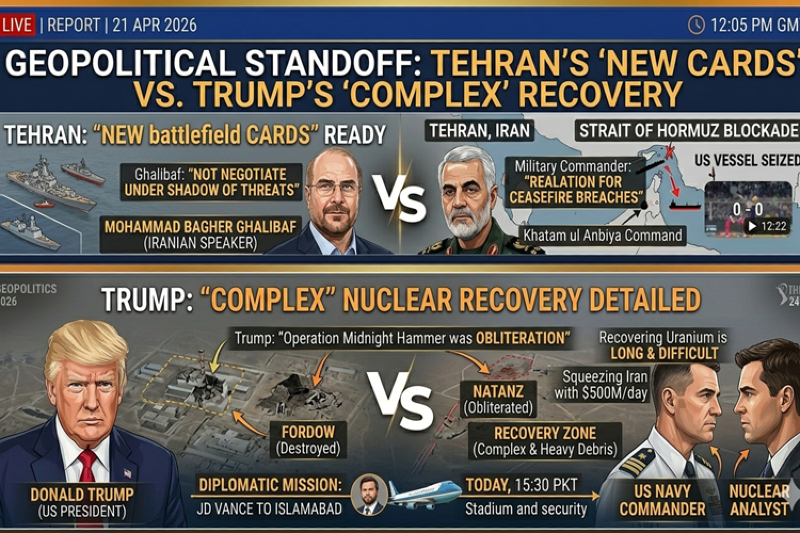
Iran’s parliamentary speaker, Mohammad Bagher Ghalibaf, took to social media to declare that Tehran has spent the last fortnight preparing "new cards on the battlefield" should active hostilities resume.
Reaffirming Iran’s refusal to engage in diplomacy under coercion, Ghalibaf stated that the Islamic Republic would "not accept negotiations under the shadow of threats."
This defiant stance comes as the 14-day truce is set to expire this Wednesday. While President Trump has described an extension of the ceasefire as "highly unlikely," Iranian officials remain split.
While President Masoud Pezeshkian suggested diplomacy should be used to de-escalate, the Foreign Ministry spokesperson clarified today that there are currently "no plans" for a second round of negotiations in Islamabad.
Trump: Nuclear Recovery a "Long and Difficult Process"
In a series of statements on Truth Social, President Trump addressed the aftermath of "Operation Midnight Hammer," the June 2025 airstrikes that targeted Iranian nuclear facilities at Fordo, Natanz, and Isfahan.
Trump warned that removing enriched uranium from these sites would be a "long and difficult process" due to the "complete and total obliteration" of the facilities. He insisted that the U.S. holds the upper hand in any potential deal, claiming the ongoing naval blockade of the Strait of Hormuz is costing Iran approximately $500 million per day.
"I am under no pressure whatsoever [to make a deal]," Trump posted, though he predicted a settlement would eventually happen "relatively quickly."
Vance Mission: High-Stakes Trip to Islamabad
Despite the "radio silence" from Tehran regarding their attendance, U.S. Vice President JD Vance is expected to depart for Islamabad today. According to sources cited by Axios and CNN, the Vice President’s mission is to lead a U.S. delegation for a second round of talks tentatively scheduled for Wednesday.
The diplomatic push is complicated by the "blockade within the blockade" strategy currently employed by the U.S. Navy. Experts suggest the White House is attempting to inflict "sufficient pain" to force Iran’s hand, but Tehran has historically shown a high tolerance for economic damage to preserve its strategic autonomy over the Strait of Hormuz.
Regional Implications
Strait of Hormuz: The U.S. continues its blockade following the seizure of an Iranian-flagged cargo ship on Sunday.
Israel-Lebanon: Amid the U.S.-Iran friction, a second round of separate talks between Israel and Lebanon is reportedly scheduled for Thursday.
Economic Pressure: The global energy market remains volatile as the Wednesday deadline approaches, with international shipping awaiting clarity on safe passage through the Gulf.
As JD Vance heads to Pakistan, the world watches to see if Tehran will play its "battlefield cards" or if the two sides can find common ground before the ceasefire clocks out.