
SPECIAL REPORT: The "Domino Crisis"—How Geopolitical Turbulence is Impacting Energy Prices, Global Supply Chains, Commodity Prices & Consumers Globally
By Anonna Reza
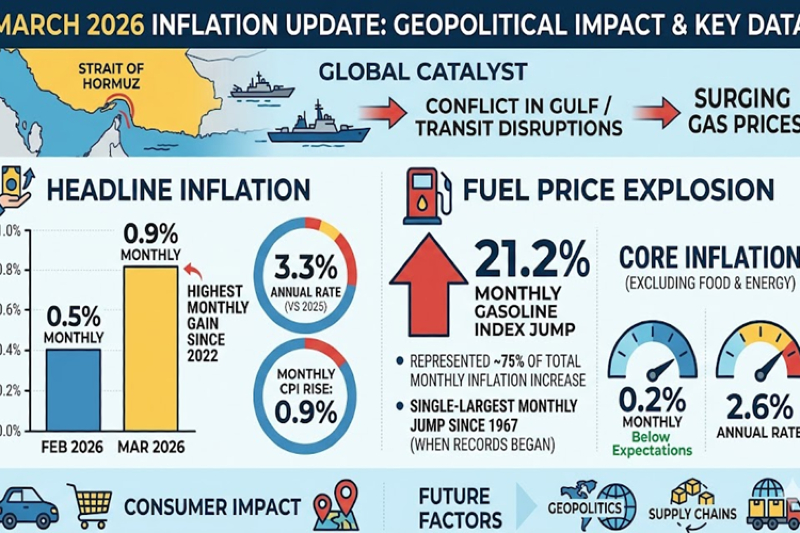
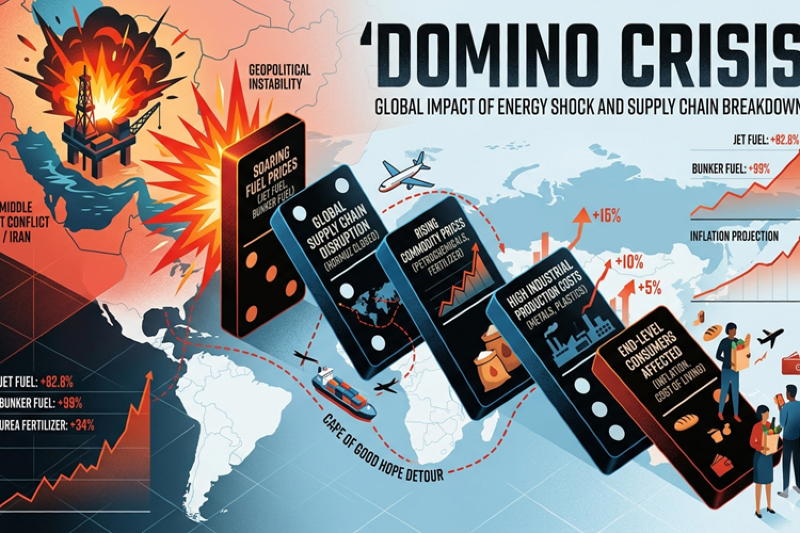
The direct transmission of energy shocks into industrial collapse and consumer inflation as the effective closure of the Strait of Hormuz following the February 28 strikes has moved beyond a "shipping delay." It has become a direct assault on global production costs. With fuel prices jumping vertically, the world is facing a synchronized spike in the cost of making and moving nearly every essential commodity.
Step 1: The Energy Trigger – Fuel Costs "Take Off"
The crisis began with a decoupling of fuel prices from crude oil. While Brent crude sits near $120/barrel, the refined fuels that power industry have surged even higher due to regional refinery damage.
Jet Fuel & Diesel: Global average jet fuel prices have spiked to $175/barrel (a 42% monthly gain). In the U.S., diesel—the backbone of manufacturing—has crossed $5.00/gallon, a level historically correlated with a 40% increase in recession probability.
Bunker Fuel: Maritime fuel in Singapore has jumped 99% since late February, reaching over $1,017 per tonne. Shipping lines are now forced to apply "Emergency Fuel Surcharges" of up to $1,500 per container.
Step 2: Surging Production Costs – The Industrial "Input Shock"
High energy prices are now "bleeding" into the factory floor. The Middle East is a primary supplier of the chemicals used to create modern products.
Petrochemicals & Plastics: The cost of Polyethylene and Polypropylene (essential for packaging and electronics) has risen by 5% in Asia and 2.5% in Europe this month alone.
The Fertilizer Crisis: Qatar’s halt in LNG production has paralyzed global urea and ammonia output. Urea prices have jumped 17% to 30% in the last three weeks. Because urea is a key ingredient for growing rice and wheat, the cost of the next harvest is being locked in at record highs right now.
Metal Smelting: Aluminum and copper production in the Gulf—representing a significant portion of global supply—is at a standstill. This is driving up the "base cost" for everything from soda cans to electric vehicle batteries.
Step 3: Supply Chain Breakdown – The "Distance Tax"
With the Strait of Hormuz "functionally impaired," the cost of moving these expensive goods has doubled.
The Cape Diversion: Rerouting ships around Africa adds 10–15 days to the journey. This doesn't just cost more in fuel; it ties up global vessel capacity, creating a "scarcity" of ships that allows freight rates to climb even further.
Inventory Carrying Costs: "Just-in-time" manufacturing is failing. Companies are now forced to pay for extra storage and higher insurance premiums—costs that add 3% to 5% to the final value of industrial goods before they even leave the warehouse.
Step 4: The End-Level Consumer – Paying the Price
The final domino is the consumer's wallet. The "hopping" fuel price has reached the checkout counter:
Food Inflation: UNCTAD warns that the combination of high shipping costs and the fertilizer shock will likely drive global food prices up by 15% by summer 2026.
Retail Goods: From electronics to clothing, the "Global Surcharge" is being added to every price tag. Major retailers are already warning that the 20% rise in air and sea freight will result in higher prices for all imported goods by Q2 2026.
The Cost of Living: As central banks struggle to contain this energy-driven inflation, the average consumer is facing a "double squeeze": higher prices for goods and higher interest rates on their debts.
Conclusion: A Deteriorating Horizon
If the conflict continues and the Hormuz channel remains blocked, the IEA estimates a global oil supply deficit of 8 million barrels per day.
For the global consumer, this means the current price spikes are not a "peak," but the beginning of a sustained period of high-cost living. The "Domino Crisis" is no longer a prediction—it is a daily reality.
Recent market surveys from mid-March 2026 reveal a sharp decline in consumer and investor sentiment across the US, Europe, and Asia.
Below is a summary of the latest surveys and market data:
1. United States: The "Gas-Price Pressure" Index
According to the University of Michigan’s Survey of Consumers (March 2026), sentiment has taken a significant hit following the start of military action on February 28.
Sentiment Drop: The Consumer Sentiment Index fell from 56.6 in February to 55.5 in March.
The "Iran Effect": Survey Director Joanne Hsu noted that interviews completed after the conflict began showed a complete reversal of earlier economic gains.
Inflation Expectations: Year-ahead inflation expectations stalled at 3.4%, ending a six-month downward trend.
Household Impact: A Morning Consult survey (March 17, 2026) showed a 4-point cumulative loss in the Index of Consumer Sentiment (ICS) over two weeks.
Most notably, high-income households (over $100k) showed a disproportionate deterioration in confidence, which typically signals a sharp drop in future discretionary spending.
2. Europe: Strategic Vulnerability & Industrial Fear
Surveys and expert roundups from the European Policy Centre (EPC) and IDDRI highlight that Europe is the most vulnerable region due to its dependence on imported energy.
Energy Bill Surge: Estimates suggest that if gas prices remain at March levels, the EU will pay an additional €25 billion to €38 billion for LNG imports in 2026 alone.
Business Outlook: A survey of EU leaders and industrial experts in Brussels (March 19, 2026) indicates that "competitiveness" is now the primary concern, as high energy input costs are making European manufacturing less viable compared to US-based firms.
The "Economic Clock": Analysis by the London School of Economics (LSE) describes the Strait of Hormuz as an "economic clock of war"—meaning the longer it remains closed, the more likely the EU will enter a recession by Q3 2026.
3. Asia: The Direct Exposure Shock
Asia is the most physically exposed to the closure of the Strait of Hormuz, as 80-84% of the oil and LNG moving through the channel is destined for Asian markets.
Currency & Rate Pressure: A MUFG Research report (March 18, 2026) warns that the Vietnamese Dong (VND) and Indian Rupee are under extreme pressure.
If oil stays at $120/barrel, significant energy shortages are expected to cause a left-tail risk scenario (a rare but catastrophic economic event) for Asian manufacturing. CommBank Australia Analysis: Surveys of commodity markets in Asia-Pacific show that "energy markets are under acute strain." There is a growing fear that markets are still underestimating the duration of the disruption, with physical shortages of LNG expected to emerge by the time of winter inventory rebuilding.
4. Global Commodity Trends (Industrial & Agricultural)
The World Economic Forum (WEF) and Farmdoc Daily have tracked the immediate price "jumps" in non-oil commodities:
| Commodity | Price Movement (Late Feb to Mid-March 2026) | Cause |
|---|---|---|
| Urea (Fertilizer) | +17% to +34% | Qatar LNG production halts |
| Corn/Soybeans | +$0.30 - $0.40 per bushel | High fuel & fertilizer costs |
| Bunker Fuel | +99% | Strait of Hormuz closure |
| Brent Crude | ~$120 / barrel | Direct conflict premium |
Summary of Survey Findings
The consensus across all regions is that the duration of the Strait of Hormuz closure is now the most critical economic variable.
Short-term (1 month): Consumers absorb the shock by dipping into savings.
Long-term (3+ months): Analysis by Morgan Stanley suggests that real consumption will begin a steep decline two to three months after the initial price shock, as higher production costs fully "pass through" to retail prices.