

U.S. Inflation Hits Multi-Year High as Energy Costs Surge Amid Global Conflict
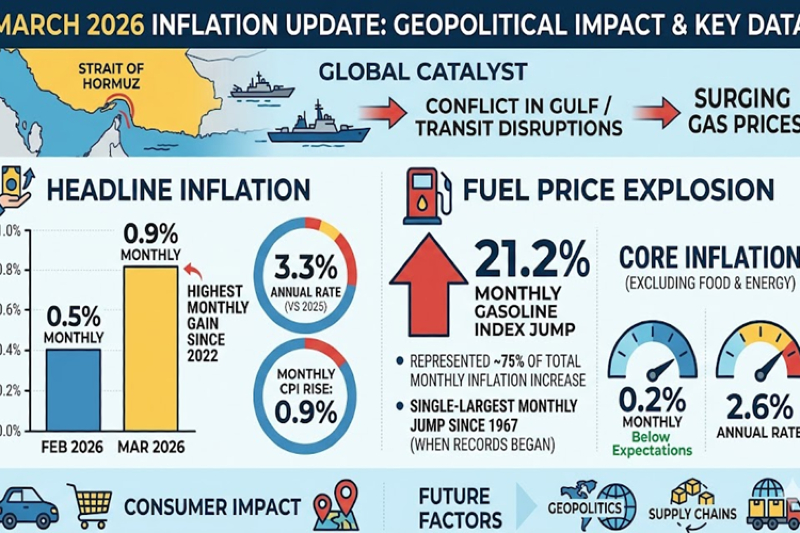
WASHINGTON — Consumer prices in the United States experienced a significant surge in March, marking the sharpest monthly acceleration in inflation since 2022.
The spike is largely attributed to the intensifying conflict between the U.S. and Israel, which has caused domestic gasoline prices to climb well above $4 per gallon.
According to the latest data from the Labor Department released on Friday, headline inflation rose 3.3% compared to the previous year. On a month-to-month basis, prices climbed by 0.9%, a rapid increase that underscores the volatile nature of the current economic climate.
This data closely mirrored the expectations of economists surveyed by Bloomberg, who had projected an annual increase of 3.4% and a monthly rise of 0.9%.
As first reported by Yahoo Finance, the primary driver of this inflationary pressure was a massive spike in energy costs. The regional war has led to the effective closure of the Strait of Hormuz, a critical maritime chokepoint for global oil transit.
Consequently, the gasoline index alone skyrocketed by 21.2% in a single month. The Labor Department noted that this increase accounted for nearly 75% of the total monthly gain in inflation, representing the largest monthly jump in gas prices since the government began tracking this data in 1967.
The Divergence of Core Inflation
While energy prices painted a grim picture, "core" inflation—which excludes the volatile food and energy sectors—offered a slightly more stable outlook:
Monthly Core Increase: 0.2% (lower than the anticipated 0.3%)
Annual Core Increase: 2.6% (lower than the predicted 2.7%)
This divergence suggests that while the broader economy is grappling with a massive energy shock, price increases in other sectors, such as housing and consumer goods, have remained relatively moderate.
Economic Fallout and Consumer Impact
The closure of the Strait of Hormuz continues to be the "X-factor" for the 2026 economy. With energy being a foundational cost for transportation, manufacturing, and heating, the 21.2% jump in gasoline is expected to trickle down into the costs of groceries and services in the coming months.
Analysts warn that until maritime security is restored and the flow of oil through the Gulf stabilizes, headline inflation figures may remain detached from the Federal Reserve's long-term targets, complicating future decisions on interest rates.
The Parallel Crisis: Russia-Ukraine Update (April 2026)
While the world's eyes are currently fixed on the Strait of Hormuz, the war in Ukraine has entered its fifth year with intensified aerial warfare.
As of April 10, 2026, Ukrainian forces have reportedly achieved a significant "drone advantage," conducting over 11,000 combat missions per day to stall Russian advances.
For global markets, this "second front" ensures that even if the Middle East crisis stabilizes, the supply chains for grain and European energy will remain under severe pressure, contributing to the "permanent economic havoc" warned of by Western leaders.
The Interconnected Crisis: A Triple Threat to Stability
According to the latest reports and official statements from April 10, 2026, the two conflicts are connected in three main ways:
1. A Pattern of Global Instability
In her Mansion House address on April 9, UK Foreign Secretary Yvette Cooper explicitly linked the two, stating that the "turbulence is now the new normal." She cited a timeline of disruptions:
The COVID-19 pandemic
The invasion of Ukraine
The current Iran conflict
The report frames these not as isolated events, but as a series of crises that have "hollowed out" Western defense capabilities and made national security inseparable from economic prosperity.
2. Differing Responses to NATO
The report highlights a significant tension between Keir Starmer and Donald Trump regarding alliance commitments. While the UK and European allies have been unified in their support for Ukraine, Trump has used the current Iran war to criticize NATO. He recently claimed that "NATO wasn't there when we needed them" (referring to the Strait of Hormuz) and suggested that European nations' reluctance to join Operation Epic Fury makes the alliance a "paper tiger."
3. Economic "Tailwinds"
Economists and financial analysts (including those cited by Yahoo Finance and Bloomberg) are currently viewing the Russia-Ukraine war and the Iran conflict as a "double hit" to global markets:
Gold & Assets: Investors are fleeing to gold because central banks are diversifying away from the dollar—a trend that started with the freezing of Russian assets and has accelerated with the current Middle East inflation.
Energy & Food: While Ukraine remains a focus for grain and European security, the Iran conflict has overtaken it as the immediate driver of inflation, specifically causing the record 21.2% jump in gasoline prices mentioned in the March report.
Summary
The report mentions Russia-Ukraine to show that the world is in a permanent state of volatility. While the current headlines are dominated by $4 gas and the Strait of Hormuz, the Russia-Ukraine war is treated as the "background" conflict that already weakened global supply chains before the current crisis began.