
Pakistan Deploys Troops and Fighter Jets to Saudi Arabia Amid Role as US-Iran Peace Mediator
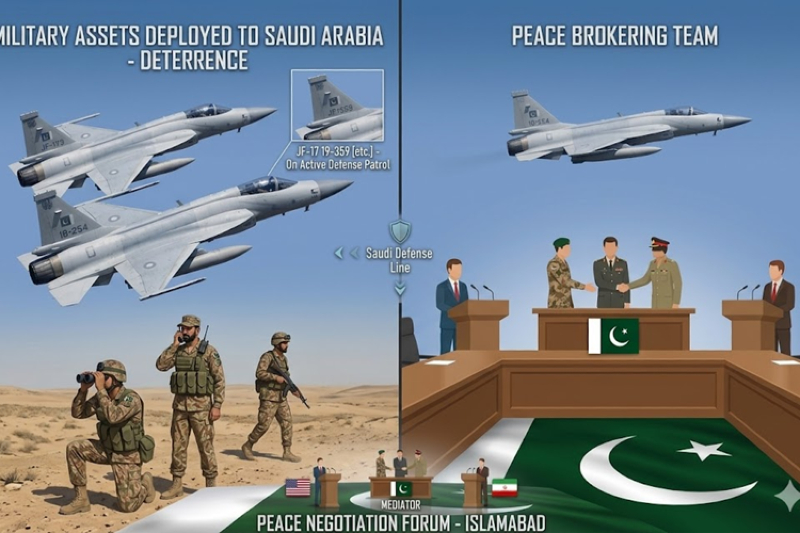
ISLAMABAD — Pakistan has deployed a significant military contingent, including combat aircraft and advanced air defense systems, to Saudi Arabia under a confidential mutual defense treaty.
The revelation highlights a complex geopolitical balancing act, as Islamabad simultaneously serves as the primary diplomatic intermediary working to resolve the ongoing war between the United States and Iran.
According to high-level security and government sources, the newly dispatched forces include approximately 8,000 troops, a full squadron of 16 JF-17 fighter jets—jointly manufactured with China—two drone squadrons, and a Chinese-made HQ-9 surface-to-air missile system.
While Pakistani personnel operate the hardware, the deployment is entirely funded by Riyadh. Sources also indicate the bilateral pact allows for the potential deployment of up to 80,000 Pakistani troops, alongside the possible future dispatch of naval warships.
A High-Stakes Diplomatic Balancing Act
The extensive military commitment brings into sharp focus the contradictory roles Pakistan is playing in the broader West Asia conflict:
The Diplomatic Track: Since late March, Islamabad has operated as the sole recognized backchannel between Washington and Tehran. The Pakistani government hosted the conflict's only round of direct peace talks, which brought U.S. Vice President JD Vance to Islamabad to meet with an Iranian delegation.
The Military Track: Simultaneously, Islamabad is heavily reinforcing the defensive and offensive capabilities of Saudi Arabia, a principal American ally and long-standing regional rival of Iran.
Pakistan’s military chief, Field Marshal Asim Munir, has reportedly maintained direct communication with U.S. President Donald Trump throughout the crisis.
President Trump publicly acknowledged that he paused further military strikes against Iran following personal deliberations with Munir and Pakistani Prime Minister Shehbaz Sharif. This diplomatic leverage eventually convinced Iran's Supreme National Security Council to agree to formal negotiations on Pakistani soil.
Deterrence and Regional Escalation
The military escalation was initially triggered by Iranian strikes targeting critical Saudi energy infrastructure, which resulted in the death of a Saudi national. Riyadh subsequently responded with multiple unpublicized retaliatory strikes against Iran.
In public, Pakistan's military leadership fiercely condemned the initial Iranian actions during a Corps Commanders Conference chaired by Munir, labeling the strikes a "dangerous escalation" and a "serious violation of Saudi Arabia's sovereignty," while reaffirming absolute support for Saudi security.
Furthermore, Pakistan’s Defence Minister Khawaja Asif previously implied that the scope of the defense agreement effectively places Saudi Arabia under the protection of Pakistan's nuclear deterrence umbrella.
Context of the Global Energy Crisis
The war erupted following highly destructive, coordinated U.S. and Israeli airstrikes that decimated significant Iranian military infrastructure and killed Supreme Leader Ayatollah Ali Khamenei.
In retaliation, Iran’s near-closure of the strategic Strait of Hormuz choked off approximately 20 percent of global seaborne petroleum transit.
According to data from the International Energy Agency, the resulting disruption has triggered the largest energy supply crisis in recorded history, causing global fuel prices to spiral.
While a U.S.-brokered ceasefire heavily negotiated by Pakistan has held for six weeks, localized violations remain frequent. Pakistani officials state they remain in continuous, round-the-clock contact with both Washington and Tehran to preserve the fragile truce.
The Pakistani military, its foreign ministry, and the Saudi government’s media office have all declined to comment on the recent troop movements.