
US Senate Backs Trump’s War Powers on Iran as Congress Keeps Option to Intervene
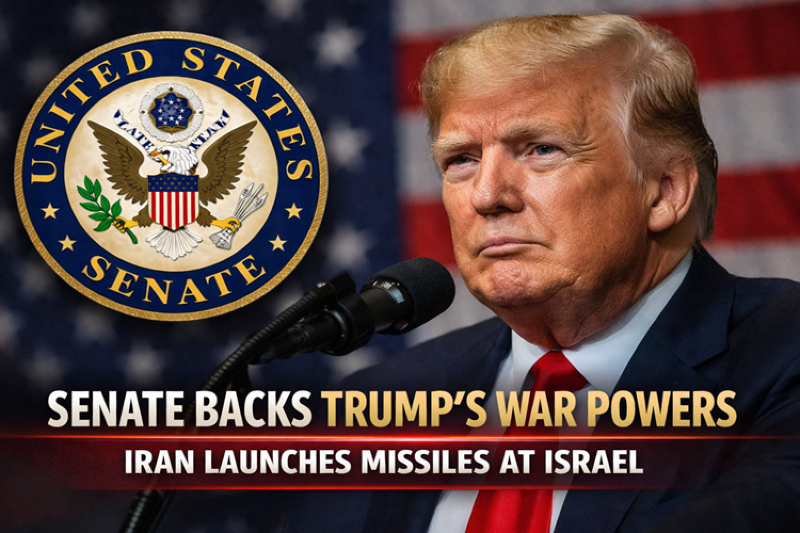
The United States Senate has rejected an attempt to restrict the military authority of Donald Trump amid the escalating conflict with Iran, while fresh Iranian missile launches toward Israel heightened fears of a wider regional war.
In a closely watched vote, US senators voted 53 to 47 against advancing a war powers resolution that would have forced the president to seek congressional approval before continuing military operations against Iran. The proposal aimed to require the withdrawal of US forces unless Congress formally authorised the mission.
Most Republicans opposed the measure, while Democrats largely supported it. Republican senator Rand Paul broke ranks to support the limitation, whereas Democratic senator John Fetterman voted with Republicans against the resolution.
Although the proposal failed in the Senate, lawmakers indicated that debate over presidential authority in the conflict is far from over. The United States House of Representatives is expected to consider a similar measure, and several senators have suggested that support for limiting military action could grow if the war continues longer than expected.
Fresh missile attacks on Israel
As political debate intensified in Washington, hostilities on the ground continued to escalate. The Israel Defense Forces said Iran launched several missiles toward Israel in the early hours of Thursday. Air raid sirens sounded across parts of the country and explosions were reportedly heard in Jerusalem.
Israeli emergency services said there were no immediate reports of casualties after the attack, and residents were later told they could leave shelters once the threat had passed. The latest missile barrage came after Israel carried out what it described as a new “wave of strikes” targeting military infrastructure in Tehran.
US submarine sinks Iranian warship
Meanwhile, the United States Department of Defense confirmed that a US submarine sank an Iranian warship in the Indian Ocean. Defence Secretary Pete Hegseth said the vessel was destroyed with a torpedo during ongoing maritime operations connected to the conflict.
The ship, identified as the Iris Dena, reportedly had about 180 people on board at the time of the attack. Authorities in Sri Lanka said 32 survivors were rescued, while around 80 bodies have been recovered from the sea so far. Search efforts are continuing for the remaining crew members.
US casualties in Kuwait attack
The Pentagon also confirmed additional casualties from an earlier drone strike on a US command facility in Port Shuaiba, Kuwait. The attack, carried out by an unmanned aircraft system that evaded air defences, killed six US service members.
Among those identified were Jeffrey O’Brien, a US Army Reserve major from Iowa, and Robert M. Marzan, a chief warrant officer from California. Military officials said forensic identification procedures are still ongoing for some of the victims.
Tensions spread across the Middle East
The conflict is also affecting several other countries in the region. Saudi Arabia said it intercepted three cruise missiles outside the city of Al-Kharj, while maritime authorities reported that a tanker off the coast of Kuwait was struck by an explosion that caused an oil spill but left the crew unharmed.
In Qatar, authorities began evacuating residents living near the United States Embassy in Doha as a precaution following recent drone attacks targeting US diplomatic facilities across the region. Washington has also urged American citizens to leave the Middle East as soon as possible while assisting thousands with evacuation flights.
Humanitarian impact grows
The intensifying violence has triggered widespread displacement. According to the United Nations High Commissioner for Refugees, around 100,000 people have fled Tehran since the conflict began. In Lebanon, about 58,000 people are sheltering in collective sites, while thousands have crossed borders into neighbouring countries.
Human rights groups say the human toll inside Iran is also rising. A US-based monitoring organisation reported that more than 1,000 civilians may have been killed since the war began, although some deaths are still being verified.
Residents in Tehran have described a city transformed by the conflict, with many streets largely deserted. Some told reporters that daily life has been severely disrupted and expressed hope for a return to normalcy.
Global concern over escalation
World leaders have increasingly called for restraint as the fighting spreads across the Middle East. Anthony Albanese, the prime minister of Australia, and Canadian leader Mark Carney urged de-escalation but said Iran must not be allowed to develop nuclear weapons.
Meanwhile, global markets remain sensitive to developments in the region because nearly 20% of the world’s oil supply normally passes through the Strait of Hormuz, a critical maritime route now threatened by the conflict.
With military operations continuing and diplomatic pressure mounting, the war between Iran and Israel—now involving the United States and other regional actors—shows little sign of easing.
Legal Explanations
What the proposed rule would have required
The measure debated in the United States Senate was linked to the War Powers Resolution of 1973, a US law designed to limit a president’s ability to conduct military operations abroad without congressional oversight.
If the resolution had passed, it would have introduced several key requirements:
1. Congressional approval for continued military action
The president — in this case Donald Trump — would have needed explicit approval from Congress before expanding or continuing major military operations against Iran.
2. Withdrawal of US forces without authorisation
If Congress refused to approve the operation, US troops involved in the conflict would have been required to withdraw from hostilities.
3. Existing law already sets time limits
Under the War Powers Resolution, a US president must notify Congress within 48 hours after deploying forces into a conflict. Military operations must then end within 60 days, unless Congress formally authorises the mission or declares war.
4. Why the vote mattered
Because the Senate rejected the proposal by 53–47, the resolution will not limit the president’s authority for now, meaning the administration can continue military operations under existing presidential powers.
Why Congress approval is still relevant
Under the War Powers Resolution, the US president can start or order military action without prior approval from Congress, but that authority is not unlimited.
Here is how the rule works:
1. President can act first in emergencies
The president — currently Donald Trump — can deploy US forces quickly if he believes there is an urgent national security threat. This is why military action can begin before lawmakers vote.
2. Congress must be notified within 48 hours
Once troops are sent into hostilities, the president must formally inform the United States Congress within 48 hours, explaining the reason for the operation.
3. 60-day limit without approval
If Congress does not approve the operation, US forces are supposed to end the military action within 60 days (with a possible additional 30-day withdrawal period).
4. Only Congress can officially declare war
Under the United States Constitution, the power to formally declare war belongs to Congress, not the president.
What the recent Senate vote means
The vote in the United States Senate did not remove Congress from the process. Instead, it simply blocked an attempt to impose new restrictions on the president’s current military actions against Iran.
So the legal situation remains:
The president can continue the current military operations for now.
But Congress could still intervene later by passing a new resolution or refusing to authorise the conflict.