
Netanyahu Under Fire as Potential U.S.-Iran Negotiations Threaten Israeli War Objectives
A significant diplomatic rift is opening between Jerusalem and Washington as reports emerge that U.S. President Donald Trump may be seeking a "way out" of the escalating conflict with Iran. The prospect of renewed dialogue between the
White House and Tehran has placed Israeli Prime Minister Benjamin Netanyahu under intense domestic and political pressure, just as military operations in Lebanon and Iran reach a critical fever pitch.
Despite the diplomatic noise, the "shadow war" between the Middle East’s two primary adversaries has transitioned into a direct and bloody exchange. Overnight, Iran launched a series of missile strikes targeting northern and southern Israel. This followed "dozens" of Israeli air strikes inside Iranian territory on Monday, which the IDF claims successfully neutralized command centers belonging to the Islamic Revolutionary Guard Corps (IRGC) and the Intelligence Ministry in Tehran.
Tel Aviv Under Fire: Residential Areas Hit
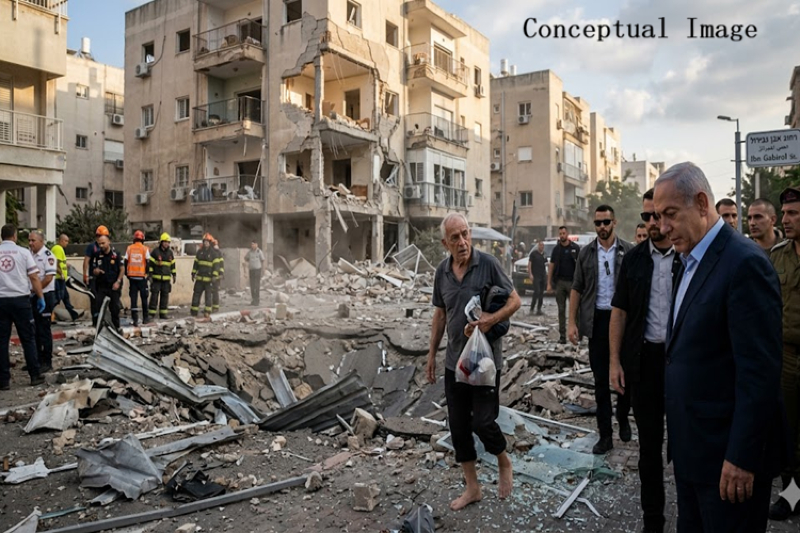
The physical toll of the Iranian retaliation is visible in the heart of Tel Aviv. In the northern districts of the city, residential blocks have been left scarred by missile impacts.
The Damage: Balconies have been sheared off buildings, and masonry continues to fall into a large crater formed between apartment complexes.
The Casualties: Local reports indicate that a direct hit narrowly missed several densely populated blocks. While six people were wounded in the blast, authorities confirmed none of the injuries are life-threatening.
The Human Cost: One resident described the terror of the impact, telling reporters he had no time to reach a bomb shelter before the blast blew his front door off its hinges, forcing him to flee into glass-strewn streets in his bare feet.
The "Trump Factor": Smokescreen or Strategic Pivot?
Speculation is mounting over President Trump’s true motivations for signaling an openness to talks with Tehran. While thousands of U.S. Marines are currently being deployed to the Middle East, the mention of "negotiations" has sparked fear in Israel that the superpower ally is looking to de-escalate prematurely.
"Netanyahu doesn't want a deal," says Michael Milstein, head of the Palestinian Studies Centre at Tel Aviv University. Milstein suggests there is a fundamental contradiction between the White House and the Prime Minister’s office. "Netanyahu promised this war would end all existential threats to Israel and potentially even trigger regime change in Iran. Right now, there is a massive gap between those promises and the reality on the ground."
Analysts describe the situation as a "Catch-22" for Netanyahu. If formal negotiations begin, he cannot easily continue the war, yet he lacks the resources to pursue a total military victory against Iran without sustained American backing.
The Standoff at the Strait of Hormuz
A central pillar of Iran’s leverage remains the Strait of Hormuz, a vital chokepoint for the global oil economy which Tehran currently controls. Iran’s confidence in a potential negotiation appears bolstered by Trump’s recent decision to withdraw an ultimatum that threatened strikes on Iranian energy infrastructure if the Strait was not reopened.
Danny Citrinowicz, an analyst from the Institute for National Security Studies, believes a deal is unlikely because Iran perceives itself as winning. "The regime is not going to capitulate. They control the bottleneck of the international economy and feel they have the upper hand," he noted.
Lebanon: The Search for a "Security Zone"
Amidst the geopolitical maneuvering involving Iran, Israel’s military focus remains fixed on its northern neighbor. On Tuesday, Israeli Defense Minister Israel Katz declared that Israeli forces would establish a permanent security zone across a large portion of Lebanon south of the Litani River.
Katz emphasized that displaced residents of northern Israeli communities would not be allowed to return home until this zone is fully cleared of Hezbollah fighters and weaponry. Even if a diplomatic breakthrough is reached with Tehran, the IDF is widely expected to continue its campaign in Lebanon to ensure the long-term safety of its borders.
Conclusion: Between Escalation and Capitulation
The regional conflict now sits at a volatile crossroads. While some observers suggest that the talk of negotiations could be a "smokescreen" for a massive U.S. military offensive, others fear that Israel and the U.S. are moving in opposite directions.
For Netanyahu, the stakes could not be higher. Having campaigned on the total defeat of the "Iranian octopus," any deal that leaves the current regime in Tehran intact—or its proxies functional—could be a political death knell for the long-serving Prime Minister. As one Likud member of parliament put it: "We’ve tried containment before; we saw it blow up in our faces on October 7. We won't let that happen with Iran."