
Massive 7.4-Magnitude Earthquake Strikes Southern Philippines; Regional Tsunami Warnings Activated
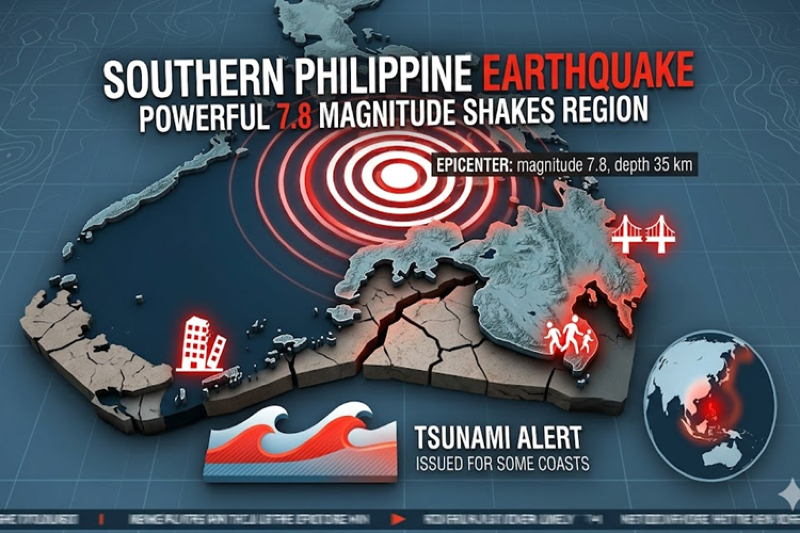
MANILA, Philippines: A powerful major earthquake struck off the coast of Mindanao island in the southern Philippines early Monday morning, triggering urgent evacuation orders and tsunami alerts across multiple countries in Asia and the Pacific.
According to initial reports from the U.S. Geological Survey (USGS), the seismic event registered at a magnitude of 7.8, striking at 7:37 a.m. local time with a depth of 35 kilometers (22 miles).
Its epicenter was located roughly 24.7 kilometers (15.3 miles) west-southwest of Burias. Meanwhile, the German Research Centre for Geosciences (GFZ) assessed the peak energy of the quake even higher at a magnitude of 8.2 with a shallower depth of 10 kilometers.
Key Takeaways
Widespread Shaking: Over 10 million people in the southern region were exposed to "strong" or "very strong" shaking.
Tsunami Advisories Issued: The Pacific Tsunami Warning Center and localized geophysics agencies issued threats for the Philippines, Malaysia, Indonesia, Taiwan, Palau, Papua New Guinea, and Japan.
Evacuation Orders: The Philippine Institute of Volcanology and Seismology (Phivolcs) warned that waves could exceed 1 meter (3.3 feet) above standard tide levels, urging coastal residents in southern provinces to move immediately inland or to higher ground.
Regional Tsunami Advisories
The scope of the ocean displacement prompted widespread warnings:
The Philippines: Residents were told to brace for sudden waves that could persist for several hours.
Indonesia & Japan: Indonesia's BMKG issued warnings for its northeastern coastal zones, while the Japan Meteorological Agency projected tsunamis up to 1 meter hitting parts of its Pacific coast.
U.S. Territories: A tsunami advisory was deployed for Guam and the Northern Mariana Islands.
Current Status: Immediate reports on major structural damage or casualties remain limited as disaster management officials begin assessing the impact zone. Tremors from the massive quake were strong enough to be felt across regional borders, including parts of Sabah, Malaysia.
The Philippines sits prominently on the Pacific "Ring of Fire," a volatile arc of seismic faults that makes the archipelago highly susceptible to intense earthquakes and volcanic activity. Experts note this event is likely the most powerful earthquake to hit the nation since the devastating Luzon quake in 1990.
Massive Earthquake Strikes Southern Philippines; Tsunami Warnings Activated Across Region
A powerful major earthquake struck off the coast of Mindanao island in the southern Philippines early Monday morning, triggering urgent evacuation orders and tsunami alerts across multiple countries in Asia and the Pacific.
According to initial reports from the U.S. Geological Survey (USGS), the seismic event registered at a magnitude of 7.8, striking at 7:37 a.m. local time with a depth of 35 kilometers (22 miles).
Key Takeaways
Widespread Shaking: Over 10 million people in the southern region were exposed to "strong" or "very strong" shaking.
Tsunami Advisories Issued: The Pacific Tsunami Warning Center and localized geophysics agencies issued threats for the Philippines, Malaysia, Indonesia, Taiwan, Palau, Papua New Guinea, and Japan.
Evacuation Orders: The Philippine Institute of Volcanology and Seismology (Phivolcs) warned that waves could exceed 1 meter (3.3 feet) above standard tide levels, urging coastal residents in southern provinces to move immediately inland or to higher ground.
Regional Tsunami Advisories
The scope of the ocean displacement prompted widespread warnings:
The Philippines: Residents were told to brace for sudden waves that could persist for several hours.
Indonesia & Japan: Indonesia's BMKG issued warnings for its northeastern coastal zones, while the Japan Meteorological Agency projected tsunamis up to 1 meter hitting parts of its Pacific coast.
U.S. Territories: A tsunami advisory was deployed for Guam and the Northern Mariana Islands.
Current Status: Immediate reports on major structural damage or casualties remain limited as disaster management officials begin assessing the impact zone. Tremors from the massive quake were strong enough to be felt across regional borders, including parts of Sabah, Malaysia.
The Philippines sits prominently on the Pacific "Ring of Fire," a volatile arc of seismic faults that makes the archipelago highly susceptible to intense earthquakes and volcanic activity. Experts note this event is likely the most powerful earthquake to hit the nation since the devastating Luzon quake in 1990.