
Supreme Court Upholds Birthright Citizenship, Striking Down Trump’s Executive Order
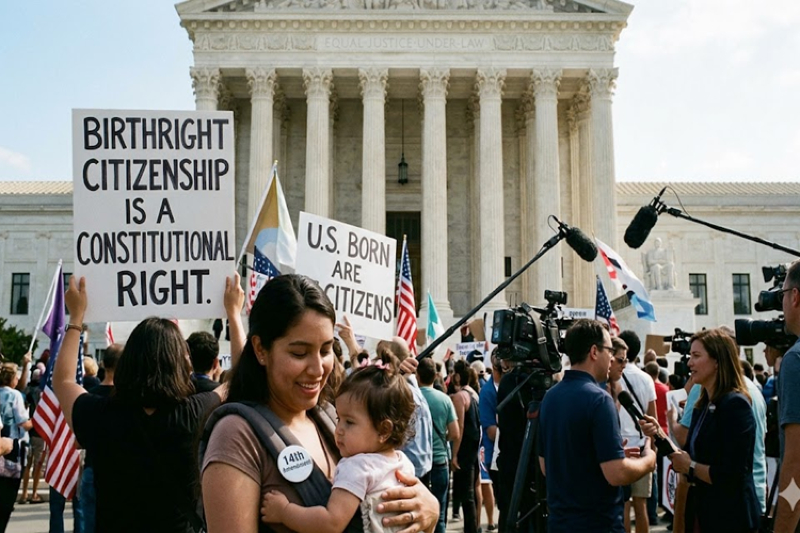
WASHINGTON — In a major constitutional showdown, the United States Supreme Court has struck down an executive order by President Donald Trump that sought to end automatic birthright citizenship for the children of undocumented immigrants and temporary foreign visitors.
The high court's 6–3 decision in Trump v. Barbara solidly defends a 150-year-old legal precedent, delivering a massive blow to the administration’s hardline immigration policy.
The Core Ruling: A Promise Maintained
Chief Justice John Roberts delivered the majority opinion, explicitly stating that children born on American soil to parents who are temporarily or unlawfully present are "citizens at birth" under the Fourteenth Amendment.
"Citizenship, then and now, was the right to have rights—to freely participate in our political community," Chief Justice Roberts wrote. "The Framers of the Fourteenth Amendment extended that promise to 'every free-born person in this land.' We keep that promise today."
Roberts was joined by the court's three liberal justices—Sonia Sotomayor, Elena Kagan, and Ketanji Brown Jackson—as well as conservative Justice Amy Coney Barrett. Justice Brett Kavanaugh concurred with the overall judgment to throw out the order, though he based his decision on federal statutory law rather than the Constitution itself.
The decision directly invalidates Executive Order 14160, a signature measure Trump signed at the start of his second term. The policy would have blocked the issuance of citizenship documents to roughly 250,000 children born in the U.S. each year to non-citizen parents. Lower federal courts had already stalled the order before it could take effect.
Behind the Legal Battle
The legal clash centered heavily on the wording of the Fourteenth Amendment, enacted in 1868 following the Civil War to guarantee citizenship to formerly enslaved people. The amendment states that all persons born in the U.S. and "subject to the jurisdiction thereof" are citizens.
The Administration's Stance: U.S. Solicitor General John Sauer argued that the original authors of the amendment never intended to cover the children of undocumented immigrants or foreign tourists, claiming the phrase required a deeper political allegiance to the country. The administration raised concerns about "birth tourism" and argued that current practices create an unsustainable economic burden.
The Court's Precedent: The majority heavily leaned on the landmark 1898 case United States v. Wong Kim Ark, which cemented the "right of the soil" (jus soli) by confirming that a child born in San Francisco to Chinese immigrant parents was an American citizen.
Sharp Ideological Divides in Dissent
The three dissenting conservative justices—Clarence Thomas, Neil Gorsuch, and Samuel Alito—issued a fierce pushback against the ruling.
Justice Thomas penned a exhaustive 91-page dissent, asserting that the Fourteenth Amendment was being "repurposed for political projects" that its original authors never intended. He argued that freed slaves were Americans with no other homeland, unlike the children of foreign visitors.
Meanwhile, Justice Alito labeled the ruling a "serious mistake," warning that it creates a permanent incentive for people to cross into the country illegally just to secure U.S. citizenship for their children.
Political Shockwaves and Reactions
The decision has ignited furious reactions across the political spectrum:
Donald Trump sharply criticized the ruling on his Truth Social platform, calling it "too bad for our Country" and a threat to economic sustainability. He urged lawmakers to bypass the court, writing: "Congress should start TODAY to work on ending expensive and unfair to our Country, Birthright Citizenship."
Stephen Miller, White House Chief of Staff, blasted the decision on social media, labeling it "one of the most destructive and outrageous decisions" in the history of the Supreme Court, adding that "American citizenship is not the birthright of the world."
Civil Rights Advocates celebrated the outcome as a monumental civil rights victory. Cecillia Wang, National Legal Director for the American Civil Liberties Union (ACLU), who argued the case against the administration, stated: "The court's decision reaffirms a fundamental American promise—if you are born here, you are a citizen. A president cannot change the Constitution by executive fiat."
Congressional Democrats, led by House Minority Leader Hakeem Jeffries, applauded the ruling for affirming long-standing law and stopping what they described as an unlawful assault on the American way of life.
Following the ruling, the Department of Justice issued a memorandum stating it would pivot its focus toward cracking down on organized "birth tourism" rings operating under false pretenses.