

Global Climate Pivot: Santa Marta Accord Signals End of "Negotiation Era" as Implementation Phase Begins
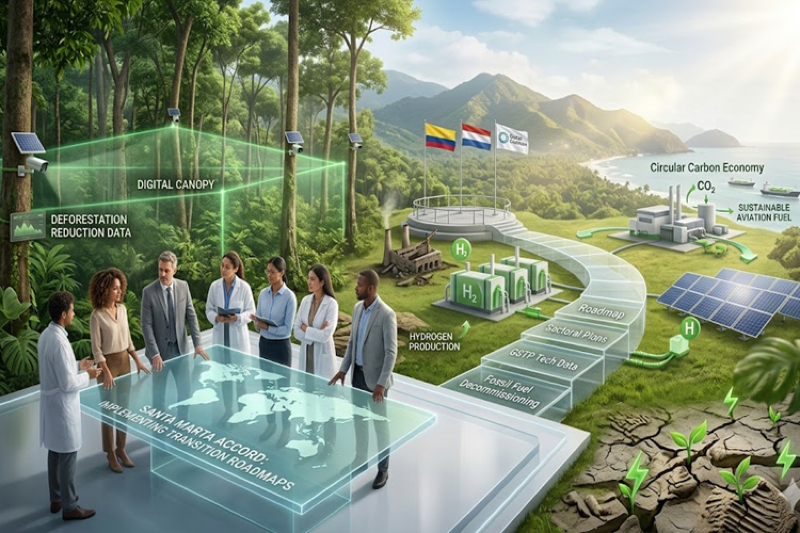
SANTA MARTA, COLOMBIA – In a move widely regarded by policy analysts as the most significant environmental breakthrough of the 2026 calendar year, a coalition of nearly 60 nations concluded the High-Level Dialogue on Climate Action on May 1st, finalizing the Santa Marta Accord.
The agreement marks a fundamental shift in global climate diplomacy, moving away from the broad aspirational pledges of previous COP summits toward a rigid, technical framework for the total phase-out of fossil fuel dependencies.
The Technical Mandate: From Pledges to Roadmaps
Unlike the sprawling 2015 Paris Agreement, the Santa Marta Accord is characterized by its "Implementation-First" architecture. Key provisions of the May 1st declaration include:
Binding Sectoral Roadmaps: Signatory nations have committed to delivering legally binding, year-by-year infrastructure transition plans. These plans dictate the exact decommissioning dates for coal and gas-fired power plants, replacing them with regionalized renewable grids.
Establishment of the GSTP: The accord established the Global Scientific Transition Panel (GSTP). This body is tasked with providing real-time, peer-reviewed technical data to assist developing nations in bypassing "bridge fuels" (like natural gas) in favor of immediate green hydrogen and battery-storage integration.
The "North-South" Financial Bridge: Co-hosted by the governments of Colombia and the Netherlands, the summit successfully secured new maritime and carbon-tax revenue streams specifically allocated for technology transfers to the Global South.
Supporting Ecological Milestones: May 2026 Briefing
I. Reforestation Resilience in the Amazon
New satellite data released this week by the World Energy Institute (WEI) confirms a 22% reduction in deforestation across the Brazilian Amazon compared to the same period in 2025.
Analysts attribute this success to the "Digital Canopy" initiative—an AI-driven monitoring system that deploys rapid-response enforcement teams within minutes of detecting illegal logging activity.
II. Technological Breakthrough: High-Efficiency Solar Catalysts
In a report published on May 2nd, UK-based researchers announced a breakthrough in solar chemistry involving a kinetic polymorph of Bismuth Vanadate ($\beta$-BiVO₄)$. This material has demonstrated the ability to convert solar energy into hydrogen fuel with a 15% increase in efficiency over previous benchmarks. This development is expected to lower the "green premium" on hydrogen, making it competitive with diesel for heavy-duty shipping by 2028.
III. The "Circular Carbon" Economy
On May 1st, the University of Surrey unveiled a "Lab-on-a-Chip" technology capable of capturing $CO_2$ directly from industrial exhaust and instantly converting it into sustainable aviation fuel (SAF). This breakthrough shifts the narrative of carbon from a liability to a high-value raw commodity for the transport sector.
Analysis: The 2026 Horizon
While the UNEP’s State of Finance for Nature 2026 report recently warned of a $7 trillion gap in "nature-negative" spending, the Santa Marta Accord suggests that regional "coalitions of the willing" are no longer waiting for universal consensus.
The focus now shifts to the UNCCD COP 17 in Mongolia this August, where the international community will address the escalating crisis of land degradation and the "water-food-energy" nexus that is currently reshaping global migration patterns.