
Trump Reviews Military Options Against Iran; Israel Braces for Conflict
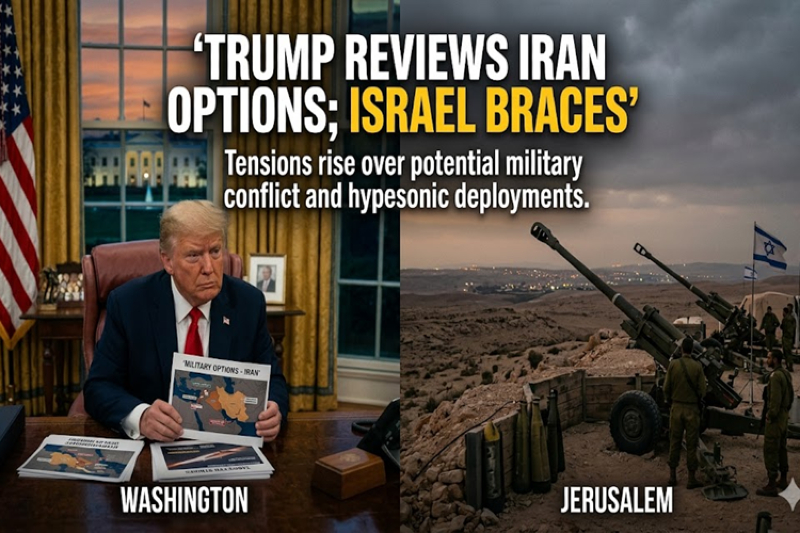
WASHINGTON/ JERUSALEM — High-level military preparations are underway as the United States and Israel signal a potential return to active hostilities against Iran.
President Donald Trump was briefed at the White House on Thursday regarding a range of military escalations, including targeted strikes on energy infrastructure and the possible deployment of advanced hypersonic weaponry to the Middle East.
The sudden surge in activity comes as diplomatic channels appear to be faltering. According to a report by the Times of Israel,
Israeli officials are preparing for the potential collapse of US-Iran negotiations as early as next week, with some cabinet ministers suggesting that military "pushes" may be necessary to maintain pressure on Tehran.
Hypersonic Deployment and Strategic Shifts
US Central Command (CENTCOM) has reportedly requested the deployment of the "Dark Eagle" hypersonic missile system to the region.
This request follows intelligence indicating that Iran has moved its missile launchers beyond the reach of existing US precision-strike assets. If approved, this would mark the debut of US hypersonic technology in a combat theater.
Simultaneously, the Trump administration is weighing several aggressive maneuvers, including:
Targeted Air Strikes: Focusing on Iranian gas, energy, and government infrastructure.
Ground Operations: Plans to seize portions of the Strait of Hormuz to ensure the passage of commercial shipping.
Enhanced Blockade: A continuation of the naval "chokehold" intended to force Tehran to abandon its nuclear ambitions.
Hardline Stance from Israel
Israeli Defense Minister Israel Katz emphasized that while Israel supports diplomatic efforts led by the US, the military remains ready to intervene.
During a military promotion ceremony, Katz stated that Israel may soon be "required to act again" to eliminate existential threats, asserting that recent strikes have already set the Iranian regime back by years.
Iran’s Defiant Response
The rhetoric from Tehran has remained equally sharp. Iranian President Masoud Pezeshkian condemned the US naval blockade as "intolerable," labeling it an act of war.
Meanwhile, Majid Mousavi, a high-ranking commander in the Islamic Revolutionary Guard Corps (IRGC), warned that even a minor tactical operation by Western forces would trigger "painful, prolonged, and extensive" retaliatory strikes.
Economic Fallout
The looming threat of war has sent shockwaves through global markets. Brent crude oil prices spiked more than 7% on Thursday, reaching a four-year high of $126 per barrel.
While the Trump administration faces domestic pressure over rising fuel costs, the Iranian economy is also in a state of crisis, with the rial plummeting to historic lows.
Negotiations remain deadlocked as Washington insists that Iran’s nuclear program be the primary focus of any deal—a condition Tehran has yet to fully accept.
As both sides dig in, the likelihood of a localized skirmish evolving into a broader regional conflict continues to grow.