
Iran Cites 'Excessive' US Demands as Peace Talks Fail; Seeks Russian Support Amid Hezbollah Suicide Squad Threats
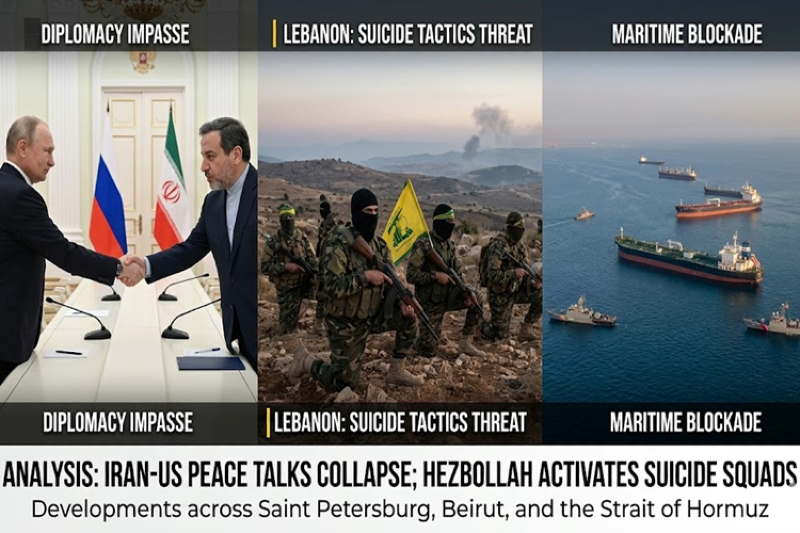
SAINT PETERSBURG / BEIRUT — The fragile hopes for a diplomatic resolution to the 2026 Iran War suffered a major blow on Monday as Iranian Foreign Minister Abbas Araghchi declared the collapse of Islamabad-mediated peace talks.
Araghchi, who arrived in Saint Petersburg to meet with Russian President Vladimir Putin, attributed the failure to "excessive and unreasonable" demands from the Trump administration.
The diplomatic stalemate is mirrored by a dangerous escalation on the ground, with Hezbollah threatening a return to 1980s-style suicide tactics in Lebanon and Israeli forces expanding their air campaign into the Bekaa Valley.
The Collapse of the Islamabad Dialogue
Negotiations in Pakistan, which many hoped would provide a permanent exit from the hostilities that began on February 28, have officially reached an impasse. Foreign Minister Araghchi told reporters upon landing in Russia that while some progress had been made in previous sessions, the United States' "misguided strategies" and shifting red lines made a final agreement impossible.
"The U.S. approach caused the previous round of negotiations to fail despite significant progress," Araghchi stated.
In response, U.S. President Donald Trump took to social media and news outlets to signal a "wait-and-see" approach. "They can come to us, or they can call us," Trump told Fox News, emphasizing that while he had called off his envoys’ planned weekend trip to Pakistan, the door for communication remains open—on his terms.
Seeking the "Russian Shield"
With Western channels cooling, Tehran is pivoting back to its strongest strategic ally.
UN Security Council Support: Iran is relying on Russia’s veto power to block a recent U.S.-led resolution.
Military Hardware: Analysts suggest Iran is looking to restock advanced air defense systems and munitions that have been significantly depleted during two months of intense US-Israeli strikes.
Strategic Alignment: The two nations are reportedly finalizing the details of their 20-year comprehensive partnership treaty, signaling a long-term defiance of Western pressure.
Hezbollah: A Shift to Extremist Tactics
As diplomacy fails, the battlefield in Lebanon is becoming increasingly radicalized. An unnamed Hezbollah military commander informed media outlets that the group is activating "suicide squads" to repel Israeli ground advances.
"We are returning to the tactics of the 1980s," the official stated, referring to the era of large-scale suicide operations.
This announcement comes as Israel launched "Operation Eternal Darkness," a massive air offensive that saw over 100 strikes in ten minutes across Lebanon.
For the first time during the current extended truce, Israeli jets targeted the Bekaa Valley in the east, destroying what they described as "Hezbollah infrastructure."
The strikes have forced thousands of displaced families, who had briefly returned to their homes during the ceasefire, to flee back to emergency shelters in Sidon and Beirut.
Maritime Blockade and Humanitarian Crisis
The economic toll of the conflict continues to reverberate globally.
Shipping Paralysis: Tracking data shows that only seven vessels transited the waterway in the last 24 hours, compared to the pre-war average of 140 daily passages.
Dual Blockade: A "dual blockade"—Iran’s closure of the strait and the U.S. naval blockade of Iranian ports—has sent global fuel and fertilizer prices to record highs.
Civilian Toll: In Iran, the Health Ministry reported that nearly 240 medical facilities have been hit by airstrikes, leaving the country’s healthcare system on the verge of collapse.
West Bank and Regional Volatility
Simultaneously, tensions are boiling over in the occupied West Bank.
As German Chancellor Friedrich Merz noted in a speech on Monday, the lack of a clear "exit strategy" from Washington and the resilience of the Iranian-led "Axis of Resistance" suggests that the 2026 war is far from its conclusion.
With Hezbollah's new threats and the collapse of the Islamabad talks, the region now faces its most volatile week since the start of the conflict.