
Diplomatic Deadlock: Trump Abruptly Cancels Envoy Trip to Pakistan for Iran Talks
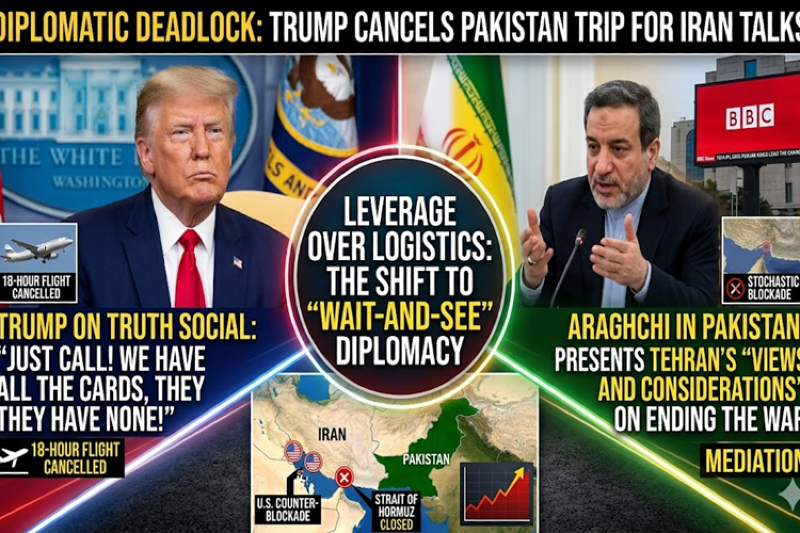
WASHINGTON/ TEHRAN/ ISLAMABAD — Efforts to negotiate a resolution to the ongoing conflict between the United States and Iran hit a significant hurdle on Saturday as President Donald Trump abruptly cancelled a scheduled diplomatic mission to Pakistan.
The high-level delegation, which included envoys Steve Witkoff and Jared Kushner, was slated to arrive in Islamabad for mediated discussions aimed at ending the war that has gripped the region since early 2026.
Taking to Truth Social, President Trump dismissed the necessity of the trip, citing logistical fatigue and a perceived lack of readiness from the Iranian leadership.
Leverage Over Logistics: The Shift to "Wait-and-See" Diplomacy
President Trump’s decision to pull the plug on the Islamabad mission underscores his "America First" approach to high-stakes diplomacy, emphasizing leverage over traditional engagement. By asserting that the U.S. "holds all the cards," he has effectively shifted the burden of initiation onto Tehran, stating bluntly that he will no longer authorize grueling 18-hour flights for envoys to "sit around and talk about nothing."
This move signals a transition from active mediation to a "wait-and-see" strategy, where the administration demands a direct, high-level outreach from Iran as a prerequisite for any further negotiations, rather than continuing through indirect channels that have yet to yield a breakthrough.
Tehran’s Strategic Maneuvers
The cancellation followed a day of intense bilateral activity in the Pakistani capital. Iranian Foreign Minister Abbas Araghchi concluded a series of meetings with Pakistani Prime Minister Shehbaz Sharif and Army Chief Asim Munir on Friday.
While Araghchi described the exchange as a presentation of Tehran’s "views and considerations," he reportedly departed for Oman and Russia shortly before the U.S. delegation's scheduled arrival.
Inside Iran, the political landscape remains opaque. Reports suggest that the new Supreme Leader, Mojtaba Khamenei, who succeeded his father following the start of the war in February, remains in hiding while recovering from serious injuries sustained during initial airstrikes.
While sources claim he is "mentally sharp," decision-making has largely shifted toward the Revolutionary Guard commanders, contributing to what Trump described as "infighting and confusion" within the Iranian leadership.
Iran’s "Crushing" Warning to the Region
As diplomatic efforts falter, rhetoric from Tehran has turned increasingly aggressive toward its neighbors.
Nabavian stated that any renewed U.S. attacks would trigger an Iranian response leading to the "complete cessation of regional oil production" and the "destruction of all infrastructure."
This threat follows a month of intermittent strikes where Iran has already targeted energy facilities in the UAE, Bahrain, and Kuwait, accusing them of allowing their territory to be used for U.S.-led operations—claims those nations have vehemently denied.
The Economic and Military Standoff
The primary obstacle to a breakthrough remains the dual blockade affecting global trade:
The U.S. Counter-Blockade: Since April 13, the U.S. has enforced a naval blockade on all ships seeking to reach Iranian ports, intercepting dozens of tankers to date.
The Strait of Hormuz: In retaliation, Iran has effectively closed the Strait of Hormuz to hostile vessels. This waterway, which carries approximately 20% of the world’s petroleum, remains largely dormant, causing global energy prices to surge.
While President Trump recently extended a conditional ceasefire, military tensions remain "locked and loaded."
Pakistan’s Role as a Fragile Bridge
As a mediator, Pakistan finds itself in an increasingly difficult position. Prime Minister Sharif has consistently emphasized the "importance of dialogue and diplomacy" to maintain regional stability.
However, with both Washington and Tehran digging into their respective positions—the U.S. refusing to lift port blockades and Iran refusing to concede on its nuclear stance—the prospect of a "face-to-face" meeting in Islamabad appears to have vanished for the immediate future.
For now, the diplomatic track has stalled, leaving the international community to watch the Strait of Hormuz for any signs of further escalation or a desperate return to the negotiating table.