
World’s Happiest Countries in 2026: What Makes Them Stand Out
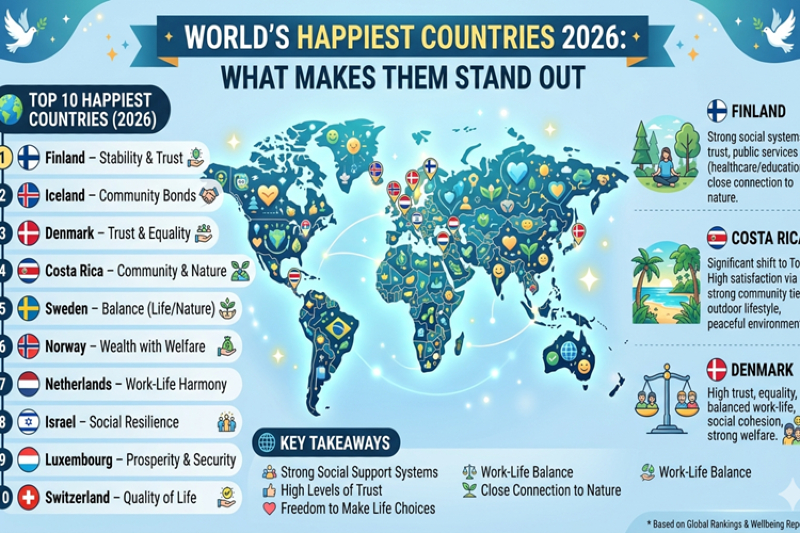
The latest global happiness rankings for 2026 highlight a familiar trend—Nordic nations continue to dominate—but with a notable shift as a Latin American country breaks into the top five for the first time.
The annual report, compiled by organizations including Gallup and the Oxford Wellbeing Research Centre, evaluates how people across more than 140 countries perceive their quality of life. The rankings consider factors such as income levels, social support, health, personal freedom, generosity and perceptions of corruption.
While Northern Europe continues to set the benchmark, Costa Rica’s rise signals that happiness is not limited to wealth alone but also shaped by community, lifestyle and environment.
🌍 Top 10 Happiest Countries in 2026
- Finland
- Iceland
- Denmark
- Costa Rica
- Sweden
- Norway
- Netherlands
- Israel
- Luxembourg
- Switzerland
🇫🇮 Finland – Stability and Trust Lead the Way
Finland continues to hold the top position thanks to strong social systems and widespread trust among citizens. People benefit from reliable public services such as healthcare and education, which provide a strong sense of security. Daily life is also closely connected to nature, with forests, lakes and clean environments easily accessible.
🇮🇸 Iceland – Strong Community Bonds
Iceland ranks second, driven largely by deep social connections. Its small population fosters a culture where people depend on one another, creating strong support networks. Residents also embrace nature and adapt to seasonal extremes, which contributes to a resilient and balanced lifestyle.
🇩🇰 Denmark – Trust and Equality
Denmark remains among the happiest countries due to high levels of trust and equality. Citizens experience a balanced work-life culture, low corruption and a strong welfare system. A sense of shared responsibility and social cohesion plays a key role in everyday happiness.
🇨🇷 Costa Rica – Community and Nature
Costa Rica’s rise into the top five is one of the biggest highlights of 2026. Despite having a smaller economy than many European countries, its people report high life satisfaction. Strong community ties, outdoor lifestyles and a peaceful environment contribute to overall wellbeing.
🇸🇪 Sweden – Balance Between Life and Nature
Sweden offers a blend of modern urban living and easy access to nature. Residents enjoy a healthy work-life balance, social equality and a culture that values simplicity and wellbeing. Trust and openness are also central to Swedish society.
🇳🇴 Norway – Wealth with Welfare
Norway combines economic strength with strong public services. High living standards, access to natural beauty and effective governance help maintain a high quality of life.
🇳🇱 Netherlands – Work-Life Harmony
The Netherlands stands out for its flexible work culture and emphasis on personal wellbeing. Shorter working hours and strong social support systems allow residents to maintain a balanced lifestyle.
🇮🇱 Israel – Social Resilience
Israel’s ranking reflects strong community bonds and resilience despite regional challenges. Social support networks and a sense of purpose contribute to overall life satisfaction.
🇱🇺 Luxembourg – Prosperity and Security
Luxembourg benefits from high income levels and a stable economy. Combined with efficient public services, this creates a secure and comfortable living environment.
🇨🇭 Switzerland – Quality of Life Excellence
Switzerland continues to rank highly due to its strong economy, excellent healthcare system and clean environment. Political stability and safety further enhance everyday life satisfaction.
🌐 Key Takeaways
The 2026 rankings show that happiness is not just about wealth. Countries that perform best tend to share common traits:
- Strong social support systems
- High levels of trust in society
- Freedom to make life choices
- Balance between work and personal life
- Close connection to nature
Costa Rica’s success highlights that community spirit and lifestyle can be just as important as economic strength in shaping happiness.