
White House AI and Crypto Czar David Sacks Transitions to Key Advisory Role
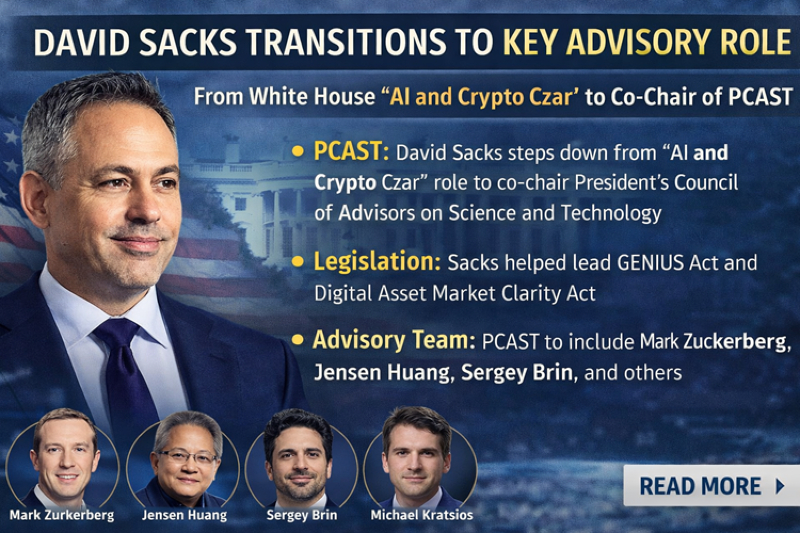
In a significant shift within the administration’s technology leadership, David Sacks, the White House "AI and Crypto Czar," announced on Thursday that he is stepping down from his specialized role to become the co-chair of the President’s Council of Advisors on Science and Technology (PCAST).
Sacks, a prominent venture capitalist and former PayPal COO, was appointed by President Donald Trump shortly after the January 2025 inauguration to spearhead the administration’s aggressive digital asset and artificial intelligence agenda. His transition to PCAST marks a move from a focused executive position to a broader strategic oversight role over the nation’s entire scientific and technological landscape.
The 130-Day Rule and Legislative Pressure
The move comes amid increasing scrutiny from Capitol Hill. Sacks revealed to Bloomberg that his position as "czar" was technically designated as a "Special Government Employee" (SGE).
Congressional Democrats had raised concerns as early as last fall, suggesting Sacks may have exceeded this legal limit. By transitioning to the PCAST co-chair role, Sacks bypasses these specific time-limit constraints while maintaining a direct line of influence to the Oval Office.
A Legacy of Legislative Success
During his tenure as the AI and Crypto Czar, Sacks was instrumental in navigating several high-stakes legislative battles. Most notably, he oversaw the passage of the GENIUS Act (Guiding and Establishing National Innovation for U.S. Stablecoins Act), which established the first comprehensive federal regulatory framework for stablecoin issuance in the United States.
More recently, Sacks has been the driving force behind the Digital Asset Market Clarity Act, a bill aimed at defining the market structure for cryptocurrencies. While the bill faced internal industry friction—highlighted by a public split between firms like Coinbase and Paradigm—Sacks’ leadership helped secure its progress through the Senate.
Shaping the Future at PCAST
In his new capacity as co-chair of PCAST alongside Michael Kratsios, Sacks will lead a "dream team" of tech luminaries.
Jensen Huang (CEO of NVIDIA)
Mark Zuckerberg (CEO of Meta)
Lisa Su (CEO of AMD)
Sergey Brin (Co-founder of Google)
Marc Andreessen (Co-founder of Andreessen Horowitz)
Michael Dell (Founder of Dell Technologies)
Sacks emphasized that PCAST will focus on high-impact sectors including quantum computing, nuclear power, and the recently released National AI Policy Framework. Interestingly, Sacks did not mention "crypto" during his initial interview regarding the new role, suggesting a strategic pivot toward broader industrial and scientific competition, particularly with China.
What’s Next for U.S. Tech Policy?
The administration’s shift suggests a move toward permanent, high-level institutionalization of tech policy. While the "czar" role was an emergency measure to kickstart the "Golden Age of Innovation," PCAST represents a long-term advisory body intended to cement American dominance in the global AI race.
"You can expect us to make significant recommendations," Sacks stated. “We want to push forward the President's AI framework to ensure the U.S. remains the undisputed leader in cutting-edge technologies.”
Quick Summary: David Sacks’ New Role
The Big Move
David Sacks is stepping down from his position as the White House AI and Crypto Czar. He isn’t leaving the administration; instead, he is joining the President’s Council of Advisors on Science and Technology (PCAST) as a Co-Chair.
Why the Change?
The 130-Day Limit: His "Czar" role was a temporary "Special Government Employee" position. By law, he could only work 130 days in that role.
Political Pressure: Congressional Democrats had already begun questioning if he had stayed in the role longer than legally allowed.
Permanent Influence: Moving to the Advisory Committee (PCAST) allows him to continue advising the President without the 130-day restriction.
Key Achievements as "Czar"
Stablecoin Regulation: He helped pass the GENIUS Act, which created the first major U.S. rules for stablecoins.
Market Structure: He led the early work on a massive bill to define how the crypto market should be regulated.
AI Framework: He played a major role in launching the President’s new AI policy framework last week.
What’s Next for the "Tech Dream Team"?
Sacks will now lead a committee of some of the most powerful people in tech to shape the future of American innovation. The council will focus on:
Artificial Intelligence (AI): Implementing the administration’s new AI rules.
Quantum Computing: Pushing the boundaries of next-gen processing.
Energy & Tech: Exploring nuclear power and other "cutting-edge" science.
The "Tech Titan" Council Members
Sacks will be working alongside a massive lineup of tech leaders, including:
Mark Zuckerberg (Meta/Facebook)
Jensen Huang (NVIDIA)
Sergey Brin (Google)
Michael Dell (Dell)
Lisa Su (AMD)