
US Spy Law Standoff: Targeting Foreigners vs. Protecting American Privacy
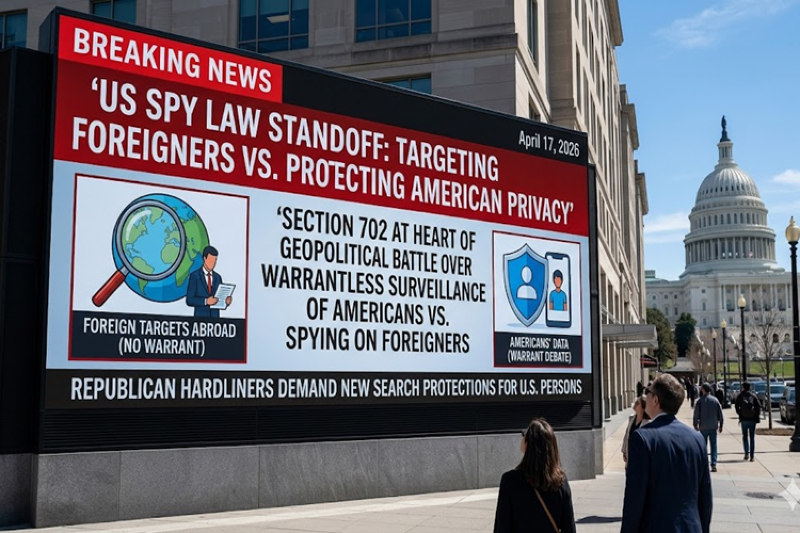
WASHINGTON – A high-stakes political battle in the U.S. Congress has reached a critical boiling point as lawmakers decide the future of a controversial surveillance law set to expire on April 20, 2026.
The debate centers on Section 702 of the Foreign Intelligence Surveillance Act (FISA)—a tool that allows the government to intercept communications of non-U.S. citizens abroad but frequently sweeps up the private data of Americans in the process.
The Target: Non-U.S. Persons Abroad
Under the current law, the U.S. government does not need a warrant to target non-Americans (foreign nationals) located outside the United States.
Purpose: To gather "foreign intelligence" on terrorism, cyber threats, and international crime.
Mechanism: Intelligence agencies can compel major tech companies like Google and AT&T to hand over emails and messages sent by these foreign targets.
The Catch: "Incidental" Collection of Americans
Because global communication is interconnected, when an American calls or emails a foreign target, their conversation is also captured.
The Loophole: Once this data is in the government’s database, the FBI can search for the names or email addresses of U.S. citizens without a warrant.
The Abuse: Civil liberties groups have documented thousands of "backdoor searches" where the government queried the private messages of American protesters, journalists, and even political donors without showing probable cause of a crime.
The Proposed Reform: A Warrant Requirement
House Speaker Mike Johnson recently delayed a vote on the law's extension due to a rebellion from a bipartisan group of lawmakers who demand a warrant requirement.
The proposed Higgins Amendment serves as a middle-ground attempt to fix this:
Targeting stays the same: Foreigners abroad would still be surveilled without a warrant.
New Shield for Americans: If the government wants to "query" or look at the data of a U.S. person found within that database, it would—in many cases—now need to obtain a warrant from a judge first.
Why the White House is Fighting It
President Trump and senior intelligence officials are pushing for a "clean" reauthorization with no new restrictions.
However, with the April 20 deadline fast approaching, the administration faces a difficult choice: accept new privacy protections for Americans or risk losing the power to spy on foreign threats altogether.
The high-stakes battle over FISA Section 702 is currently at a "make or break" point in Washington, with the program set to expire this Monday, April 20, 2026.
FISA Section 702: Summary Highlights & Key Developments
As of this morning, April 17, negotiations are moving into their final 72 hours. Here is the latest status and the core issues at play.
The Current Standoff
Speaker Mike Johnson is attempting to bridge a deep divide within the Republican party and between the House and the White House.
The "Clean" Extension: President Trump and the White House are pushing for an 18-month "clean" reauthorization with no new privacy guardrails.
They argue that the ongoing regional conflicts (including the tensions with Iran) make this tool too vital to disrupt with new legal requirements. The Reformers: A coalition of conservative hard-liners and privacy-focused Democrats is refusing to vote for any extension that doesn't include a warrant requirement for searching Americans' data.
The "Higgins Amendment" Compromise
The most likely path forward currently being discussed is a proposal by Rep. Clay Higgins (R-La.). This is designed as a middle-ground solution:
The Rule: It would require federal agents to get a warrant before querying the database for a "U.S. person"—but only once they have "probable cause" to believe that person is a foreign agent or has committed a crime.
The Criticism: Privacy advocates argue this is "watered down" because it codifies existing practices rather than creating a strict barrier against "backdoor" searches.
What Happens if it Expires?
If Congress does not act by Monday, the legal authority to start new surveillance under Section 702 will lapse. However, there is a technical safety net:
Certifications: Because the FISA Court (FISC) recently renewed the program’s annual certifications, the government argues it can technically continue existing surveillance through March 2027.
The Risk: Despite that technicality, the lapse of the underlying law would create immense legal uncertainty for tech companies (like Google and AT&T) that are currently compelled to cooperate.
Timeline for the Weekend
| Date | Expected Action |
|---|---|
| Fri, April 17 | Final text of a potential compromise bill is expected to be released. |
| Sat, April 18 | Possible emergency House session to advance the bill to the floor. |
| Sun, April 19 | Senate "pro forma" session to receive the House bill (if passed). |
| Mon, April 20 | EXPIRATION DEADLINE. |