
US Military to Stay Near Iran Until Nuclear Terms Met: Trump Issues Stern Ultimatum as Fragile Ceasefire Faces Early Turmoil
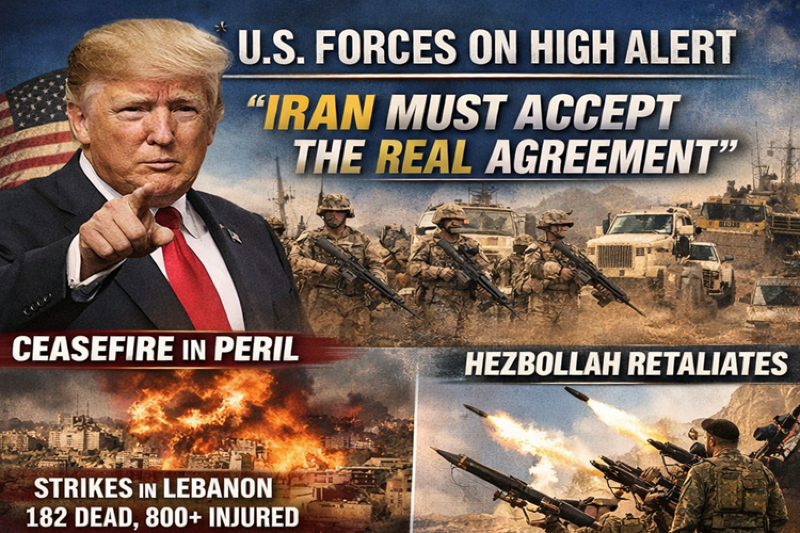
WASHINGTON D.C. – In a series of high-stakes developments, U.S. President Donald Trump has warned that American military forces will remain fully mobilized in the Middle East until Iran adheres to what he describes as the "REAL AGREEMENT."
The statement comes as a newly brokered two-week ceasefire shows immediate signs of strain, fueled by deadly strikes in Lebanon and conflicting interpretations of the peace terms.
The "Real Agreement" vs. Conflicting Demands
The ceasefire, intended to halt the conflict involving the U.S., Israel, and Iran, has been mired in confusion since its announcement. On Truth Social, President Trump clarified his expectations, asserting that any valid deal must include two non-negotiable pillars:
Zero Nuclear Weapons: A total commitment from Tehran to abandon nuclear ambitions.
Open Maritime Routes: Guaranteed safe and unrestricted passage through the Strait of Hormuz.
Trump dismissed alternative versions of the "10-point plan" circulating in Iranian media, which suggested the U.S. had agreed to lift all sanctions and include Lebanon in the truce.
"There is only one group of meaningful 'POINTS' that are acceptable to the United States," Trump stated, warning that if compliance fails, “the ‘Shootin’ Starts,’ bigger, and better, and stronger than anyone has ever seen before.”
Escalation in Lebanon Threatens Regional Truce
While the U.S. and Iran have technically entered a cooling-off period, the situation in Lebanon has reached a boiling point. On Wednesday, the Israeli military launched an intensive bombardment, reportedly hitting 100 targets in just 10 minutes.
Human Toll: Lebanese health officials report at least 182 deaths and over 800 injuries from the recent wave of strikes.
Hezbollah’s Stance: The militant group retaliated with rocket fire into northern Israel, claiming the right to defend against “Israeli-American aggression.”
The Diplomatic Gap: A major point of contention is whether Lebanon is covered by the ceasefire. President Trump has referred to the fighting there as a "separate skirmish," whereas Iranian officials insist the truce must cover all regional fronts.
UN Secretary-General António Guterres condemned the strikes, warning that the ongoing violence poses a "grave risk" to the sustainability of the two-week peace window.
The Battle for the Strait of Hormuz
The Strait of Hormuz, a vital artery for global oil supplies, remains a flashpoint. Despite White House assurances that the waterway is open, the Islamic Revolutionary Guard Corps (IRGC) issued a stern warning that any vessel entering without explicit permission would be "targeted and destroyed."
Iranian state media has even published maps directing commercial ships to alternative routes to avoid "sea mines," a move Western analysts view as a de facto blockade.
White House Press Secretary Karoline Leavitt countered these reports, stating that the U.S. has seen an "uptick" in traffic and expects immediate, total transparency in the channel.
| Key Player | Stance on the Ceasefire |
|---|---|
| United States | Forces stay "in place" until nuclear and maritime demands are met. |
| Iran | Claims the U.S. is already violating the 10-point plan regarding uranium enrichment. |
| Israel | Vows to continue striking Hezbollah in Lebanon regardless of the Iran truce. |
| NATO | Facing criticism from Trump for a perceived lack of support during "Operation Epic Fury." |
Tensions with NATO
Adding to the diplomatic complexity, President Trump took aim at European allies following a "frank" meeting with NATO Secretary General Mark Rutte.
Trump claimed the alliance "wasn't there when we needed them" during recent military operations against Iran. He also revived his controversial interest in Greenland, criticizing the territory's management and signaling continued friction with Danish and NATO leadership.
What’s Next?
The world’s attention now turns to Islamabad, Pakistan, where U.S. Vice President JD Vance is scheduled to lead high-level negotiations this Saturday.
While Vance acknowledged the "choppiness" of the current situation, the success of these talks may determine whether the region moves toward a lasting peace or descends back into a full-scale conflict.
As of Thursday morning, holy sites in Jerusalem have begun to reopen to worshippers, offering a rare, if quiet, glimmer of normalcy in a region still teetering on the edge.