

Turkey Enters ICBM Arena with Reveal of 6,000km Range 'Yildirimhan' Missile
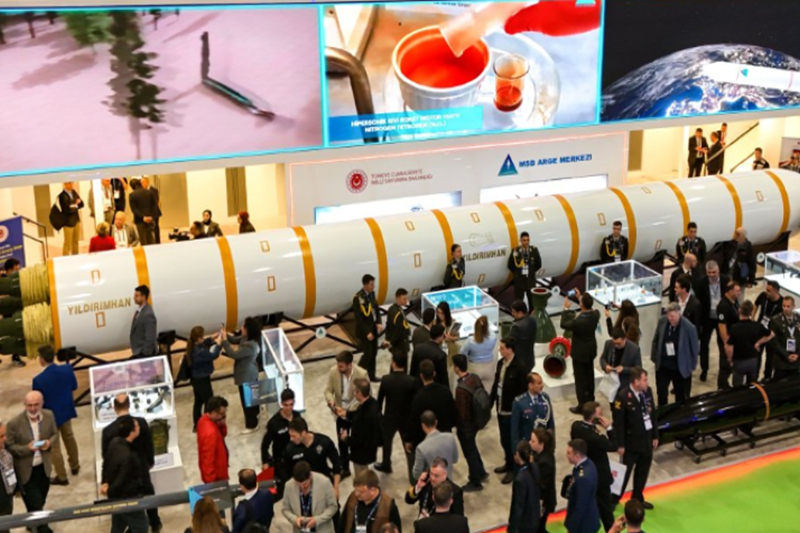
ISTANBUL — In a major leap for its domestic defense industry, Turkey has officially unveiled the prototype for its first intercontinental ballistic missile (ICBM), the Yildirimhan.
The announcement, made during the SAHA 2026 Defence and Aerospace Exhibition, signals Ankara's ambition to transform from a regional power into a global strategic player with sovereign strike capabilities.
Technical Specifications of the Yildirimhan
Developed by the Turkish Ministry of Defense’s research wing, the Yildirimhan (meaning "Lightning") boasts specifications that place it firmly within the elite category of long-range strategic weapons.
Range: 6,000 km (approx. 3,728 miles), allowing Turkey to project power across Europe, Africa, and deep into Asia.
Speed: A reported maximum speed of Mach 25, making it exceptionally difficult for current missile defense systems to intercept.
Propulsion: The missile utilizes four rocket engines powered by liquid nitrogen tetroxide.
Payload: It features a massive 3,000 kg payload capacity for its warhead.
While the missile is currently in the prototype and mock-up stage, its reveal marks Turkey’s intent to join the exclusive group of nations—including the U.S., Russia, China, and India—possessing ICBM-class technology.
The "Sovereignty Project": Strategic Autonomy
Defense Minister Yasar Guler emphasized that the project is as much about the "security economy" as it is about hardware. By developing its own ICBM, Ankara is working to shed its historical reliance on Western suppliers, particularly the United States.
Defense analysts suggest the Yildirimhan is the military derivative of Turkey's civilian space ambitions. "The physics required to reach orbit for a satellite is nearly identical to the trajectory of an ICBM," noted security expert Burak Yildirim. He characterized the project as a "sovereignty project," designed to ensure Turkey cannot be coerced by foreign powers.
A Message to Regional Adversaries
The timing of the unveiling is significant, coinciding with heightened volatility in the Middle East. Recent incidents, including the interception of ballistic missiles over Turkish soil during the U.S.-Israel-Iran conflict, have underscored Turkey's need for "hard deterrence."
Furthermore, the project appears to be a response to shifting regional alliances and increasing hostility from Israel.
Israeli politicians have recently labeled Turkey a "emerging threat" similar to Iran. Analysts believe the ICBM serves as a clear message that Turkey possesses the reach to strike distant targets if its national security is compromised.
Strengthening the NATO Alliance
Despite the move toward self-sufficiency, Turkish officials frame the Yildirimhan as an asset to the NATO alliance. As a member of the 32-nation bloc, Turkey has committed to raising its defense spending to 5% of its GDP by 2035—a goal championed by the Trump administration.
Ozgur Unluhisarcikli of the German Marshall Fund noted that a more technologically advanced Turkey strengthens NATO’s southern flank.
"Turkey is pivotal in securing the connection between the Black Sea and the Mediterranean. A stronger Turkey inherently means a stronger NATO," he said.
Economic Impact: A Global Arms Exporter
Turkey’s defense exports hit a record $10.05 billion in 2025, driven by the international success of the Bayraktar TB2 drones. The development of the Yildirimhan is expected to further elevate Turkey’s status in the global arms market, offering high-tech solutions to allies such as Qatar, Pakistan, and the UAE.
While critical subsystems and flight tests have yet to be publicly verified, the Yildirimhan represents a bold declaration of Turkey’s 21st-century identity: a nation seeking a seat at the table of the world’s most advanced military powers.