
Trump Repeats Iran “Deal” Claim as Tehran Denies Talks; Reports Emerge of US 15-Point War Plan
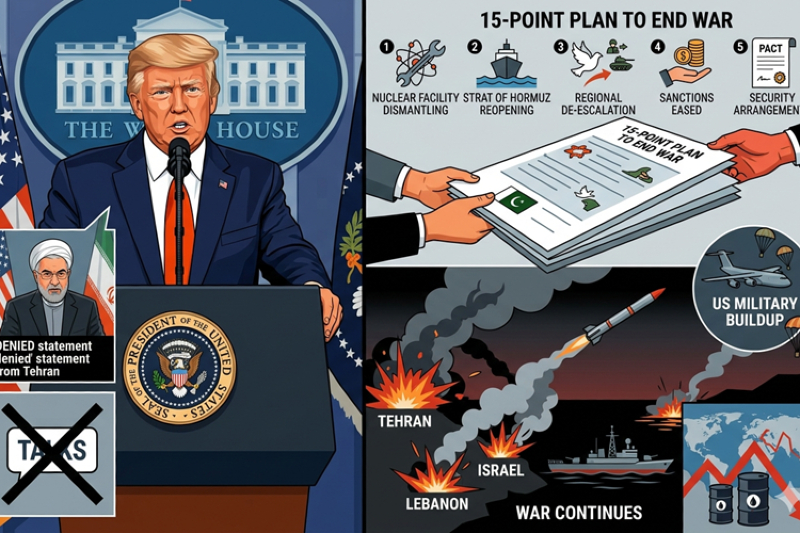
Tensions in the Middle East remain high as the United States and its ally Israel continue military operations against Iran, even as Donald Trump insists that negotiations to end the war are actively underway. Tehran, however, has firmly rejected those claims, creating a sharp contradiction between the two sides.
Speaking from the White House, Trump repeatedly asserted that Iranian representatives are eager to reach an agreement, saying they “want to make a deal so badly.”
He suggested that ongoing discussions were the reason behind his decision to delay planned strikes on Iran’s energy infrastructure. The US president also claimed that progress had been made on key issues, particularly ensuring that Iran would not develop nuclear weapons.
Iranian officials have pushed back strongly, dismissing the notion of direct talks as false and describing such statements as misinformation. This divergence has added to uncertainty over whether any real diplomatic channel exists behind the scenes.
Reported 15-Point Plan to End War
Amid the conflicting narratives, multiple international media outlets have reported that Washington has drafted and sent a 15-point proposal aimed at ending the conflict. The plan, reportedly delivered through intermediaries such as Shehbaz Sharif’s government, has not been officially confirmed in full detail.
While the contents remain largely undisclosed, sources suggest the framework includes several core demands and incentives:
The plan was reportedly delivered to Tehran through Pakistani intermediaries (specifically the government of Shehbaz Sharif) and is being spearheaded by U.S. envoys Jared Kushner and Steve Witkoff.
The Reported 15-Point Plan
While no government has officially released the full text, credible reports have identified 14 of the 15 key points, structured as a "grand bargain" of concessions and demands:
Core Demands of Iran
Nuclear Dismantlement: Full dismantling of all existing Iranian nuclear capabilities.
Zero Enrichment: A permanent ban on uranium enrichment activities on Iranian soil.
Stockpile Turnover: Handover of all enriched uranium (including the estimated 450kg of 60% enriched material) to the IAEA.
Facility Decommissioning: Decommissioning and destruction of the Natanz, Isfahan, and Fordow nuclear sites.
Unfettered IAEA Access: Granting the IAEA full, real-time access to all sites, personnel, and historical data.
Strait of Hormuz: Permanent reopening of the Strait of Hormuz as a "free maritime zone" with no interference.
Proxy Disengagement: Complete cessation of funding, arming, and directing regional proxy groups (Hezbollah, Houthis, etc.).
Missile Restrictions: Strict limits on the range and quantity of Iran’s ballistic missile program.
Defensive Limitation: A legal commitment to use remaining missile technology only for self-defense purposes.
U.S. & International Concessions
Full Sanctions Relief: The lifting of all primary and secondary economic sanctions related to the nuclear program and the current war.
Civilian Nuclear Assistance: International aid and funding for a strictly civilian nuclear energy program centered on the Bushehr reactor.
End of "Snapback": Removal of the UN "snapback" mechanism that allows for the automatic reimposition of sanctions.
Regional Security Pact: Development of a non-aggression pact or regional enrichment consortium involving Gulf neighbors (Saudi Arabia, UAE, Qatar).
Ceasefire Window: A proposed one-month ceasefire to facilitate the formal negotiation of these points.
(Reported as a final security guarantee or mutual non-interference clause, though details remain the most vague).
Current Status of the Proposal
Tehran’s Stance: Officially, Iran has dismissed these reports as "fake news" intended to manipulate oil markets.
However, some reports suggest senior officials are internally reviewing the list while demanding a complete cessation of U.S./Israeli aggression first. Israel’s Stance: Prime Minister Netanyahu has expressed skepticism, fearing a "partial deal" that might leave Iran with residual capabilities, though the 15-point plan aligns with many long-standing Israeli security demands.
Military Context: Despite the diplomatic signals, the U.S. has simultaneously moved the 82nd Airborne Division toward the region to maintain "maximum leverage" during this sensitive window.
It is still unclear whether Israel would support the proposal, or how widely it has been circulated among Iranian leadership.
War Continues Despite Diplomatic Signals
On the ground, hostilities show no sign of slowing. Israeli forces have carried out fresh strikes in Tehran, while Iran has launched missiles toward Israeli territory.
The conflict has also expanded beyond the two countries, with deadly strikes reported in southern Lebanon and rising tensions involving Iran-backed groups.
The strategic Strait of Hormuz remains a critical flashpoint. Iran has indicated it will allow passage for “non-hostile” vessels under its supervision, signaling continued control over one of the world’s most vital energy corridors.
Nearly a fifth of global oil shipments typically pass through the route, and disruptions have already driven volatility in global energy markets.
US Military Buildup Raises Stakes
Even as Trump highlights diplomacy, the Pentagon is preparing for a possible escalation. Reports indicate that troops from the US Army’s 82nd Airborne Division could be deployed to the region, adding to an already significant American military presence.
Analysts suggest such a move could be aimed at pressuring Iran to reopen shipping lanes or to strengthen Washington’s position in any potential negotiations. However, it also risks widening the conflict further.
Global Concern Over Economic Fallout
The war’s economic implications are becoming increasingly evident. Oil prices have fluctuated sharply, and major financial figures warn of serious consequences if instability continues. Prolonged disruption in energy supply could trigger inflation and even a global economic slowdown.
At the same time, international actors including European and regional leaders are urging restraint and encouraging both sides to engage in credible negotiations.
Uncertain Path Ahead
Despite Trump’s repeated assertions of imminent progress, the absence of confirmed talks and Iran’s continued denial leave the diplomatic outlook unclear.
With active military operations ongoing and a reported peace framework yet to be verified, the situation remains volatile—caught between claims of negotiation and the reality of escalating conflict.