
Beyond the Aches: Why Multiple Myeloma is the ‘Silent Crisis’ for the Over-60s in 2026 (Part-1)
Multiple myeloma is a serious blood cancer that begins in the plasma cells—a type of white blood cell responsible for producing antibodies.
While it remains a significant health challenge, the narrative that patients only have "weeks or months" has been fundamentally changed by modern medicine. Today, many patients live for a decade or more thanks to breakthroughs in immunotherapy and targeted treatments.
1. Who is Most Affected? (Age & Demographics)
Multiple myeloma is primarily a disease of the aging population. It is rarely seen in young people, though incidence rates have been slightly rising globally due to better diagnostic tools.
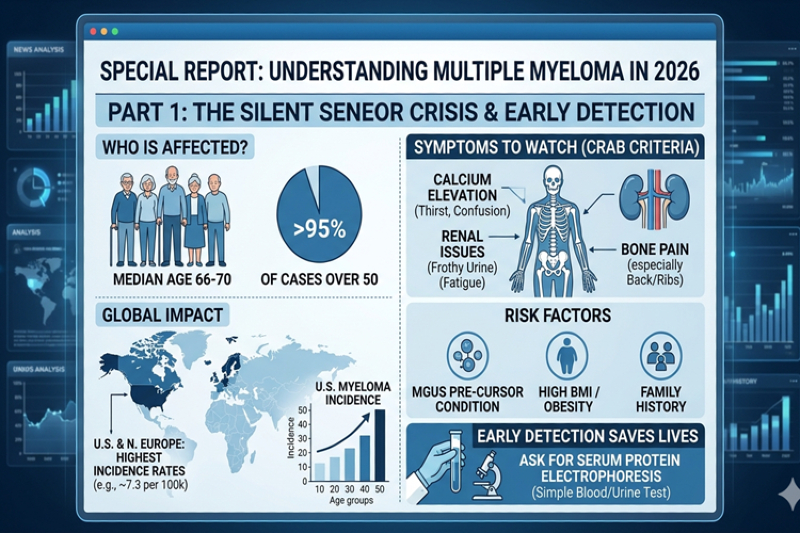
Peak Age Frame: The median age at diagnosis is 66 to 70 years.
The "50+" Rule: Approximately 95% of all cases are diagnosed in individuals over the age of 50.
Early Onset: Only about 2% of cases occur in people under age 40.
Gender & Race: * Men are slightly more likely to develop the disease than women.
Black populations face the highest risk, with incidence rates roughly double those of white populations.
2. Global Prevalence & Hotspots
Multiple myeloma accounts for about 1.8% of all new cancer cases worldwide and roughly 10% to 15% of all hematologic (blood) malignancies.
| Region | Status |
|---|---|
| Most Affected | Northern America, Northern Europe, and Australia/New Zealand report the highest age-standardized incidence rates. |
| Rising Burden | East Asia and Central Asia have seen the steepest increases in disease burden over the last decade. |
| Least Affected | Regions in Western and Middle Africa and parts of South-East Asia report lower incidence, though this may be partially due to under-diagnosis. |
3. Symptoms: The "CRAB" Criteria
Because the symptoms often mimic general signs of aging (like back pain or fatigue), the disease is frequently caught in later stages. Doctors use the CRAB acronym to identify classic clinical markers:
C – Calcium Elevation: High blood calcium levels caused by bone destruction, leading to extreme thirst, nausea, and confusion.
R – Renal (Kidney) Failure: "M-proteins" produced by cancer cells can clog and damage the kidneys.
A – Anemia: Cancerous cells crowd out healthy red blood cells, causing persistent fatigue and shortness of breath.
B – Bone Damage: Soft spots (lytic lesions) and "holes" in the bone, leading to severe pain and easy fractures, especially in the spine or ribs.
4. Risk Factors
While the exact cause is unknown (genetic mutations occur in the DNA of plasma cells), several factors increase susceptibility:
MGUS: A "pre-cancerous" condition called Monoclonal Gammopathy of Undetermined Significance. About 1% of people with MGUS progress to myeloma each year.
Obesity: High Body Mass Index (BMI) is a proven risk factor for myeloma development.
Family History: Having a first-degree relative with the disease increases risk.
Environmental Exposure: Exposure to certain chemicals (petroleum, pesticides) or high-dose radiation.
5. Modern Treatment & Life Expectancy
The "weeks to months" prognosis is a common misconception from decades ago. In 2026, multiple myeloma is treated as a chronic, manageable disease for many.
Standard Care (2026): Quadruplet therapies—combining four types of drugs (Monoclonal antibodies, Proteasome inhibitors, Immunomodulatory drugs, and Steroids)—are now the first line of defense.
Stem Cell Transplant: Autologous stem cell transplants remain a standard for eligible patients, often leading to long periods of remission.
Revolutionary Immunotherapy: * CAR T-Cell Therapy: Genetically modifying a patient’s own T-cells to attack cancer. Some patients remain cancer-free for over 5 years after a single treatment.
Bispecific Antibodies: "Off-the-shelf" drugs that bridge the gap between immune cells and cancer cells.
The Numbers: The 5-year relative survival rate has climbed to approximately 60-70% in many developed regions, with many patients living 10+ years.
6. Awareness & Action
Early detection is the key to survival. Because bone pain and fatigue are so common in older age, a simple blood or urine test (looking for abnormal proteins) can be life-saving.
Expert Insight: "Age significantly impacts prognosis, but it is no longer the sole deciding factor. With the DKRd regimen and CAR-T therapies available in 2026, we are seeing unprecedented remission rates even in older patients."