
Global Health Bulletin: The 2026 Cancer Landscape
Munshi Firoz Al Mamun
The global fight against cancer has reached a pivotal juncture in 2026. While incidence rates continue to climb—driven by aging populations and lifestyle shifts—breakthroughs in immunotherapy and early detection are rewriting the prognosis for millions.
Below is an independent analysis of the most prevalent cancer types, their progression, and the current state of treatment.
1. Lung Cancer: The Leading Global Threat
Lung cancer remains the primary cause of cancer-related mortality worldwide. Despite a steady decline in smoking-related cases in Western nations, rising pollution and tobacco use in other regions maintain its status as a global crisis.
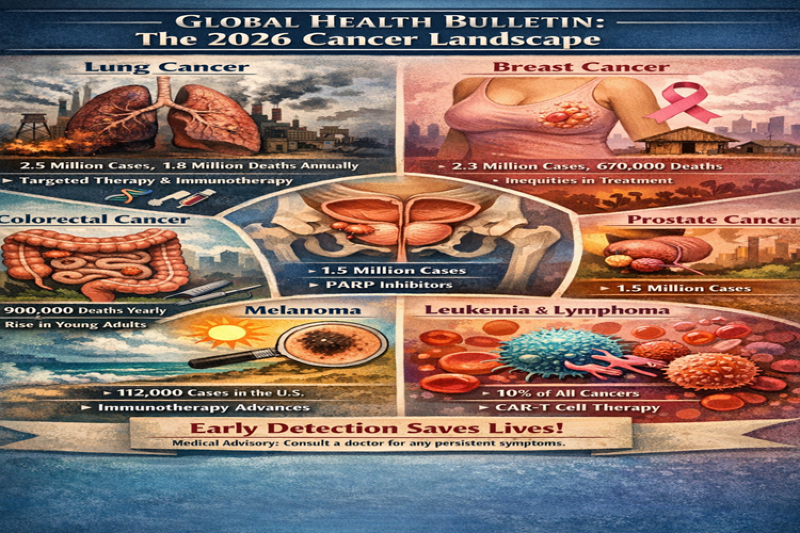
Global Impact (2026): Estimated 2.5 million new cases and 1.8 million deaths annually.
Symptoms: Persistent "smoker's" cough, hemoptysis (coughing up blood), chest pain, and unexplained shortness of breath.
Stage-Wise Complications:
Early (Stage I-II): Often asymptomatic; found incidentally. Complications are rare but include localized lung collapse.
Advanced (Stage III-IV): Metastasis to bones (causing severe pain), brain (neurological deficits), and liver.
Treatment: A shift toward targeted therapies for specific genetic mutations (EGFR/ALK) and immune checkpoint inhibitors.
Survival: 5-year survival is roughly 22% overall, but rises significantly if caught in the "localized" stage.
2. Breast Cancer: A Story of Growing Inequity
Breast cancer is the most commonly diagnosed cancer among women globally, appearing in almost every country.
Global Impact: Approximately 2.3 million new cases and 670,000 deaths.
Symptoms: A painless lump or thickening, skin dimpling (peau d'orange), and nipple inversion or discharge.
Stage-Wise Complications:
In Situ (Stage 0): Non-invasive, but requires monitoring.
Metastatic (Stage IV): Spread to the lungs or brain, leading to respiratory failure or cognitive decline.
Treatment: Personalized regimes based on hormone receptor (ER/PR) and HER2 status. Surgical options range from lumpectomies to radical mastectomies, often followed by long-term hormone therapy (5–10 years).
Survival: In high-income countries, the 5-year survival rate exceeds 90%, but this drops to below 50% in low-income regions due to late-stage diagnosis.
3. Colorectal Cancer: The Rising Concern for Young Adults
A disturbing trend in 2026 is the sharp rise of colorectal cancer in individuals under age 50, a demographic previously considered low-risk.
Global Impact: Second leading cause of cancer death with 1.9 million cases and 900,000 deaths annually.
Symptoms: Change in bowel habits (diarrhea/constipation), rectal bleeding (bright or dark tar-like stool), and persistent abdominal cramps.
Stage-Wise Complications:
Stage I-II: Bowel obstruction.
Stage III-IV: Spread to the liver is most common, potentially leading to jaundice and liver failure.
Treatment: Surgery is the primary curative tool for early stages. For advanced cases, immunotherapy is now used for tumors with specific "mismatch repair" deficiencies.
Survival: Highly curable if caught early (91% survival); however, survival for distant metastasis remains low at roughly 13%.
4. Prostate Cancer: Precision in the "Living With" Era
Prostate cancer remains the most common cancer among men in over 100 countries. In 2026, the focus has shifted from just "surviving" to "survivorship"—managing the disease as a chronic condition.
Global Impact: 1.5 million new cases; it is the second most common cancer in men.
Symptoms: Urinary frequency (especially at night), weak flow, and blood in the urine or semen.
Stage-Wise Complications:
Local: Urinary incontinence and erectile dysfunction.
Metastatic: High affinity for bone spread, causing fractures and spinal cord compression.
Treatment: Options include active surveillance for slow-growing tumors, radical prostatectomy, and the 2026 standard for high-risk cases: PARP inhibitors (which target DNA repair kits in cancer cells).
Survival: The 5-year relative survival rate is near 97% for localized disease.
5. Skin Cancer (Melanoma): The UV Crisis
While non-melanoma skin cancers are more frequent, Melanoma accounts for the vast majority of skin cancer deaths.
Global Impact (2026): Over 112,000 invasive cases in the U.S. alone, with a rising incidence linked to indoor tanning and climate-driven UV exposure.
Symptoms: The ABCDE rule (Asymmetry, Border irregularity, Color changes, Diameter >6mm, and Evolving).
Stage-Wise Complications: * Early: Minimal.
Stage IV: Rapid spread to the brain and lungs.
Treatment: The "Immunotherapy Revolution" has been most successful here. Drugs like anti-PD-1 have increased metastatic survival from 16% to 35% in recent years.
Survival: Overall 5-year survival is approximately 94%.
6. Blood Cancers (Leukemia & Lymphoma): The Frontier of CAR-T
Blood cancers are diverse, affecting the bone marrow (leukemia) or the immune system (lymphoma).
Global Impact: Leukemia and Lymphoma account for approximately 10% of all new cancer cases.
Symptoms: Persistent fever, drenching night sweats, easy bruising, and swollen (but painless) lymph nodes.
Stage-Wise Complications: * Leukemia: Severe anemia, life-threatening infections, and "blast crisis."
Lymphoma: Spleen enlargement and compromised immunity.
Treatment: The hallmark of 2026 is CAR-T cell therapy, where a patient’s own T-cells are genetically re-engineered to "hunt" cancer cells.
Survival: Survival has surged; pediatric leukemia survival is now at 89%, and Hodgkin Lymphoma is considered one of the most curable cancers (92% survival).
Medical Disclaimer: The information provided is for educational purposes. If you experience persistent symptoms, consult a healthcare professional immediately. Early detection remains the single most effective tool for survival.
➡️ Read more:
https://theimpartial24.blogspot.com/2026/02/global-health-bulletin-2026-cancer.html