
Political "Rubicon": GOP Lawmakers Warn Trump Against Ground Invasion of Iran Without Congressional Approval
As the month-long conflict in the Middle East enters a precarious new phase, U.S. President Donald Trump is facing an internal revolt from within his own party.
Prominent Republican lawmakers are increasingly vocal in their demands that any escalation involving "boots on the ground" must be sanctioned by Congress, setting the stage for a constitutional showdown over war powers.
The Congressional "Say": Representative Nancy Mace Leads the Charge
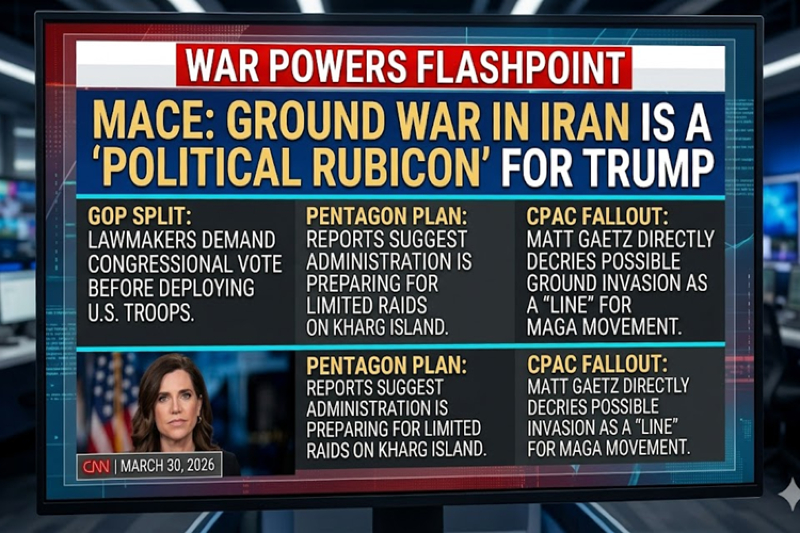
Representative Nancy Mace (R-SC) emerged from a high-level classified briefing on Sunday to deliver a firm warning to the White House.
Speaking on CNN, Mace emphasized that while there has been general support for the initial phases of the war, a conventional ground operation would be a "political Rubicon."
"If we’re going to do a conventional ground operation with Marines and the 82nd Airborne, that is a ground war that I believe Congress should have a say in," Mace stated. Her comments reflect a growing anxiety among GOP members that the administration may be planning a significant escalation without a clear legislative mandate. "We don’t want troops on the ground. I think that’s a line for a lot of people."
Pentagon Preparations: Raids on Kharg Island?
The debate has been intensified by recent reports in The Washington Post suggesting that the Pentagon is already drafting blueprints for limited ground maneuvers. These potential operations are said to include:
Targeted Raids: Precision strikes on Kharg Island, Iran's critical energy export hub.
Strait of Hormuz Security: Seizing strategic points to ensure the flow of global oil.
Nuclear Neutralization: Ground teams tasked with ensuring the permanent decommissioning of hardened research sites.
While White House Press Secretary Karoline Leavitt did not deny these reports, she clarified that the Pentagon’s role is to provide the Commander-in-Chief with "maximum optionality" rather than indicating a final decision has been made.
The MAGA Divide: Gaetz and the "America First" Skeptics
The potential for a ground war has created a visible rift in the "Make America Great Again" (MAGA) movement. At the recent Conservative Political Action Conference (CPAC) in Dallas, the tension was palpable.
Former Congressman and staunch Trump ally Matt Gaetz delivered a blunt critique of a potential invasion. "A ground invasion of Iran will make our country poorer and less safe," Gaetz told the crowd. He warned of a domestic fallout, including "higher gas prices and higher food prices," and questioned the long-term efficacy of a ground campaign in actually reducing the threat of terrorism.
Military Reality: The Limits of Air Power
Despite the destruction of approximately 13,000 targets via air strikes, military analysts warn that air power alone cannot achieve the administration’s stated goals of total regime change or the complete dismantling of Iran's nuclear infrastructure.
Director of National Intelligence (DNI) reports suggest that while Iran’s conventional military is "decimated," the country retains the asymmetrical capability to inflict severe damage on regional neighbors and U.S. assets. This reality has forced the administration to consider the 82nd Airborne and specialized Marine units, roughly 3,500 of whom recently arrived in the region aboard the USS Tripoli.
Economic and Political Stakes
For President Trump, the decision to deploy troops is fraught with political peril. His "America First" platform was built on the promise of ending "forever wars." A protracted ground conflict in Iran could alienate his core base and provide ammunition for political rivals ahead of the next election cycle.
Furthermore, the global economy is already reeling. With oil prices hovering near $117 per barrel, any further instability caused by a ground war could trigger a global recession, a risk that Representatives Eli Crane and Derrick Van Orden—both veterans—say is weighing heavily on Republican leadership.
Conclusion: A Fragile Consensus
As the U.S. continues to bolster its presence—potentially adding 10,000 more troops to the 40,000 already stationed in the Middle East—the question of "what comes next" remains unanswered.
While the President claims to be seeking a "15-point peace deal," the build-up of hardware and the rhetoric from Capitol Hill suggest that the window for a purely diplomatic solution is closing fast.
War Power Breakdown: The Legal Landscape
| Authority | Description | Status in Current Conflict |
|---|---|---|
| Article II | President's power as Commander-in-Chief | Used for current air strikes |
| War Powers Resolution | Requires notice to Congress within 48 hours | Ongoing reporting to House/Senate |
| AUMF | Authorization for Use of Military Force | Subject of intense GOP debate |