
Pakistan-Brokered "Islamabad Accord" Offers Glimmer of Hope as Trump’s Infrastructure Deadline Looms
ISLAMABAD/TEHRAN – A high-stakes diplomatic effort led by Pakistan has emerged as the primary vehicle for averting a catastrophic escalation in the Middle East.
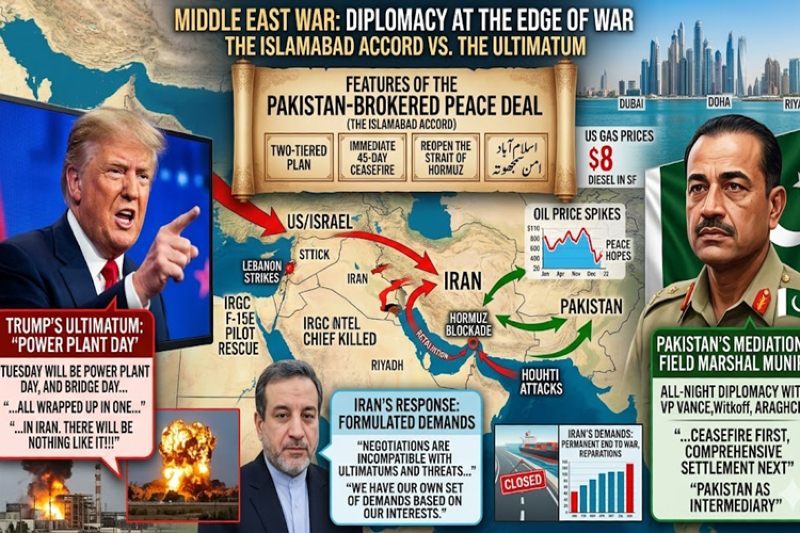
Dubbed the "Islamabad Accord," the proposal aims to secure an immediate ceasefire between the U.S., Israel, and Iran, even as the region sits hours away from President Donald Trump’s "Power Plant Day" deadline.
The "Islamabad Accord": A Two-Tiered Peace Plan
Sources close to the negotiations reveal that Pakistan's Army Chief, Field Marshal Asim Munir, remained in "all-night" contact with U.S. Vice President JD Vance, Special Envoy Steve Witkoff, and Iranian Foreign Minister Abbas Araghchi.
The proposed framework consists of two critical phases:
Immediate 45-Day Ceasefire: An instant cessation of hostilities to allow for the reopening of the Strait of Hormuz, a vital global energy artery currently under Iranian blockade.
Comprehensive Settlement: A 15-to-20-day window for high-level negotiations in Islamabad to address long-term issues, including nuclear enrichment limits, regional proxy activity, and the permanent lifting of U.S. sanctions.
Iran Formulates Response Amid Airstrikes
Iranian Foreign Ministry spokesperson Esmail Baghaei confirmed on Monday that Tehran has officially formulated its response to the Pakistani proposal.
A senior Iranian official told Reuters that while they are reviewing the Islamabad framework, they will not reopen the Strait of Hormuz for a "temporary" truce.
Trump’s Looming Deadline and "Epic Fury"
The diplomatic push comes against a backdrop of immense military pressure. President Trump has set a firm deadline of Tuesday, 8:00 PM ET, for the reopening of the Strait.
"Tuesday will be Power Plant Day, and Bridge Day, all wrapped up in one, in Iran. There will be nothing like it!!!" Trump posted on Truth Social.
While the White House confirmed that the Pakistani plan is "one of many ideas" being considered, officials stressed that Operation Epic Fury—the U.S.-led campaign against Iranian assets—continues unabated until a deal is signed.
Internal Security and Regional Retaliation
As the peace deal hangs in the balance, Iran has intensified its internal security measures. Authorities in West Azerbaijan province announced the arrest of 17 individuals accused of espionage and sharing sensitive military data with "U.S. and Israeli-linked entities."
The arrests follow a devastating morning for Iran’s military leadership, which saw the elimination of Brig. Gen. Majid Khademi (IRGC Intelligence Chief) and Asghar Bagheri (Quds Force Commander) in precision strikes.
Economic Stakes and Global Impact
The prospect of the "Islamabad Accord" provided a brief respite for global markets. Oil prices, which had spiked toward $110 a barrel, retreated by over $2 per barrel on Monday as investors assessed the likelihood of a breakthrough. However, fuel prices remain at record highs in the U.S., with diesel in San Francisco reaching an unprecedented $8 per gallon.
As mediators from Egypt and Turkey join Pakistan in a final push for the accord, the world watches to see if Field Marshal Munir’s "all-night" diplomacy can bridge the gap between Trump’s infrastructure threats and Tehran’s demands for a permanent end to the war.