

NASA Uses James Webb Telescope to Rule Out 2032 Asteroid Threat
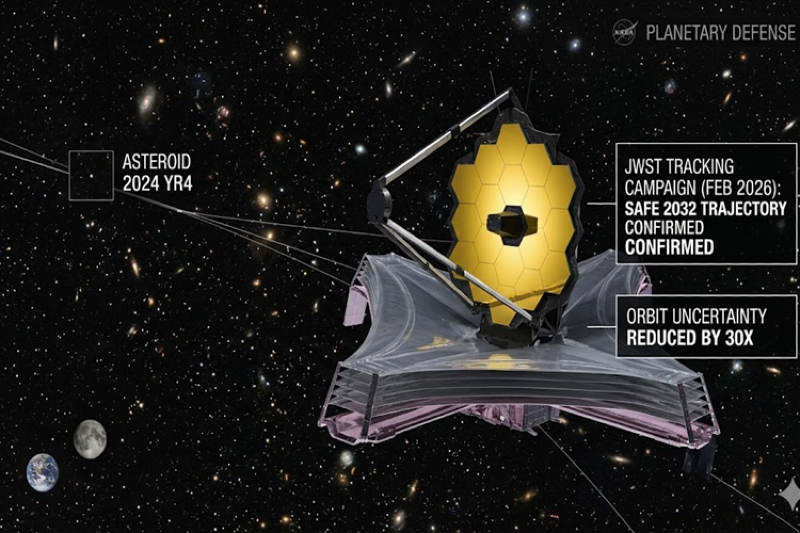
NASA has officially confirmed that the asteroid 2024 YR4 no longer poses a threat to Earth or the Moon.
The asteroid, which measures approximately 200 feet (60 meters) in diameter, is now projected to pass roughly 13,200 miles (21,200 km) above the lunar surface on December 22, 2032—a distance considered safe by experts.
A Vanishing Threat
Asteroid 2024 YR4 first made headlines in early 2025 when initial calculations suggested a small but notable risk of hitting Earth.
Because the asteroid is extremely dim—roughly four billion times fainter than a star visible to the naked eye—ground-based telescopes lost sight of it in May 2025.
The Webb Advantage
Using Webb’s Near-Infrared Camera (NIRCam) on February 18 and 26, 2026, a team led by Andy Rivkin at the Johns Hopkins University Applied Physics Laboratory (APL) captured the asteroid against a backdrop of distant stars.
"Without Webb, we would have needed to wait until 2028 with a large amount of uncertainty," Rivkin explained.
By doubling the length of time the asteroid has been tracked, the team was able to reduce the margin of error for its 2032 position by a factor of 30.
Protecting the Lunar "Traffic Lane"
While an asteroid of this size would not cause global devastation on Earth, a lunar impact would have been significant.
Such a "debris storm" could have endangered satellites in high-Earth orbit and created hazardous conditions for future crewed Artemis missions.
A New Playbook for Planetary Defense
The successful tracking of 2024 YR4 is being hailed as a major milestone for planetary defense. It demonstrates a new "standard" for monitoring potential hazards: using wide-field surveys like ATLAS for discovery, followed by the deep-space sensitivity of Webb for precise tracking.
NASA is currently developing the NEO Surveyor, a dedicated mission designed to find and track dark asteroids in infrared.
Before and After: The Asteroid 2024 YR4 Scare
This graphic compares the perceived threat of asteroid 2024 YR4 before and after crucial observations by the James Webb Space Telescope (JWST).
Before JWST Observations:
The Hazard: Asteroid 2024 YR4, discovered in early 2025, initially showed a small but notable risk of colliding with Earth.
Refining the Orbit: While subsequent observations ruled out an Earth impact, a lingering 4.3% chance of the asteroid striking the Moon remained.
The "Wait and See" Problem: Because the asteroid is incredibly faint, it was lost to ground-based telescopes in May 2025. Without a powerful observatory, scientists would have had to wait until 2028 for it to become visible again, leaving a multi-year period of uncertainty.
Potential Consequences: A lunar impact, while not a threat to life on Earth, could have created a massive crater and a "debris storm" that could damage satellites and endanger future crewed missions to the Moon.
After JWST Observations:
The Game-Changer: NASA used the JWST's unique capabilities in February 2026 to track the asteroid.
Precise Data: The high-precision data from JWST allowed scientists to refine the asteroid's orbit with unprecedented accuracy, reducing the margin of error by a factor of 30.
Uncertainty Removed: The detailed observations officially confirmed that 2024 YR4 poses no danger of impacting either Earth or the Moon.
Safe Passage: The asteroid is now projected to pass safely at a distance of approximately 13,200 miles (21,200 km) above the lunar surface on December 22, 2032.
A New Model for Defense: This success demonstrates a new approach for planetary defense, utilizing a combination of wide-field surveys for discovery and specialized telescopes like JWST for precise tracking and characterization of potential hazards.