

NASA Reveals Artemis III Crew for High-Stakes Test Flight Critical to Saving Future Moon Landing Missions
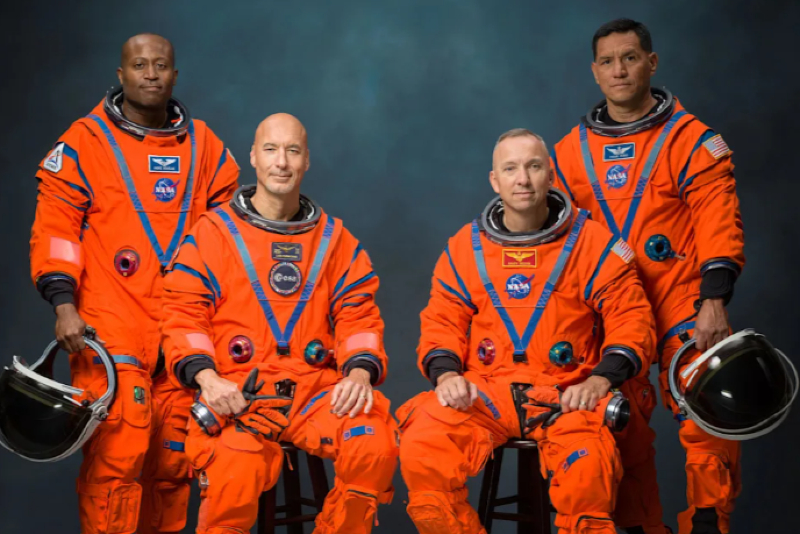
HOUSTON — NASA on Tuesday officially revealed the four-man crew selected for its upcoming Artemis III spaceflight, marking the next critical phase in the agency's effort to return humans to the lunar surface.
The two-week mission, scheduled to launch next year into low-Earth orbit, will focus on high-stakes testing of commercial lunar landers currently being built by Elon Musk's SpaceX and Jeff Bezos' Blue Origin.
The Artemis III Crew Lineup
The newly selected prime crew brings a mix of seasoned veterans and fresh expertise to the mission:
Commander: Randy Bresnik, a veteran NASA astronaut, retired Marine Corps colonel, and former International Space Station (ISS) commander.
Pilot: Luca Parmitano of Italy, a highly experienced European Space Agency (ESA) astronaut and experimental air force test pilot.
Mission Specialist: Frank Rubio, a U.S. Army colonel who holds the American record for the longest single continuous spaceflight (371 days).
Mission Specialist: Andre Douglas, a systems engineer, Coast Guard reserve officer, and spaceflight rookie who previously served as a backup for Artemis II.
Backup Crew Member: NASA astronaut Bob Hines will train alongside the team to step in if necessary.
Shifting Gears: Why Earth Orbit Instead of a Moon Landing?
The mission layout represents a significant structural shift for the Artemis program. NASA initially intended for Artemis III to place boots directly on the Moon.
However, following a recent programmatic overhaul led by NASA Administrator Jared Isaacman to accelerate the launch pace and mitigate long-term risks, the mission parameters were updated.
Instead of traveling to deep space, the crew will remain closer to Earth. This adjustment is specifically designed to thoroughly evaluate complex automated rendezvous and docking maneuvers.
During the mission, the crew will launch aboard the Orion spacecraft atop the massive Space Launch System (SLS) rocket from the Kennedy Space Center in Florida.
Once in orbit, they will practice linking up with test models of SpaceX's Starship and Blue Origin’s Blue Moon landers.
Masterfully executing these docking procedures is vital; during final lunar landing missions, astronauts must seamlessly transfer from the Orion capsule into a waiting lander to descend to the Moon's surface, and later blast off to rejoin Orion for the journey home.
Private Aerospace Companies Face Strict Deadlines
Both SpaceX and Blue Origin are actively racing against the clock to finalize their hardware. The stakes are particularly high for Blue Origin, which recently experienced a prominent setback when its New Glenn heavy-lift rocket exploded during an engine test in Cape Canaveral, Florida. The incident destroyed the rocket and heavily damaged the company's sole operational launch pad.
Despite the obstacle, Blue Origin management remains highly optimistic about meeting deadlines. John Couluris, the company's senior vice president of lunar permanence, noted that factories are currently running around-the-clock shifts. Blue Origin expects its vehicle to be fully assembled and flight-ready by 2027.
NASA officials likewise view the recent mishap as a constructive learning opportunity rather than a program-stopping failure. The agency is actively working hand-in-hand with its commercial partners, providing direct logistical and technical support to ensure milestones are met safely.
The Road Map to the Lunar South Pole
If the upcoming orbital dress rehearsal proves successful, it will clear the path for Artemis IV in 2028, which aims to execute the first crewed American lunar landing since the Apollo 17 mission in 1972.
The long-term objective of the multi-billion dollar Artemis program is to establish a permanent human outpost near the lunar south pole, staying a step ahead of China's competing space program, which aims to land taikonauts on the Moon by 2030.
Additionally, NASA confirmed that a redesigned, highly scrutinized heat shield for the Orion capsule has successfully passed all stress tests and inspection protocols.
The component is ready for final vehicle installation, resolving engineering anxieties sparked by minor erosion observed during the uncrewed Artemis I flight.