
Modi Addresses Knesset, Elevates India–Israel Ties to Strategic High in Post-October 7 Geopolitical Climate
Indian Prime Minister Narendra Modi delivered a landmark address at the Knesset, becoming the first Indian premier to speak before Israel’s parliament and signaling a decisive strengthening of bilateral ties amid shifting global geopolitics.
Framing India and Israel as “ancient civilizations” shaped by resilience and innovation, Modi underscored the strategic logic behind the partnership.
He described Israel as a global innovation hub and positioned India as an emerging economic powerhouse poised to rank among the world’s top three economies in the coming years.
The convergence of India’s growth ambitions and Israel’s technological edge, he argued, forms a natural and durable alliance.
Strategic Convergence in Technology and AI
A central pillar of Modi’s message was technological cooperation, particularly in artificial intelligence. He emphasized that collaboration in AI and advanced technologies would drive future economic growth and deepen strategic interdependence.
As global competition intensifies in emerging technologies, India’s market scale combined with Israel’s research ecosystem presents a mutually reinforcing model.
The two sides have expanded institutional links, including a parliamentary friendship group, and reinforced commercial engagement through a bilateral investment treaty signed last year.
According to Modi, the treaty enhances predictability for investors and strengthens long-term trade and capital flows between the two democracies.
Bilateral trade has already doubled in recent years, reflecting growing cooperation across defense, agriculture, cyber technology, and innovation-driven industries.
Firm Support After October 7
Addressing security concerns, Modi strongly condemned the October 7 attacks and expressed solidarity with Israel. Speaking at the Knesset plenum, he said India stands firmly with Israel and supports coordinated global action against terrorism.
He reiterated that counterterrorism requires sustained international cooperation and stressed India’s backing for efforts aimed at regional stability. His remarks were welcomed by Israeli Prime Minister Benjamin Netanyahu, who described Modi as a steadfast friend and praised India’s immediate support following the attacks.
Netanyahu characterized the India–Israel relationship as a “strategic multiplier,” highlighting shared democratic values and expanding cooperation in defense and economic sectors.
Symbolism and Strategic Messaging
In a symbolic gesture reflecting the significance of the visit, Knesset Speaker Amir Ohana awarded Modi the Knesset Medal—the first time the honor has been bestowed. Israeli officials described the award as recognition of Modi’s role in elevating bilateral relations and deepening strategic alignment.
The visit also carried domestic political undertones in Israel. Opposition lawmakers initially boycotted parts of the special parliamentary session over internal judicial disputes but returned for Modi’s address, citing respect for the India–Israel alliance.
Diaspora Diplomacy and Historical Memory
Modi referenced the Indian Jewish community in Israel, including members of the Bnei Menashe community, noting their contributions to Israeli society while maintaining cultural ties to India.
He also recalled the sacrifice of Indian soldiers in the region during World War I, underscoring historical links between the two nations.
Highlighting people-to-people connections, Modi praised Indian caregivers and workers in Israel, particularly those who remained during times of crisis. He encouraged greater Israeli tourism to India, emphasizing cultural exchange as a stabilizing dimension of the partnership.
Expanding Agenda: Security, Economy, Diplomacy
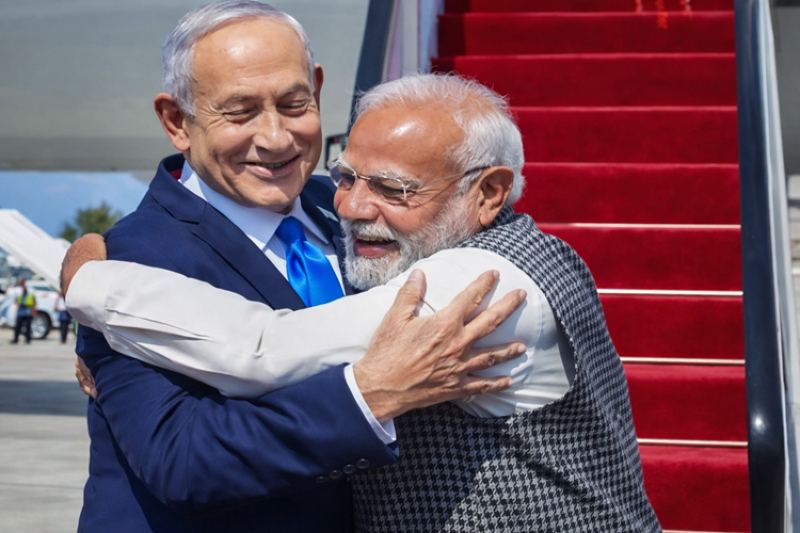
Upon arrival at Ben-Gurion Airport, Modi was welcomed by Netanyahu and held a private meeting before traveling to Jerusalem. He later signed the Knesset Guest Book, emphasizing shared commitments to pluralism, rule of law, and freedom.
As part of the state visit, Modi and Netanyahu are scheduled to visit Yad Vashem, reinforcing historical remembrance as a diplomatic bridge.
Expanded bilateral talks and the signing of new agreements are expected to cover economic cooperation, security coordination, and diplomatic collaboration.
A Broader Geopolitical Context
Modi’s address comes at a time of intensified geopolitical realignment. India is balancing deepening ties with Western partners, strengthening engagement in the Middle East, and managing its long-standing strategic autonomy. Israel, for its part, is seeking reliable global partners amid regional volatility and evolving security challenges.
The visit highlights how India and Israel are positioning their partnership not only as a bilateral relationship but as a strategic axis shaped by innovation, security cooperation, and shared democratic identity.
In a rapidly transforming global order, both governments appear intent on translating political goodwill into long-term geopolitical influence.