
Starmer and Trump Deliberate on Strait of Hormuz Maritime Security
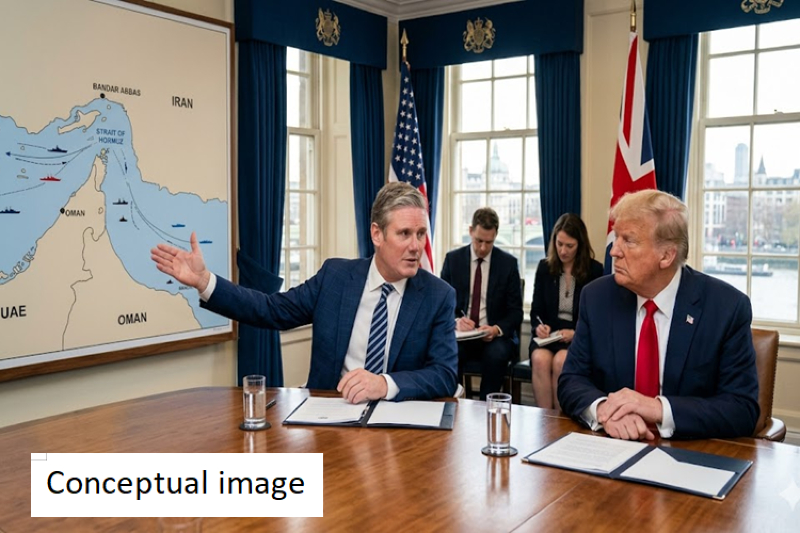
LONDON — British Prime Minister Keir Starmer confirmed on Friday that he and U.S. President Donald Trump have engaged in high-level discussions regarding military strategies to secure the Strait of Hormuz.
The talks, which took place on Thursday, focused on the logistics of ensuring safe passage for commercial vessels through the volatile waterway.
During an official visit to the Gulf region, Starmer emphasized that the UK is spearheading an international coalition dedicated to maintaining regional stability.
"We have been assembling a coalition of nations to work on a political and diplomatic roadmap," Starmer stated. "However, we are also looking closely at military capabilities and the complex logistics of moving vessels through the Strait."
Diplomatic Breakthrough in the UAE
Following his discussions with the U.S. administration, Starmer traveled to Abu Dhabi for a pivotal meeting with UAE President Sheikh Mohamed bin Zayed Al Nahyan.
The outcome of the summit was a shared "integrated framework" for security.
Warning of "Permanent Economic Havoc"
Despite the relief brought by the two-week ceasefire, Starmer delivered a blunt assessment of the financial landscape. He warned that the world should not expect an immediate return to pre-conflict stability.
The Prime Minister suggested that the disruption to the Strait of Hormuz—through which 25% of the world’s seaborne oil passes—has already baked a level of "permanent economic havoc" into global markets.
"While we welcome the pause in hostilities, the damage to investor confidence and the structural shifts in energy shipping are profound," Starmer remarked. He noted that even with a ceasefire, the cost of insurance for maritime trade and the backlog in global logistics could take years to normalize.
Key Discussion Points:
Logistical Framework: Planning the safe movement of cargo ships and tankers.
Military Readiness: Assessing available naval assets from coalition members.
Economic Impact: Addressing the surge in UK fuel prices, which have risen nearly 34% since the conflict's onset.
The NATO Context
The conversation comes at a sensitive time for transatlantic relations. When questioned by reporters on whether he addressed President Trump’s previous suggestions regarding a potential U.S. withdrawal from NATO, Starmer opted for a broader defense of the treaty.
The Prime Minister described the alliance as a cornerstone of global security, asserting that NATO serves the strategic interests of both Europe and the United States.
"NATO is a defensive alliance which, for decades, has kept us much safer than we would otherwise have been," Starmer remarked, though he avoided detailing Trump’s specific stance on the matter.