
Report: US and Israel Accused of Violating International Law in Iranian Conflict
TEHRAN / WASHINGTON — A devastating new analysis has surfaced detailing the human and infrastructural toll of the ongoing conflict in Iran, alleging that the United States and Israel have systematically bypassed established Rules of Engagement (ROE).
According to a report published Thursday by The New York Times, the five-week-old war led by the Trump administration has resulted in the destruction of numerous civilian "safe zones," including schools and hospitals, raising urgent questions about potential war crimes under international law.
Evidence of Infrastructure Damage
The investigation highlights a grim reality on the ground, particularly in densely populated urban centers like Tehran. The findings indicate:
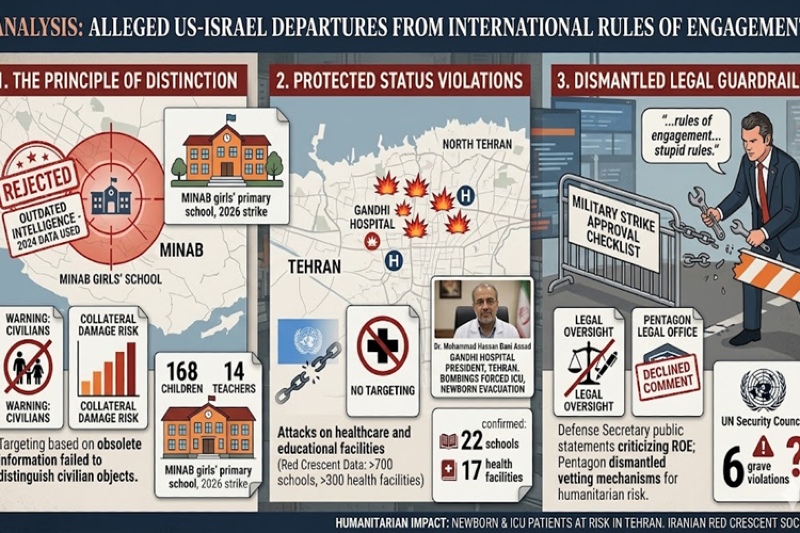
Educational Impact: At least 22 schools have been confirmed damaged.
Healthcare Crisis: 17 medical facilities have been struck by aerial bombardments.
Discrepancy in Data: While the Times report focuses on confirmed instances, the Iranian Red Crescent Society claims the scale is much larger, citing damage to over 700 schools and 300 health facilities as of early April.
The report notes that in many of these strikes, the specific military objective remained "unclear," making it difficult to distinguish between intentional targeting and collateral damage in neighborhoods as crowded as New York City.
Violations of International "Rules of Engagement"
The controversy centers on the abandonment of legal guardrails designed to protect non-combatants. Critics point to several ways the current military strategy has allegedly violated the "Rules of Business" in warfare:
1. The Principle of Distinction
Under international humanitarian law, military forces must always distinguish between combatants and civilians. The strike on a girls’ primary school in Minab, which resulted in the deaths of 168 children, was reportedly the result of "outdated intelligence." Using obsolete data to label a school as a military target is viewed by legal experts as a failure of the "due diligence" required by the ROE.
2. Protection of Special Objects
The UN Security Council identifies attacks on schools and hospitals as one of the six grave violations against children. Schools and hospitals are granted "protected status." Even if a military claim—such as Defense Secretary Pete Hegseth’s assertion that Iran hides rocket launchers in civilian areas—is true, the law requires a high burden of proof and extreme proportionality, neither of which has been evidenced by the Pentagon.
3. Dismantling Legal Oversight
Defense Secretary Hegseth has faced intense scrutiny for publicly criticizing what he termed "stupid rules of engagement." Reports suggest the Pentagon has actively dismantled internal legal mechanisms that typically vet strike coordinates for humanitarian risks. By sidestepping these "legal guardrails," the administration has significantly lowered the threshold for strikes in civilian-heavy zones.
Humanitarian Consequences in Tehran
The impact on the Iranian healthcare system has been catastrophic. Dr. Mohammad Hassan Bani Assad, president of Gandhi Hospital, reported that bombings in close proximity to medical wards forced the evacuation of newborns and ICU patients in critical condition.
As the international community calls for a more transparent inquiry, the US administration maintains that its guidelines are "clear," though the mounting civilian death toll continues to draw condemnation from global human rights monitors and the United Nations.
At a Glance
According to the report you provided, the primary source of the data is an analysis published by The New York Times on Thursday, April 9, 2026.
The reporting was further detailed and summarized by journalist Edith Olmsted for Yahoo News and The New Republic.
Key Entities Involved in the Report:
The New York Times: Conducted the original investigation and satellite/data analysis that identified the specific number of damaged schools (22) and hospitals (17).
The Iranian Red Crescent Society: Provided even higher figures, claiming that as many as 763 schools and 316 healthcare facilities have been impacted as of early April.
The United Nations Security Council: The report frames these findings against the UN's "six grave violations" criteria, which are designed to protect children during armed conflicts.
Just Security: An open letter signed by over 100 international law experts from institutions like Harvard, Yale, and Stanford was also released via this policy journal, corroborating the legal concerns regarding war crimes.
The report specifically attributes the shift in military strategy to Defense Secretary Pete Hegseth, noting his public stance against traditional "rules of engagement," which the analysis suggests led to the targeting of civilian infrastructure in densely populated areas like Tehran and Minab.