
Bipolar Diplomacy: US-Iran Summit Opens in Islamabad as Israel-Lebanon Track Shifts to Washington
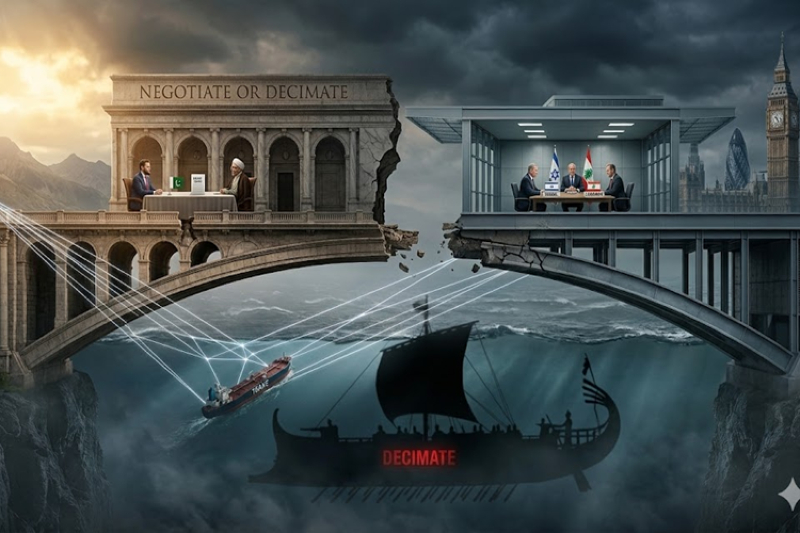
WASHINGTON/ ISLAMABAD — The global diplomatic stage has split into two high-stakes theaters this weekend as U.S. Vice President JD Vance arrived in Pakistan for "make or break" peace talks with Iran, while the White House confirmed that Israel and Lebanon will open a separate direct negotiation track in Washington this coming Tuesday.
In Islamabad, the atmosphere is one of extreme tension. President Donald Trump has issued a final warning, stating that U.S. warships are currently being "loaded up with the best weapons ever made" in preparation for a return to hostilities should the summit fail.
The Islamabad Summit: US and Iran Face Off
Vice President Vance, leading a delegation that includes Jared Kushner and Steve Witkoff, landed in a heavily fortified Islamabad on Friday.
The U.S. Stance: Vance expressed "cautious optimism" but warned Tehran against "playing" the administration.
President Trump took a harder line on Truth Social, asserting that Iran has "no cards" left and that "the only reason they are alive today is to negotiate." Iran’s Preconditions: The Iranian delegation, led by Parliament Speaker Mohammad-Bagher Ghalibaf and Foreign Minister Abbas Araghchi, has insisted on two "non-negotiable" requirements: a total ceasefire in Lebanon and the immediate release of frozen Iranian assets.
The Washington Track: Israel and Lebanon
While the U.S. and Iran focus on the broader regional war and the Strait of Hormuz in Pakistan, a specialized diplomatic effort is moving to the United States.
The Lebanese presidency announced that negotiators will meet an Israeli delegation at the U.S. State Department on Tuesday. This meeting aims to:
Formalize a Ceasefire: Establishing a permanent end to the intense strikes in southern Lebanon.
Direct Negotiations: Setting a concrete date to begin formal peace talks between the two nations for the first time in years.
"Make or Break" for Global Stability
Pakistani Prime Minister Shehbaz Sharif described the Islamabad summit as a defining moment for the Muslim world and global security. The primary driver remains the economic "strait-jacket" caused by the closure of the Strait of Hormuz, which has kept oil prices at record levels.
The Stakes: President Trump suggested the world would know "in about 24 hours" if a long-term deal is possible.
If not, he warned that the U.S. military "reset" is complete, and the newly loaded ships are ready to act "very effectively."
As diplomats in Islamabad exchange messages through Pakistani mediators, the scheduled talks in Washington provide a sliver of hope that the Lebanese theater may finally see a reprieve from the "absurd and inhuman" violence recently condemned by the Vatican.
The U.S. Conditions: Security and Denuclearization
Led by Vice President JD Vance, the American delegation has presented a "15-point proposal" that prioritizes the immediate and permanent reopening of the Strait of Hormuz to restore global oil flow.
Furthermore, Washington is seeking a regional framework that guarantees maritime security and places strict limits on Iran’s ballistic missile capabilities and its support for regional proxy groups.
The Iranian Conditions: Ceasefire and Sovereignty
The Iranian delegation, headed by Parliament Speaker Mohammad-Bagher Ghalibaf, has entered the talks with a "10-point counter-proposal" that views the current truce as insufficient unless it is expanded.
Tehran’s non-negotiable "preconditions" for formal dialogue include an immediate ceasefire in Lebanon—halting all Israeli military operations—and the unfreezing of billions of dollars in Iranian assets currently blocked in foreign banks.
Beyond these immediate demands, Iran is seeking international recognition of its sovereignty over the Strait of Hormuz, the payment of war reparations, and a comprehensive end to U.S. and Israeli "aggression" across Lebanon, Iraq, and Yemen. For Tehran, these measures are essential "security guarantees" that must be implemented before any long-term peace agreement can be finalized.
Global Push: UK Leads 41-Nation Coalition
While the primary talks unfold in Islamabad, a massive UK-led diplomatic offensive is gaining momentum to break the economic "strait-jacket" in the Persian Gulf. British Foreign Office officials are set to lead a critical meeting of 41 nations next week, following a high-level roundtable involving more than 40 foreign ministers.
This coalition is working "very hard" to establish a multilateral mechanism to reopen the Strait of Hormuz, as the current blockade continues to choke international shipping.
Though President Trump noted the U.S. no longer relies on the waterway for energy, the UK-led group is leveraging its "massive diplomatic footprint" to coordinate smaller and mid-level nations in a desperate bid to restore global trade routes and stabilize record-high oil prices.