
Iran Rejects US Peace Proposal, Demands Reparations Amid Escalating Regional Conflict
A high-stakes diplomatic effort to end the burgeoning conflict in the Middle East hit a significant roadblock on Wednesday as Iran officially dismissed a US-led peace proposal.
Describing the terms as "excessive," Tehran countered with its own list of five stringent conditions, even as the Pentagon confirmed the deployment of elite ground troops to the region.
The Stalled Diplomacy
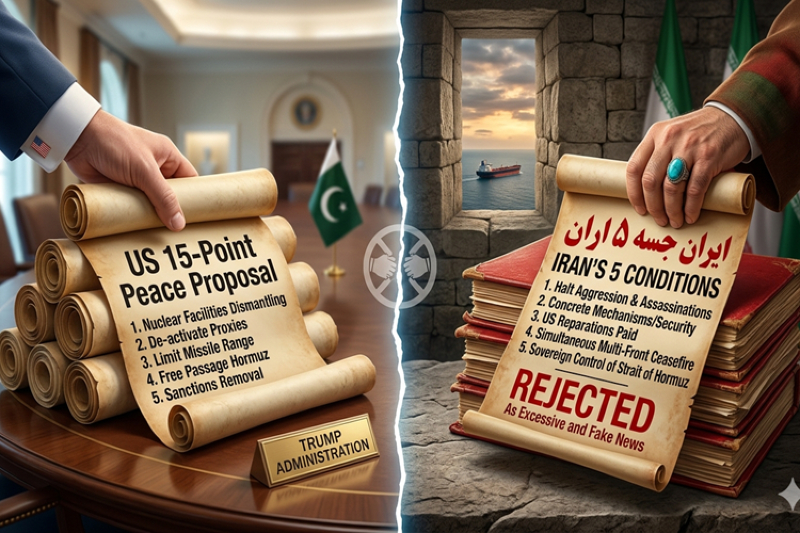
The friction centers on a 15-point proposal delivered by the Trump administration through Pakistani intermediaries.
While the full text remains classified, reports suggest the US plan demands the complete dismantling of Iran’s nuclear infrastructure and a cessation of support for regional proxies. In exchange, Washington offered a comprehensive lifting of economic sanctions.
The Iranian response, broadcast via state media, was a firm "no." A senior security official stated that Tehran would only end hostilities on its own terms, rejecting the idea of a temporary ceasefire in favor of a total conclusion to the war. Iran’s counter-demands include:
A complete halt to all "aggression and assassinations" by US and Israeli forces.
Guaranteed reparations and war damages paid to the Islamic Republic.
International recognition of Iran’s absolute sovereignty over the Strait of Hormuz.
A permanent end to the conflict across all regional fronts involving "resistance groups."
Military Escalation and "Wartime Footing"
Despite President Trump’s claims that his administration is "talking to the right people" who want to "make a deal," the situation on the ground suggests a deepening military commitment.
The Pentagon confirmed that elements of the 82nd Airborne Division and the 1st Brigade Combat Team are being deployed to the Middle East. These units are specialized in rapid entry and sustained combat, providing the US with the capability to seize key territories like Kharg Island.
Simultaneously, Defense Secretary Pete Hegseth announced that the US defense industrial base is being placed on a "wartime footing," accelerating the production of precision missiles and high-altitude interceptor systems (THAAD).
Regional Fallout
The human and economic toll of the conflict continues to mount, with the estimated death toll surpassing 4,500.
Israel: Defense Minister Israel Katz confirmed a new list of targets has been approved, noting that the Israeli Air Force has dropped over 15,000 bombs on Iranian targets since late February.
Gulf States: Iran has expanded its strikes to include Saudi Arabia, Kuwait, and Bahrain, targeting energy infrastructure and airports. Analysts suggest this is a deliberate strategy to weaponize the global oil supply and pressure Arab nations into forcing a US withdrawal.
Iraq: The Iraqi government has announced plans to file a formal complaint with the UN Security Council following US strikes on its territory that killed several fighters linked to the Popular Mobilization Forces.
The Israeli Perspective
In Jerusalem, Israeli Economy Minister Nir Barkat expressed skepticism regarding the peace plan. While calling the proposal "beautiful on paper," he emphasized that Israel’s core objectives—the total elimination of Iran’s nuclear capabilities, missiles, and proxies—remain non-negotiable. "We will accomplish these goals," Barkat told reporters, "with or without a deal."
As both sides remain entrenched, the global community watches the Strait of Hormuz, where Iranian authorities have begun restricting maritime traffic, further threatening the stability of international energy markets.
Based on the latest reports from March 2026, the two sides are operating with fundamentally different "endgame" visions. The US is pushing for a total strategic reset, while Iran is demanding structural changes to the regional military and economic order.
Here is a point-by-point comparison of the competing proposals:
The US 15-Point Proposal
The Trump administration’s plan focuses on "Zeroing Out" Iran’s military and nuclear leverage in exchange for economic integration.
Nuclear Program: Complete dismantling of all nuclear facilities, a total halt to uranium enrichment, and the physical removal of all existing enriched uranium stockpiles from Iranian soil.
Regional Proxies: An immediate end to the funding, arming, and training of the "Axis of Resistance," specifically naming Hezbollah, Hamas, and the Houthis.
Missile Technology: Strict limitations on the range and quantity of Iran’s ballistic missile arsenal, restricting them to "self-defense" only.
Maritime Access: Declaring the Strait of Hormuz a "free international maritime zone" with guaranteed open passage for all global shipping, including US and Israeli vessels.
The "Carrot" (Incentives): In exchange, the US offers full lifting of all primary and secondary sanctions, removal of the UN "snapback" mechanism, and technical assistance for a strictly civilian, light-water nuclear energy project at Bushehr.
Iran’s 5 Conditions
Tehran has labeled the US plan "excessive" and countered with a list of demands that prioritize sovereignty and financial recovery.
Security Guarantees: A complete and "permanent" halt to all Western-led "aggression and assassinations," with concrete international mechanisms to ensure war is not reimposed.
War Reparations: Guaranteed and clearly defined payment of financial reparations by the US and Israel for damages to Iranian infrastructure and civilian life.
Strait of Hormuz Sovereignty: International recognition of Iran’s absolute sovereign right to exercise authority over the Strait, effectively placing it under Iranian legal and economic control.
Regional De-escalation: A total conclusion of the war across all fronts simultaneously—meaning any deal must include a ceasefire for all its regional allies (Hezbollah, PMF, etc.), not just Iran.
US Withdrawal: Several reports indicate a "sixth" implicit condition: the total closure of US military bases across West Asia (the Middle East), which Iran views as a prerequisite for lasting peace.
Comparison Summary
| Feature | US Proposal | Iran's Counter-Demand |
|---|---|---|
| Nuclear | Total dismantling; zero enrichment. | Right to civil nuclear technology. |
| Regional | Abandon all proxies/allies. | Stop all "assassinations" of leaders. |
| Financial | Lift sanctions in exchange for cuts. | Direct payment of war reparations. |
| Maritime | "Free Zone" for all shipping. | Absolute Iranian legal control. |
| Military | Limit missile range/capabilities. | US withdrawal from regional bases. |
Current Status: While President Trump has described the negotiations as being "ahead of schedule," Iranian military officials have publicly mocked the idea of coming to terms, stating they are "negotiating with themselves."
The situation is a deadlock of conflicting narratives.
1. The "Fake News" Stance
Iranian officials, including Parliament Speaker Mohammad Bagher Ghalibaf, have explicitly labeled President Trump’s claims of "productive talks" as fake news.
The Reason: Tehran argues that Washington is using these claims to stabilize global oil markets and manipulate financial sentiment while continuing military strikes.
The Military's View: Lt. Col. Ebrahim Zolfaghari of Iran’s central command recently mocked the US, saying it is "negotiating with itself" and that "people like us will never make a deal with people like you."
2. Why the "Five Conditions" Exist
Even though Iran denies being in active "peace talks," it has issued these five conditions as a public ultimatum.
Pre-conditions for Engagement: Iran is essentially saying, "We aren't talking now, but if you want us to even consider stopping our defensive operations, these five things must happen first."
Messaging through Intermediaries: While there are no direct face-to-face meetings, Pakistan and Oman are acting as messengers.
Iran has delivered these conditions through these third parties to ensure its "red lines" are known without granting the US the political win of a "negotiation."
3. The Trust Deficit
The core reason Iran refuses to call this a "peace process" is a deep lack of trust.
Current View: They see the US 15-point plan not as a peace offer, but as a "surrender document" designed to buy time for the Pentagon to deploy more troops (like the 82nd Airborne) to the region.
Summary of the Impasse
US Position: "We are talking to the right people; a deal is near."
Iran Position: "There are no talks.
We will continue to strike until our five specific conditions—including reparations and control of the Strait—are met."
In short, there is no "peace" yet—only a psychological war of words where both sides are trying to dictate the terms of how the war might eventually end, without actually sitting at the same table.