

Federal Appeals Court Deals Blow to Trump Administration’s Asylum Restrictions
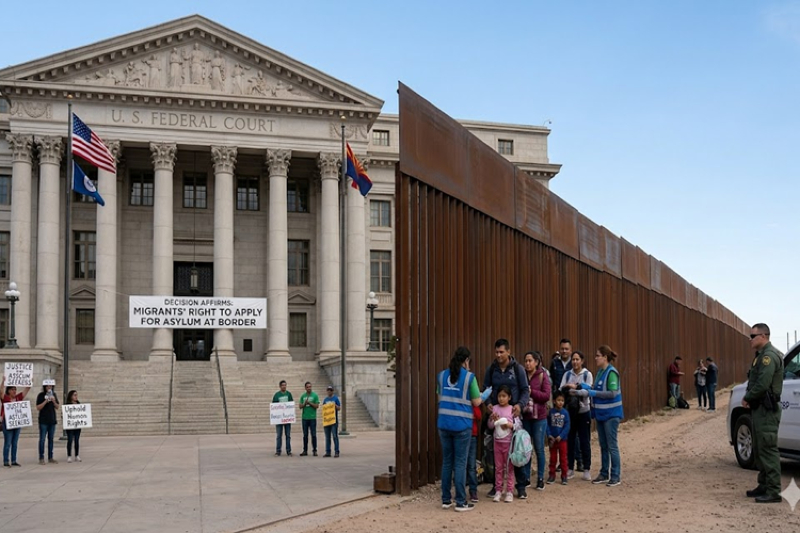
WASHINGTON — A federal appeals court on Friday handed a significant legal defeat to the Trump administration, ruling that an executive order aimed at suspending asylum access for migrants at the southern border is illegal.
The decision, delivered by a three-judge panel of the U.S. Court of Appeals for the District of Columbia Circuit, upholds a previous ruling by a lower court.
The judges concluded that existing U.S. immigration statutes, specifically the Immigration and Nationality Act (INA), grant individuals a clear legal right to seek asylum at the border—a right that the executive branch cannot unilaterally override.
The Legal Ruling
Writing for the majority, Judge J. Michelle Childs stated that the president does not have the authority to bypass mandatory legal processes established by Congress. “The power by proclamation to temporarily suspend the entry of specified foreign individuals... does not contain implicit authority to override the INA’s mandatory process,” Childs noted.
The court emphasized that the administration cannot establish its own removal procedures that strip migrants of their right to apply for asylum or curtail protections designed to prevent the deportation of individuals to countries where they might face torture or persecution.
Reaction and Dissent
The American Civil Liberties Union (ACLU), which has been a primary challenger of the administration’s border policies, lauded the decision. ACLU attorney Lee Gelernt described the ruling as "essential" for protecting those fleeing immediate danger.
While Judge Justin Walker offered a partial dissent, he notably agreed with the majority on a key humanitarian point: the president is legally barred from deporting migrants to nations where they are likely to face persecution. However, Walker suggested that the administration might still possess broader discretion to issue general denials of asylum applications.
Broader Policy Fallout
The ruling comes amid a flurry of legal and political battles over the administration’s immigration strategy. In addition to the asylum ban, reports emerged this week regarding a Department of Justice (DOJ) initiative to ramp up "denaturalization" cases.
The DOJ has reportedly flagged nearly 400 foreign-born Americans to have their citizenship stripped, citing a "White House initiative" to root out naturalization fraud.
Furthermore, internal friction is growing within the Republican Party. A new conservative super PAC, the Homeland Political Action Committee, has begun targeting GOP members of Congress who support bipartisan immigration reform, such as Florida Representative María Elvira Salazar’s "DIGNIDAD Act."
As the 2026 midterms approach, these legal setbacks and internal party divisions highlight the intensifying debate over the future of U.S. border and citizenship policy. The White House has not yet issued a formal response to the appellate court’s ruling.