
Dynastic Opulence Amidst Structural Decay: North Korea’s Great Economic Contradiction
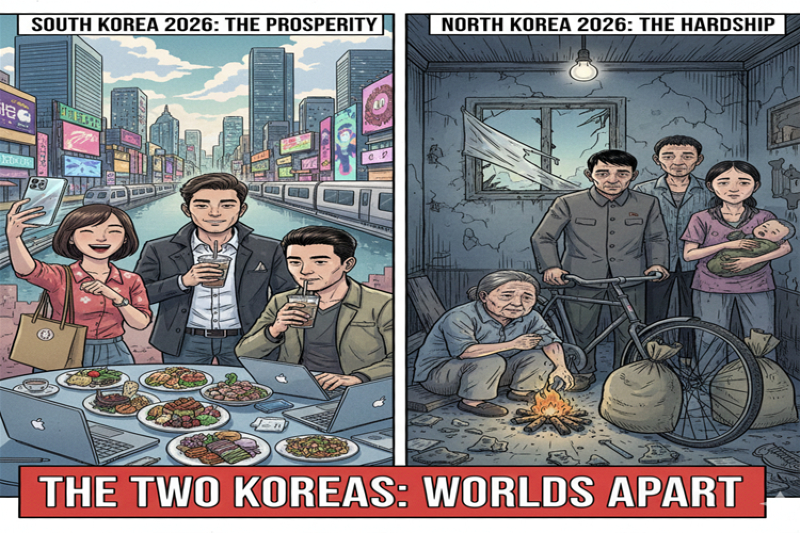
As the Ninth Workers' Party Congress concludes in the North Korean capital, a sharp and disturbing contrast has emerged between the regime's carefully curated "success stories" and the grim reality of a nation teetering on the edge of a systemic collapse.
While Supreme Leader Kim Jong Un uses the global stage to laud a new era of "Regional Development," reports from the interior paint a portrait of deepening inequality, chronic malnutrition, and a leadership increasingly insulated by luxury.
The "20×10" Hype vs. The Plastic Sheet Crisis
To the international community, Kim Jong Un has promoted his "20×10 Regional Development Policy"—a decade-long plan to modernize 20 counties annually. State media is currently saturated with images of the Leader touring pristine machine complexes and newly completed housing blocks.
However, beneath this propaganda veneer, the standard of living for the average North Korean has reached a decade-low.
The Insulation Gap: In the border regions, where winter temperatures plummet, families are reportedly unable to afford even basic plastic sheeting for window insulation.
The Cost of Survival: A square meter of plastic now costs nearly as much as 500 grams of rice—a luxury most households cannot justify as food prices have surged nearly 4.5 times since 2017.
Economic Scapegoating: In a rare admission of internal friction, Kim recently dismissed a Vice Premier over "man-made confusion" at the Ryongsong Machine Complex, a move experts call a calculated attempt to deflect blame for the regime's broader mismanagement onto subordinates.
Luxury in the Forbidden City
While ordinary citizens struggle to secure basic winter necessities, the Kim family continues to flaunt extreme wealth in open defiance of United Nations sanctions.
"While ordinary North Koreans struggled to obtain food and other necessities, Pyongyang expanded censorship and surveillance... and limited market activity," notes Lina Yoon, a senior researcher at Human Rights Watch.
That quote comes from Lina Yoon, the senior Koreas researcher at Human Rights Watch (HRW).
It was featured in the Human Rights Watch World Report 2026, which was released on February 4, 2026.
Context of the Quote
The quote appears in the section of the report titled "North Korea: Unrelenting Repression, Hunger, Inequality." Lina Yoon used this statement to contrast the regime's focus on military spending and high-tech surveillance with the extreme poverty of the general population.
Key Points from the Original Report:
Market Restrictions: The report details how the North Korean government has moved to reimpose state control over the economy by cracking down on the informal markets (jangmadang) that many citizens rely on for survival.
Information Control: It mentions the enforcement of the Reactionary Ideology and Culture Rejection Law, which punishes citizens for accessing foreign media.
Economic Disparity: The quote highlights that while the Kim family and the Pyongyang elite maintain a high standard of living, rural areas face "deepening food insecurity and inequality."
Recent observations of the ruling family highlight this divide:
High-Fashion Diplomacy: Kim's wife, Ri Sol-ju, has been seen carrying Gucci handbags, while his daughter, Kim Ju Ae, has made public appearances in Dior down jackets (valued at nearly $2,000) and Cartier watches encrusted with diamonds.
The "Guiding Star" Ascends: Kim Ju Ae, estimated to be around 13, has moved to the "successor-designate" stage. Her presence at military parades and missile launches—often dressed in tailored silks and furs—is designed to project a narrative of eternal dynastic stability, even as the country's infant mortality and stunting rates remain among the highest in Asia.
The Shadow Economy: Cybercrime and Russian Shells
North Korea's survival is no longer tied to its domestic productivity, which remains strangled by centralized inefficiency. Instead, the regime has pivoted to a "Predatory State" model:
Digital Heists: In 2025 alone, North Korean state-sponsored hackers reportedly stole over $2 billion in cryptocurrency to fund the regime's missile program.
The Russia-Ukraine Pivot: The dispatch of over 10,000 troops and millions of artillery shells to Russia has secured a lifeline of fuel and food for the elite in Pyongyang, though little of this aid is believed to have reached the civilian population.
| Economic Indicator | Status in 2026 | Impact on Populace |
|---|---|---|
| Market Activity | Restricted | Diminished access to non-state food sources |
| Foreign Luxury Imports | Increasing | Wealth concentrated among "Donju" (money masters) |
| Inflation (Rice/Won) | High/Volatile | Deepening food insecurity for the working class |
The Korean Divide: 2026 Statistical Comparison
| Category | North Korea (DPRK) | South Korea (ROK) |
|---|---|---|
| Government | Totalitarian / One-Party State | Liberal Democracy / Multi-Party |
| GDP (PPP) | ~$15 Billion | ~$2.9 Trillion |
| Currency | N. Korean Won (KPW) | S. Korean Won (KRW) |
| Internet Access | < 1% (State Intranet Only) | 97% (Global 5G/6G Leader) |
| Active Military | 1.3 Million (4th Largest) | 550,000 (Tech-Enhanced) |
| Nuclear Status | Yes (Estimated 50–90 Warheads) | No (US Nuclear Umbrella/Deterrence) |
| Life Expectancy | ~70 Years (High Famine Risk) | 84 Years (Global Top 10) |
| Primary Exports | Coal, Weapons, Cyber-Services | Electronics, Cars, K-Culture/Media |
| Human Rights | "Worst in World" (Amnesty Intl.) | Strong Legal Protections |
Conclusion: A Fragile Façade
As the 2026 Congress sets the agenda for the next five years, the "Kim Jong Un style" of governance remains fixed: prioritize the nuclear arsenal, maintain the family's opulent lifestyle, and pass the burden of sanctions onto the most vulnerable citizens.
Without a fundamental shift away from the "Military-First" (Songun) policy, the gap between the regime's hype and the people's hardship is set to become a permanent fixture of the North Korean landscape.
NOTE:
The data provided in the comparison table is synthesized from a variety of reputable international organizations and think tanks that track global economic and social metrics. Because North Korea is a highly opaque state, researchers often use "satellite intelligence," "trade mirror data" (tracking what other countries report importing from/exporting to North Korea), and "econometric modeling" to reach these figures.
Primary Sources for the Comparison:
Human Rights & Government:
Human Rights Watch (HRW): The quote from Lina Yoon and the "Unrelenting Repression" status are from the World Report 2026.
Amnesty International: Provides the basis for the "Worst in the World" human rights ranking.
Economic Data (GDP & Trade):
Bank of Korea (BOK) & KDI: The South Korean central bank and the Korea Development Institute provide the most accurate estimates for North Korean GDP by analyzing industrial activity and weather patterns.
IMF & World Bank: Provide the $2.9 Trillion PPP figure for South Korea, which is one of the world's top 15 economies.
Military & Nuclear Status:
38 North & KIDA: The Korea Institute for Defense Analyses (KIDA) released reports in early 2026 suggesting the North may have between 50–90 warheads based on fissile material production.
SIPRI: The Stockholm International Peace Research Institute tracks global military spending and troop counts.
Social Metrics (Internet & Health):
ITU (International Telecommunication Union): Tracks global internet penetration. The <1% figure for North Korea refers to the "Kwangmyong" intranet, which is isolated from the global web.
United Nations World Population Prospects: Provides the 2026 life expectancy projections ($70$ for the North vs. $84$ for the South).
Reliability Note
While South Korean data is official and audited, North Korean data is always an estimate. For example, the GDP of North Korea is often debated; some organizations like Trading Economics project it slightly higher (~$19$ Billion), while the Bank of Korea often leans more conservatively toward ~$15$ Billion. We use the more conservative figures to reflect the most widely accepted academic consensus.