
Cosmic Close Call: NASA’s Final Verdict on Asteroid 2024 YR4
The mystery surrounding the near-Earth object known as Asteroid 2024 YR4 has finally been laid to rest. After months of tracking and high-stakes observations, NASA and the European Space Agency (ESA) have officially updated the risk assessment for the 2032 flyby.
For space enthusiasts and concerned citizens alike, the news is overwhelmingly positive: the "invisible" threat is no longer a threat at all.
The Discovery: A Brief Moment of Alarm
Asteroid 2024 YR4 was first detected on December 27, 2024, by the ATLAS survey in Chile.
At its peak uncertainty in February 2025, the probability actually climbed to 3.1%, briefly making it the most dangerous asteroid tracked in two decades.
How the James Webb Telescope Saved the Day
The main challenge for astronomers was the object's extreme faintness.
Enter the James Webb Space Telescope (JWST). In a rare application of the telescope's deep-space sensors for planetary defense, an international team used "Director’s Discretionary Time" to hunt the asteroid in February 2026.
The Findings: JWST successfully captured the asteroid, which was reflecting about as much light as an almond at the distance of the Moon.
The Result: The new infrared data allowed NASA’s Center for Near-Earth Object Studies (CNEOS) to refine the orbit with surgical precision.
Key Statistics & 2032 Projections
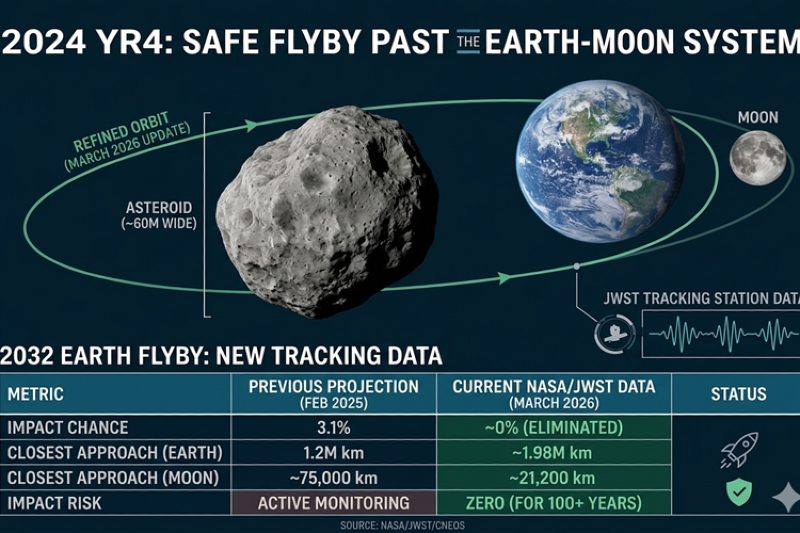
The updated data has eliminated the risk of impact for both Earth and the Moon.
| Metric | Official 2026 Data |
|---|---|
| Impact Probability | 0% (Ruled out for the next century) |
| Lunar Pass Distance | 21,200 km (13,200 miles) |
| Asteroid Size | 60 ± 7 meters (Approx. 15-story building) |
| Energy Potential | 2–30 Megatons of TNT (If it had hit) |
Why Do Projections Change?
It is common for "high-risk" asteroids to be downgraded as more data arrives.
"Think of it as a circle in the sky," says Professor Martin Ward of Durham University. "As our data gets better, the circle becomes smaller. If the Earth is no longer inside that smaller circle, the danger vanishes."
Looking Ahead
While 2024 YR4 is no longer a concern, the mission proved that humanity now has the tools—specifically the JWST and the upcoming Near-Earth Object Surveyor—to spot and track tiny, faint threats years before they become a problem.
As of March 2026, there are no known significant asteroid threats to Earth for the foreseeable future. The planetary defense community will next turn its attention to the famous asteroid Apophis, which is set for an exceptionally close (but safe) flyby in April 2029.