
Congress Challenges War Authority as Trump Defends “Last Best Chance” Strike
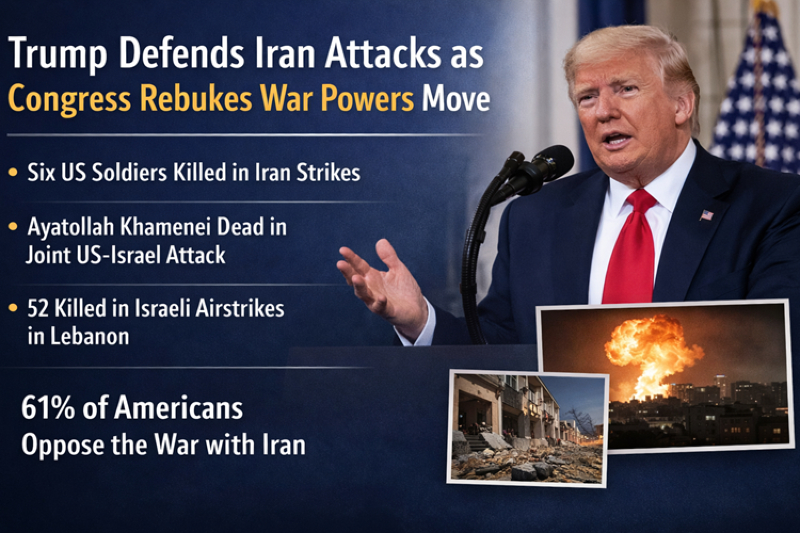
US President Donald Trump said he ordered the strikes because it was the “last, best chance” to stop what he described as an imminent threat from Iran’s regime. Speaking at the White House, he confirmed that more than 1,250 targets have been struck under what the Pentagon has called Operation Epic Fury.
According to US Central Command, targets include Iranian naval vessels, missile systems, air defence networks and command centres linked to the Islamic Revolutionary Guard Corps. Six US service members have been killed and at least 18 seriously wounded since operations began.
US Secretary of State Marco Rubio said the objective is the destruction of Iran’s ballistic missile capabilities and its ability to threaten global shipping. While he stated regime change is not the formal goal, he added the US would welcome political change led by the Iranian people.
Iran confirmed the death of Supreme Leader Ayatollah Ali Khamenei following coordinated US and Israeli strikes — a development that dramatically intensifies the conflict and raises uncertainty over Iran’s leadership and next steps.
Six US Service Members Killed, Central Command Confirms
The US Central Command has confirmed that six American service members have been killed in action since the start of operations against Iran and related regional hostilities.
In its latest statement, Centcom said the remains of two previously unaccounted-for personnel were recovered from a location struck during Iran’s initial retaliatory attacks.
The announcement underscored that “major combat operations continue,” even as families await official notification of the fallen. In addition to the fatalities, dozens of US troops have reportedly been wounded, highlighting the human cost of the widening conflict.
Trump Refuses to Rule Out Ground Intervention
In a significant escalation of rhetoric, the Trump administration has signaled that the current aerial and naval campaign against Iran could expand into a land-based conflict. While the President initially suggested a high-intensity "four to five week" timeline for Operation Epic Fury,
Secretary of State Marco Rubio clarified that the U.S. will not "rule out anything," including the deployment of ground forces to ensure the total destruction of Iran’s ballistic missile and nuclear capabilities.
This shift toward strategic ambiguity comes despite Defense Secretary Pete Hegseth’s assurances that the U.S. seeks to avoid another "endless war."
The possibility of boots on the ground marks a pivot from a purely "regime change from the air" approach to a more comprehensive military strategy, even as internal political pressure from both Democrats and the Republican base grows regarding the legality and long-term costs of such an escalation.
Regional Fallout: Energy, Gulf Tensions and Embassy Evacuations
The conflict has begun to ripple across the Middle East.
Iranian retaliatory strikes were reported on a major gas facility in Qatar. Qatari officials said air defences intercepted two aircraft, seven missiles and five drones. Incidents near the Strait of Hormuz — a key route for roughly 20% of global oil shipments — have increased fears of disruption to global energy supplies.
Oil prices surged sharply, with Brent crude briefly rising above $80 a barrel before easing. Airlines and shipping companies are facing operational disruptions, and global markets have shown signs of volatility.
The US embassy in Jordan has temporarily evacuated personnel following security warnings, highlighting concerns that American diplomatic sites could become targets.
Israel Expands Strikes into Lebanon
Alongside operations in Iran, Israel has launched multiple airstrikes in Lebanon, targeting positions it says are linked to Hezbollah.
Israeli officials say military operations will continue until the threat from Hezbollah is “fully removed.” Lebanon’s health ministry reports that at least 52 people have been killed, and hundreds of residents in Beirut have been forced to evacuate as strikes continue.
The expansion of Israeli military action beyond Iran raises concerns about a broader regional war involving Iran-backed groups across multiple fronts.
Political Division in the West
The military campaign has triggered political debate in Washington and Europe.
Some US lawmakers argue the strikes were launched without proper Congressional approval, invoking the War Powers Resolution. Critics within Trump’s Republican base have also questioned whether the action contradicts past promises to avoid prolonged foreign wars.
UK Prime Minister Keir Starmer said Britain deliberately chose not to participate, stating his government “does not believe in regime change from the skies.” Spain similarly declined to allow its bases to be used for operations related to Iran.
Read more🔗
https://theimpartial24.blogspot.com/2026/03/operation-epic-fury-white-house-defends.html
https://theimpartial24.blogspot.com/2026/03/3-us-military-killed-in-action-during.html