
Xi–Merz Summit in Beijing: US Nuclear Tensions and Japan Security Warnings Overshadow Trade Talks
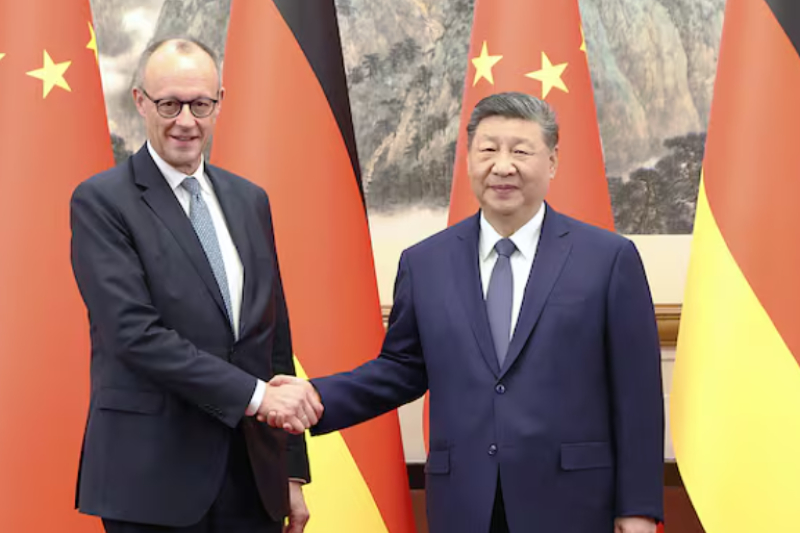
Chinese President Xi Jinping met German Chancellor Friedrich Merz in Beijing on Wednesday, marking the centrepiece of Merz’s inaugural visit to China since taking office. The high-level talks come at a time of widening trade imbalances, rising geopolitical friction and deepening debates within Europe over how to manage relations with Beijing.
According to China’s state news agency Xinhua, the two leaders exchanged views on bilateral cooperation and broader international issues. The meeting signals an effort on both sides to stabilize economic ties even as strategic mistrust grows.
Trade Imbalance Looms Large
While the optics of diplomacy were carefully staged, the economic realities remain stark.
China has once again become Germany’s largest trading partner in 2025. However, German imports from China surged to €170.6 billion last year, while exports to China fell to €81.3 billion — creating a trade deficit of roughly €90 billion.
German industry leaders argue that the imbalance reflects structural distortions, including Chinese industrial subsidies, overcapacity and pricing strategies that undercut European competitors. Key sectors such as automobiles, machinery and chemicals have been particularly affected.
Ahead of the visit, Chancellor Merz said Germany seeks a partnership with China that is “balanced, reliable and fair,” while reaffirming Berlin’s policy of “de-risking” — reducing excessive dependencies without fully decoupling from the Chinese economy.
Beijing’s Strategic Messaging
The meeting took place against a backdrop of assertive messaging from Beijing on multiple fronts.
In a related feature, Xinhua highlighted President Xi’s emphasis on pursuing a high-quality development path tailored to China’s national conditions — a narrative reinforcing Beijing’s confidence in its economic model despite global headwinds.
Separately, a spokesperson for China’s Foreign Ministry urged the international community to firmly reject what was described as reckless moves linked to Japanese neo-militarism, reflecting heightened sensitivities in East Asian security dynamics.
China also called on the United States to stop seeking what it termed pretexts for resuming nuclear tests, underscoring Beijing’s stance on global strategic stability and non-proliferation.
Together, these signals frame the Xi–Merz meeting within a broader geopolitical narrative: China positioning itself as a defender of its development path while warning against security escalations in both Asia and the wider international arena.
Europe Between Washington and Beijing
Merz’s visit comes as Europe navigates economic turbulence and shifting alliances. With US President Donald Trump pursuing tariff-heavy trade policies, Berlin faces mounting pressure from both Washington and Beijing.
Analysts say Europe is reluctant to enter a two-front trade confrontation with the world’s two largest economies. Yet concerns are mounting that Chinese industrial overcapacity and export-driven growth are hollowing out parts of Europe’s manufacturing base.
Germany’s powerful car industry — long a symbol of its economic strength — is under strain amid the global transition to electric vehicles, a sector where Chinese firms have gained a significant edge.
Rare Earths and Strategic Vulnerabilities
Beyond trade figures, strategic dependencies are also under scrutiny.
Germany and the broader European Union rely heavily on China for rare earth elements and critical raw materials essential for high-tech manufacturing, renewable energy and defense systems. Recent export controls by Beijing have heightened concerns about supply chain resilience.
Berlin’s de-risking strategy aims to gradually diversify sourcing while maintaining economic engagement. However, industry leaders warn that such transitions will take years — time that struggling manufacturers may not have.
Diplomatic Optics, Limited Expectations
Merz’s delegation includes senior executives from major German companies, reflecting Berlin’s desire to preserve market access even amid tensions. His itinerary reportedly includes meetings with Chinese Premier Li Qiang, corporate visits and cultural engagements.
Few observers expect sweeping agreements. Instead, the focus is on managing friction, conveying concerns behind closed doors and testing whether both sides can recalibrate relations without escalation.
Background: Germany’s “China Shock”
For years, Germany championed the policy of “change through trade,” deepening economic ties with Beijing in the belief that engagement would foster mutual stability. Former Chancellor Angela Merkel expanded commercial cooperation significantly, often prioritizing economic interests.
However, since the pandemic and Russia’s invasion of Ukraine, the trade relationship has flipped dramatically. Germany now faces a record deficit with China, and manufacturing job losses have accelerated, with industry groups warning of structural deindustrialization.
Business associations have urged Berlin to confront what they describe as distorted competition, including state-backed “zombie companies,” aggressive pricing and export restrictions on critical materials.
At the same time, China’s slowing domestic demand has increased its reliance on export markets such as the European Union — a dynamic some policymakers believe gives Brussels leverage, if it chooses to use it.
The Bigger Picture
The Xi–Merz meeting underscores a defining challenge for Europe’s largest economy: how to balance economic necessity with strategic caution in an increasingly polarized global order.
As China promotes its development model and signals firmness on security issues, and as transatlantic trade tensions simmer, Germany finds itself recalibrating a relationship that once powered its industrial rise but now presents complex risks.
Whether this inaugural visit marks the beginning of a new equilibrium — or simply a pause in mounting tensions — remains to be seen.