
US Military Faces “Extreme Danger” in High-Stakes Search for Missing Airmen in Iran
WASHINGTON / TEHRAN — The United States military is currently navigating a “very dangerous phase” in one of the most sensitive combat search and rescue (CSAR) missions in modern history.
Following the downing of an F-15E Strike Eagle and an A-10 Warthog over the past 24 hours, the Pentagon is racing against a “ticking clock” to locate two missing service members amidst intense Iranian hostility.
According to reports from Al Jazeera, the operation has already seen direct combat between rescue assets and Iranian forces.
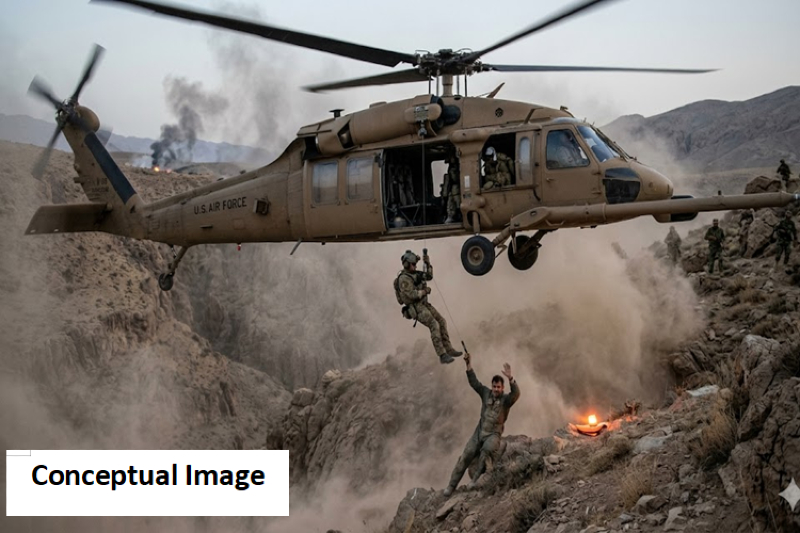
Multiple US officials, speaking on the condition of anonymity, confirmed that two UH-60 Black Hawk helicopters mobilized for the rescue effort were struck by Iranian fire.
Unprecedented Operational Hurdles
Military analysts and sources close to the operation have detailed several factors that make this mission uniquely difficult compared to previous theaters:
Hostile Air Defense Environment: Despite US efforts to neutralize Iranian capabilities, CSAR teams are facing persistent threats from advanced air defense systems and small-arms fire.
The downing of the jets itself—attributed by Tehran to new defense technologies—suggests that rescuers cannot rely on total aerial superiority. The Ground "Manhunt": Iranian state media has reportedly announced rewards for the capture of US pilots, triggering what officials describe as a "massive manhunt" by both regular military and local paramilitary groups.
This complicates the "Golden Hour" of rescue, as every minute increases the likelihood of the airmen being intercepted by ground forces. Communication Silos: The Pentagon has maintained a strict "radio silence" regarding the exact location of the missing crew.
While one pilot from the F-15E and the pilot of the A-10 (who ejected over Kuwaiti airspace) are safe, the status of the remaining two crew members is officially listed as "unknown," a term used when the Department of Defense cannot confirm a person's whereabouts.
A Sensitive Military Reality
President Donald Trump, who remained in Washington to monitor the crisis, described the situation simply as "a war," while refusing to elaborate on the specifics of the search.
He expressed visible frustration with the media's coverage of the "intense and sensitive" rescue operation, citing the risk that public information could inadvertently aid Iranian search parties.
As the US enters day 35 of the conflict, the mission has become a test of the military’s elite rescue capabilities. The "Golden Hour" has long since passed, and the operation has now transitioned into a high-risk extraction mission where the primary obstacle is no longer just the terrain, but an adversary that is actively hunting the same targets as the American rescue teams.