
US Military Dominance Questioned After Warplanes Downed Over Iran
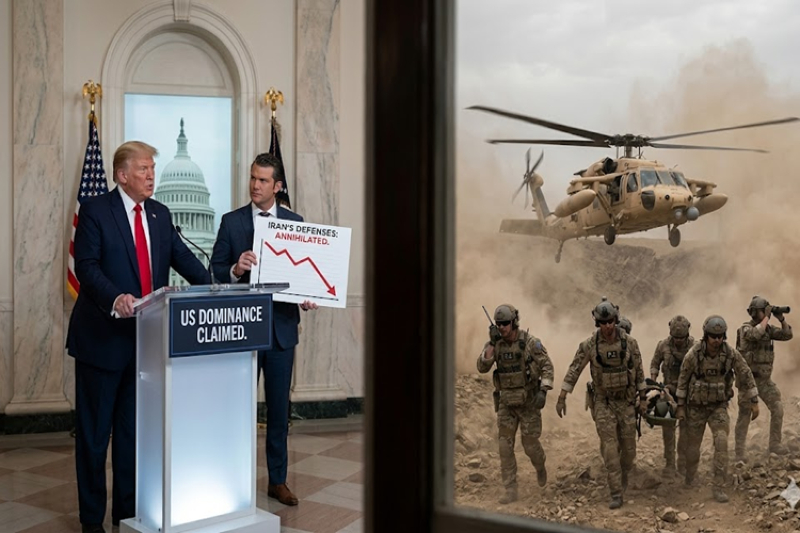
WASHINGTON / TEHRAN — The narrative of total American air supremacy over Iran is facing its most significant challenge yet following the downing of multiple U.S. aircraft. For weeks, President Donald Trump and Defense Secretary Pete Hegseth have maintained that Iranian anti-aircraft capabilities were "annihilated," but recent events on the battlefield suggest a more resilient and adapting adversary.
According to a report by ABC News, this official account of a "defenseless" Iran came into sharp focus Friday when an F-15E Strike Eagle was brought down over Iranian territory. The incident was followed by reports of two Black Hawk rescue helicopters taking incoming fire and an A-10 Warthog crashing in a neighboring allied country after being struck during a separate mission.
Rhetoric vs. Reality on the Battlefield
The losses contrast sharply with the confident briefings provided by the White House and the Pentagon throughout the five-week conflict. Just days ago, during a primetime address, President Trump claimed that Iran's radar was "100% annihilated" and their air force was "in ruins."
Secretary Hegseth had echoed these sentiments, previously asserting that the U.S. and Israel held "complete control" of Iranian skies, allowing American forces to fly "uncontested" over Tehran. Hegseth famously described the rare Iranian successes as "squirters"—isolated incidents that managed to slip through otherwise impenetrable American defenses.
A Shifting Tactical Landscape
While the administration has focused on the massive degradation of Iranian hardware—claiming missile and drone volumes are down by over 90%—military officials on the ground have offered a more nuanced view. General Dan Caine, Chairman of the Joint Chiefs, has characterized Iran as a "determined enemy" that is actively adapting even as its traditional infrastructure is destroyed.
The downing of a nimble, fast-moving F-15E—a jet far more difficult to hit than the heavy bombers Trump recently suggested could fly over Iran without concern—indicates that Iran may have re-developed or hidden mobile defense systems that bypassed initial intelligence sweeps.
Political and Strategic Implications
As the war enters its sixth week, the discrepancy between Washington's "unstoppable" rhetoric and the reality of American boots on the ground (and pilots in the air) facing lethal fire is creating a "headache" for the administration.
The Missing Airman: The ongoing search for a missing F-15E weapon systems officer has become a focal point of the conflict, with Iran offering bounties for their capture.
Domestic Pressure: With 13 service members killed and 365 wounded to date, the American public is increasingly scrutinizing the "coherent argument" for the war’s continuation.
While the White House maintains that the U.S. will "finish the job" soon, the recent loss of advanced aircraft proves that the Iranian "defensive industrial base" may be more sophisticated—and more dangerous—than previously touted.
The Great Disconnect: Rhetoric vs. Reality in the War on Iran
The recent downing of U.S. aircraft has created a stark contrast between the official narrative from Washington and the tactical reality on the ground in Iran. Below is a breakdown of the assertions made by President Trump and Secretary of Defense Pete Hegseth versus the events reported by ABC News and military officials.
| Feature | Trump & Hegseth’s Assertion | The Reality on the Ground |
|---|---|---|
| Air Defense Capability | "They have no anti-aircraft equipment. Their radar is 100% annihilated." (Trump, April 1) | Multiple Hits: An F-15E was downed, and two Black Hawk rescue helicopters were struck by incoming fire while searching for the crew. |
| Airspace Control | "Complete control of Iranian skies... fly all day, all night, day and night... uncontested." (Hegseth, March 4) | Contested Skies: An A-10 Warthog was hit in a separate incident and crashed in a neighboring allied country. |
| Iran's Military Status | "Their air force is in ruins... their ability to launch missiles and drones is dramatically curtailed." (Trump, April 1) | Lethal Success: Despite losses, Iran successfully targeted a "nimble, fast-moving" fighter jet—a feat rarely achieved against U.S. forces. |
| Threat Level | "We are just floating over the top looking for whatever we want, and we're hitting it." (Trump, March 30) | Deep Danger: Elite Combat Search and Rescue (CSAR) units are facing "extreme danger" and "harrowing" conditions to retrieve missing personnel. |
| Enemy Adaptation | "They don't have any spotters... their leaders have all been killed at every level." (Trump, March 23) | A "Determined Enemy": Gen. Dan Caine noted that Iran is "adapting" and remains a capable adversary despite infrastructure damage. |
| Frequency of Failure | Occasional "squirters" (isolated missiles) might slip through. (Hegseth, March) | Systemic Risk: The loss of multiple high-value air assets in a 24-hour window suggests a more organized defensive capability. |
Key Takeaway
While the Trump administration has focused on the "obliteration" of Iranian hardware (stating missile volume is down 90%), the reality of the missing F-15E crew member and the bounty offered by Tehran proves that Iran retains the capacity to create significant military and political "headaches" for the United States as the war enters its sixth week.
Get Details: The political fallout of the search for the missing airman