

US Congress Extends Validity of Law Permitting Surveillance of Foreign Nationals
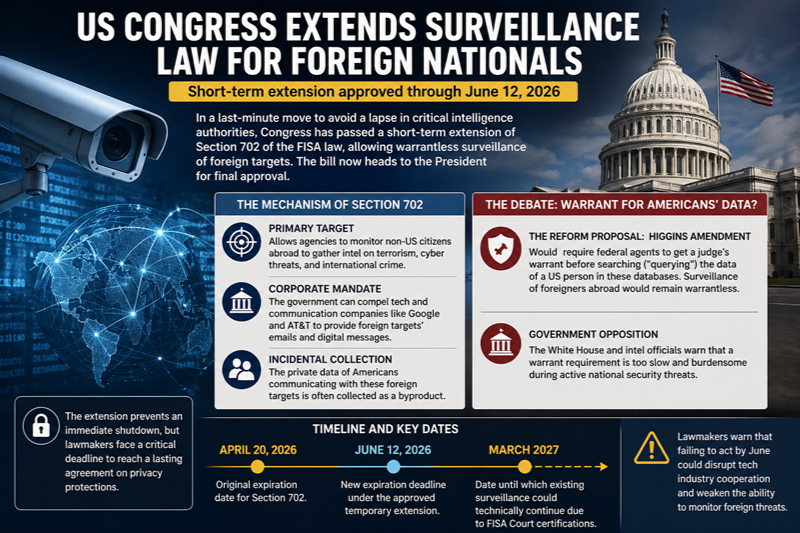
WASHINGTON — In a move to prevent a lapse in national security capabilities, the US Congress has passed a short-term extension of a critical intelligence-gathering provision that allows for the warrantless surveillance of foreign targets.
The temporary patch, which maintains the program through June 12, 2026, was approved just hours before existing authorities were set to expire. The bill now moves to the President for final approval, buying lawmakers additional time to debate significant reforms regarding how the data of Americans is handled during these foreign operations.
The Mechanism of Section 702
At the heart of the extension is Section 702 of the Foreign Intelligence Surveillance Act (FISA), a tool designed to track threats outside of United States borders.
Primary Target: The law allows intelligence agencies to monitor non-US citizens located abroad to gather intelligence on terrorism, cyber threats, and international crime.
Corporate Mandate: Under this authority, the government can compel major technology and communication providers—including Google and AT&T—to provide emails and digital messages belonging to these foreign targets.
Incidental Collection: Because global communications are interconnected, the private data of Americans communicating with these foreign targets is often captured as a byproduct, a process known as "incidental collection".
The Debate Over a Warrant Requirement
While the program targets foreigners, a bipartisan group of lawmakers argues that the current system lacks sufficient protections for Americans whose data is swept into government databases.
The Reform Proposal: The proposed Higgins Amendment seeks to establish a new legal shield. While surveillance of foreigners would remain warrantless, federal agents would—in many cases—be required to obtain a warrant from a judge before searching for or "querying" the data of a US person within those databases.
Government Opposition: The White House and senior intelligence officials have pushed for a "clean" reauthorization without these restrictions. They contend that requiring a warrant to access already-collected data would be too slow and burdensome during active national security threats.
Timeline and Security Risks
The extension to June 12 prevents an immediate shutdown of the program, but the path toward a permanent solution remains uncertain.
| Date | Significance |
|---|---|
| April 20, 2026 | Original expiration date for Section 702. |
| June 12, 2026 | New expiration deadline under the approved temporary extension. |
| March 2027 | Date until which existing surveillance could technically continue due to FISA Court certifications. |
Lawmakers warn that if a compromise is not reached by the new June deadline, the legal uncertainty could hinder the ability of tech companies to cooperate, potentially creating a gap in the monitoring of foreign threats.