
U.S. House of Representatives Passes Bill to End Historic 76-Day DHS Shutdown
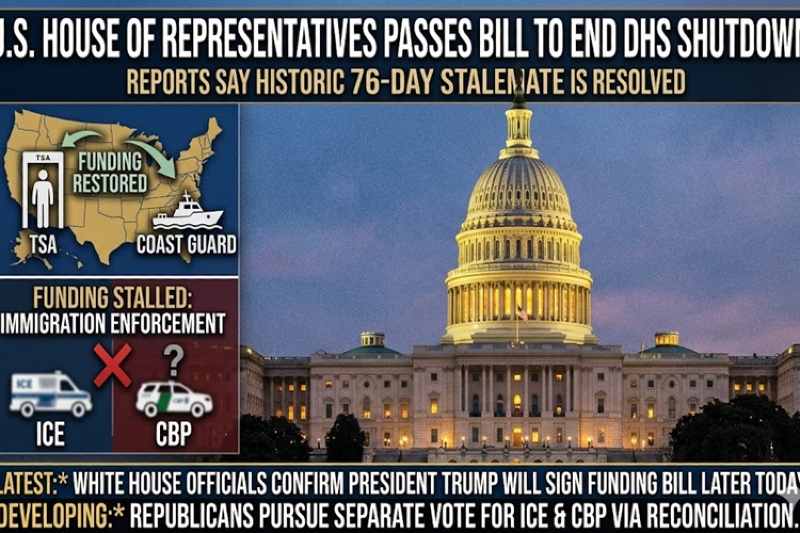
WASHINGTON — The United States House of Representatives (the lower chamber of the U.S. Congress) moved on Thursday to end the longest partial Department of Homeland Security (DHS) shutdown in American history.
By passing a funding measure previously approved by the Senate, lawmakers have cleared the final legislative hurdle to restore operations for the third-largest department in the federal government.
The bill now heads to the White House for the signature of President Donald Trump. According to administration officials, the President is expected to sign the legislation later today, effectively ending the 76-day stalemate.
Understanding the U.S. Legislative Process
For international readers, the U.S. legislative branch is divided into two parts: the House of Representatives and the Senate.
For a bill to become law, both chambers must approve the exact same text before it is sent to the President.
In this instance, the Senate had already passed this funding package in late March. The shutdown continued because leaders in the House of Representatives had delayed a vote until they could reach an internal agreement on how to handle immigration enforcement funding.
What the Bill Restores
The approved package provides immediate funding for several critical security agencies, ensuring that employees who have been working without pay will now receive their checks. These agencies include:
TSA (Transportation Security Administration): Responsible for airport security screening.
The U.S. Coast Guard: Tasked with maritime safety and border patrol at sea.
The Secret Service: Providing protection for national leaders.
FEMA (Federal Emergency Management Agency): Managing the response to natural disasters.
CISA (Cybersecurity and Infrastructure Security Agency): Defending against digital threats.
"This will relieve pressure from the Department of Homeland Security," said House Speaker Mike Johnson. "We're not going to have lines at TSA. Everybody will get their paychecks now."
The Funding Split: ICE and CBP
While the bill restores most DHS operations, it notably excludes funding for two high-profile agencies:
ICE (Immigration and Customs Enforcement)
CBP (Customs and Border Protection)
The decision to separate these agencies comes amid a fierce political battle over immigration tactics.
Following a controversial incident in Minneapolis where federal agents fatally shot two U.S. citizens during an immigration operation, Democrats refused to fund these agencies without significant operational reforms.
To bypass this opposition, House Republicans are pursuing a "reconciliation" strategy—a specific legislative process that allows them to pass a separate budget bill for ICE and CBP with only a simple majority, rather than the usual bipartisan support required in the Senate.
Deadlines Ahead
President Trump has set a firm June 1 deadline for Congress to finalize the remaining funding for immigration enforcement.
While the broader DHS shutdown has ended, the debate over the future of U.S. border and immigration policy remains the primary flashpoint in Washington.