
Tel Aviv Anti-War Protest Met With Force Following High Court Ruling
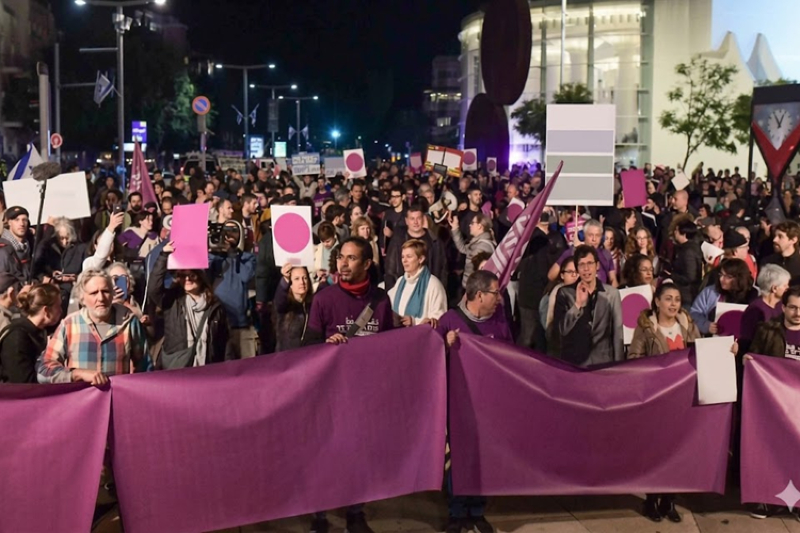
TEL AVIV — Clashes erupted in Tel Aviv on Saturday night as police moved to violently disperse an anti-war rally at Habima Square. The confrontation followed a landmark High Court of Justice ruling that had temporarily eased attendance restrictions despite ongoing military concerns over missile threats.
Police arrested 17 demonstrators, including activist leader Alon Lee Green, after declaring the gathering illegal. Authorities claimed the crowd had surpassed the court-mandated limit of 600 participants.
Legal Tension and Religious Backlash
The protest took place under a cloud of legal and religious controversy. Hours earlier, the High Court issued an interim order allowing larger crowds than those permitted by the IDF Home Front Command. The judges argued that police were enforcing safety regulations selectively, noting that malls and religious sites remained open while political demonstrations were being stifled.
The decision drew a sharp rebuke from Sephardic Chief Rabbi David Yosef, who labeled the High Court an "enemy of Judaism." Yosef expressed outrage that the court held a session on Shabbat to facilitate a protest against the government during wartime.
Sheltering During Missile Strikes
The volatility of the night intensified when sirens signaled an incoming ballistic missile attack from Houthi rebels in Yemen. While most protesters sought refuge in the square's underground parking garage, those already in police custody claimed they were denied proper protection.
Detainees reported being held in a room with large glass windows and doors, which they argued offered no defense against potential blasts.
Police Stance: Officials stated they moved the detainees to a "safer area" due to extreme overcrowding at the main shelter entrances.
Activists' Claim: Detained protesters filmed the glass-walled room, accusing officers of reckless endangerment.
Public Sentiment Divided
The rally highlighted deep domestic fractures regarding the conflict with Iran. Protesters, some dressed in prison jumpsuits to mock government ministers, accused the coalition of prolonging the war for political gain.
Statistical data reflects a stark divide in public opinion:
Jewish Israelis: Approximately 78% support the ongoing military campaign against the Islamic Republic.
Arab Israelis: A large majority remains opposed to the war.
Iran Strikes Central Israel with Cluster Munitions; IAF Retaliates
As civil unrest unfolded in the streets, the military conflict escalated as Iran launched several salvos of ballistic missiles at the Israeli heartland on Saturday.
Damage and Casualties
The strikes, which included the use of cluster bomb warheads, impacted over a dozen sites.
Ramat Gan: A building partially collapsed following a direct hit.
Rosh Ha’ayin: Damage to high-voltage power lines resulted in widespread blackouts.
Injuries: At least six people were reported wounded, mostly by flying glass and debris.
The Israeli Response
The Israeli Air Force (IAF) launched a massive retaliatory wave, targeting Iranian infrastructure. Significant strikes were reported at:
A major petrochemical facility.
A cement production plant.
The perimeter of the Bushehr nuclear power plant.
Meanwhile, a search and rescue operation is underway for an American pilot whose aircraft was downed by Iranian forces. Tehran has reportedly offered a bounty for the pilot’s capture, while U.S. and allied forces continue a frantic search in the region.