
Report: CIA Plans to Arm Kurdish Forces to Spur Uprising in Iran, as Trump Holds Talks with Iraqi Leaders
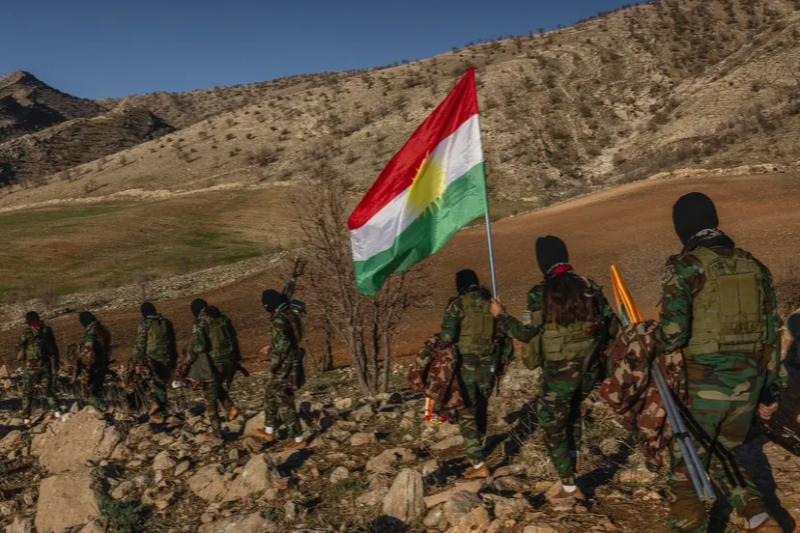
The United States is weighing expanded support for Kurdish armed groups as part of broader efforts to increase pressure on Iran, according to multiple sources familiar with discussions inside Washington and the region.
Officials and regional sources say the CIA has been engaged in conversations with Iraqi Kurdish leaders and Iranian Kurdish opposition figures about the possibility of providing assistance that could enable coordinated action along Iran’s western border. The discussions reportedly began months before the current escalation in hostilities.
Iranian Kurdish armed factions operate primarily in Iraq’s semi-autonomous Kurdistan Region near the Iran-Iraq frontier.
In recent days, several of these groups have issued statements suggesting that developments inside Iran may create an opportunity for renewed resistance activity.
Iran’s Islamic Revolutionary Guard Corps (IRGC) has responded with drone strikes targeting Kurdish positions, saying it acted against armed elements near the border.
Trump’s Outreach to Kurdish Leaders
Amid rising tensions, President Donald Trump held phone calls Sunday with two of Iraq’s most influential Kurdish leaders—Masoud Barzani of the Kurdistan Democratic Party (KDP) and Bafel Talabani, head of the Patriotic Union of Kurdistan (PUK).
According to regional officials, the discussions focused on the evolving US-Israel confrontation with Iran and potential coordination as the situation develops.
The Kurdistan Region of Iraq, which borders Iran and hosts US forces, plays a strategically sensitive role in regional security calculations.
Kurdish Peshmerga forces are widely regarded as among the most organized armed groups in Iraq and were key partners of the United States during the fight against ISIS.
Sources familiar with the contacts say any effort to facilitate support for Iranian Kurdish groups would require cooperation from Iraqi Kurdish authorities, particularly for logistical transit.
One senior Kurdistan Regional Government official described the situation as “extremely delicate,” citing fears of retaliation and regional instability.
Possible Objectives and Risks
People briefed on the discussions say one idea under consideration is whether Kurdish forces could engage Iranian security units along border areas, potentially stretching Tehran’s resources.
Others suggest the goal would be to create conditions that reduce pressure on civilian protest movements inside major Iranian cities.
However, US defense officials have publicly downplayed the notion that American strategy hinges on arming a specific group.
Defense Secretary Pete Hegseth told reporters that US objectives are not dependent on supporting “any particular force,” while declining to address intelligence matters directly. The CIA has not commented.
Analysts note that Kurdish opposition factions in Iran are fragmented and have historically faced internal divisions.
US intelligence assessments have long indicated that, on their own, Iranian Kurdish groups lack the capacity to significantly alter the balance of power inside Iran without sustained external backing.
Former US officials have cautioned that such a move could carry serious consequences. Some warn that empowering armed groups might undermine Iraqi sovereignty or complicate relations with Baghdad, which has reiterated it will not allow its territory to be used for cross-border attacks.
Tehran Signals Concern
Iranian authorities have publicly expressed alarm over what they describe as “terrorist movements” near the Iraqi border.
Foreign Minister Abbas Araghchi recently held a phone call with Bafel Talabani, emphasizing the need for closer security coordination between Tehran and Iraqi Kurdish authorities.
The warning came after reported strikes on facilities linked to Iranian Kurdish opposition groups in northern Iraq.
Regional observers say the timing suggests Tehran is closely monitoring diplomatic contacts between Kurdish leaders and Washington.
A Complicated History
The United States has maintained a long, complex relationship with Kurdish forces across Iraq and Syria, particularly in counterterrorism campaigns.
While Kurdish fighters have often partnered with Washington, some Kurdish officials privately express concern about the reliability of US commitments over the long term.
“There is strong opposition among many Kurds to Iran’s current leadership,” one regional official said. “But there is also fear of being left exposed if circumstances change.”
As tensions between Washington and Tehran intensify, the role of Kurdish forces—both inside Iraq and across the border in Iran—appears increasingly central to regional calculations.
Whether the discussions translate into concrete action remains uncertain, but diplomatic and security contacts are expected to continue in the coming days.
Read more🔗
https://theimpartial24.blogspot.com/2026/03/report-cia-considering-support-for.html
https://thereporter24.com/news/inside-the-shadows-how-cia-mossad-intelligence-led-to-the-strike-on-khamenei
War Intensifies Across Region
US and Israeli forces continue large-scale bombardment of Iran and Lebanon, with strikes reported in Tehran, Qom and Beirut as the death toll surpasses 1,045.
US Senate to Vote on Iran War Powers
The US Senate is set to vote on a resolution to limit President Donald Trump's authority to continue military action in Iran without congressional approval, amid escalating conflict in the region.
Iran Expands Retaliation
Tehran launches drone and missile attacks for a fourth consecutive night, targeting US facilities in Dubai, Qatar, Iraq and Kuwait.
Lebanon Front Escalates
Israeli airstrikes hit Beirut’s suburbs and eastern Lebanon, including Hazmieh and Baalbek, while evacuation warnings spread across the south.
Gulf Tensions Rise
Missiles and drones intercepted over Saudi Arabia and the UAE; shipping risks increase amid threats surrounding the Strait of Hormuz.
Regional Military Mobilisation
US confirms major troop and naval deployment; France deploys Rafale jets over the UAE; Israel redeploys reserve forces near the Lebanon border.
Iranian Warship Sinks Near Sri Lanka
An Iranian naval vessel, identified as IRIS Dena, has reportedly sunk off the coast of Sri Lanka following what was described as a submarine attack. Sri Lankan authorities said 32 crew members were rescued, while several bodies were recovered during ongoing search operations.
Political Fallout Grows
Democrats criticise President Trump’s justification for the strikes; Canada and Spain question the legality of the military actions.
Global Economic Shockwaves
Asian markets tumble sharply, with Seoul recording its largest single-day drop amid fears of oil supply disruption.
Russia & China React
Moscow and Beijing raise diplomatic objections, calling for restraint and warning of wider regional destabilisation.
Canada Questions Strike Legality
Canada’s Prime Minister said the US-Israeli strikes on Iran appear inconsistent with international law, noting that military actions should comply with global legal standards and diplomatic principles.
Spain Opposes War Expansion
Spain’s prime minister reiterated his opposition to the conflict, saying that the Spanish government supports peace while warning that further escalation could destabilise global security and trade. Trump has also vowed to sever diplomatic ties with Spain.
Espionage Arrests in Israel
Israeli police announce the arrest of seven suspects accused of spying for Iran and gathering sensitive military information.
Iran Mourns School Victims
Iran is observing nationwide mourning after a reported strike on a girls’ primary school in Minab, southern Iran, where around 165 schoolgirls and staff were said to have been killed. Thousands have gathered for funeral ceremonies as communities grieve the young victims.
Future Leadership Speculation
Mojtaba Khamenei is reported to have survived the recent strikes, and some international assessments consider him a possible figure in Iran’s future political leadership despite holding no official government post.
Israeli Defence Stance Hardens
Israel’s defence leadership has stated that the military will pursue any future Iranian leader succeeding the current political authority, signalling continued strategic pressure.
ASEAN Expresses Serious Concern
The Association of Southeast Asian Nations has expressed serious concern over the expanding Middle East conflict and urged all parties to respect international law. ASEAN warned that the US-Israeli attacks and counterattacks across the Gulf region heighten civilian risk and threaten global peace and stability.
Missile and Drone Interceptions Reported
Turkey’s defence ministry said NATO air defence systems intercepted an Iranian missile approaching its airspace. Saudi Arabia also reported a drone attempt targeting a major oil refinery, though officials confirmed no damage was recorded.