
Pyongyang Shifts Strategy: North Korea Distances from Tehran to Court Washington
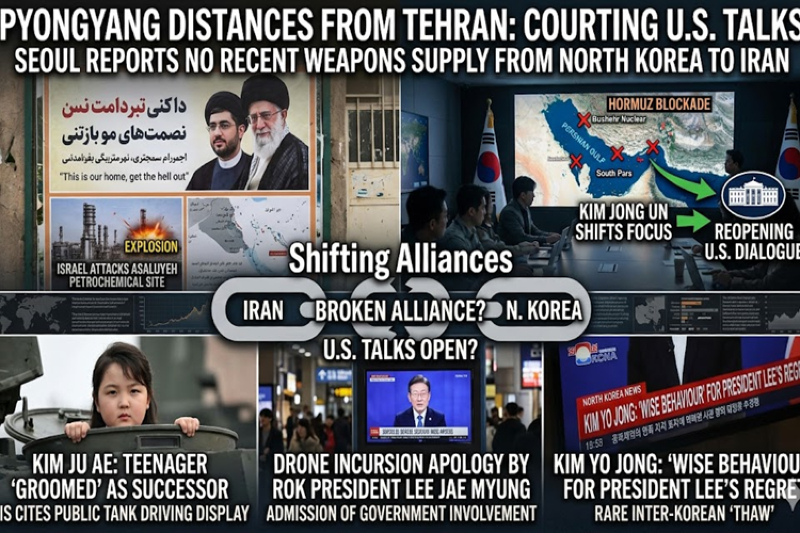
SEOUL – In a significant shift in Cold War-era alliances, South Korean intelligence reports that North Korea is intentionally distancing itself from its long-time military partner, Iran.
The move is viewed by analysts as a strategic calculation by Kim Jong Un to pave the way for a diplomatic "new chapter" with the United States.
A Calculated Silence
According to a closed-door briefing by Seoul’s National Intelligence Service (NIS), there are currently no signs that Pyongyang has provided weapons or military hardware to Tehran since the outbreak of the U.S.-Israel-Iran conflict in late February.
This absence of military support marks a departure from decades of cooperation on missile technology. The NIS highlighted several key indicators of this diplomatic cooling:
Toned-down Rhetoric: While China and Russia have issued frequent, fiery condemnations of the war, North Korea’s Foreign Ministry has released only two "muted" statements.
Lack of Formal Protocol: Pyongyang notably withheld public condolences following the death of Supreme Leader Ayatollah Ali Khamenei and failed to send a congratulatory message to his successor, Mojtaba Khamenei.
Strategic Positioning: Intelligence officials believe North Korea is cleaning its diplomatic slate to appear as a viable negotiating partner for Washington once regional tensions subside.
The Rise of the "Military Successor"
Domestically, the NIS provided new insights into the North Korean succession plan. Intelligence suggests that Kim Jong Un’s teenage daughter, believed to be 13-year-old Ju Ae, is being fast-tracked as the heir apparent.
Recent state media footage showed the youngster driving a battle tank—a display the NIS interprets as a move to establish her "military aptitude." This carefully choreographed imagery mirrors the public introduction of Kim Jong Un in the early 2010s, effectively sidelining his powerful sister, Kim Yo Jong, from the top spot.
A Rare Thaw in Inter-Korean Relations?
Despite the internal focus on succession, a rare diplomatic opening appeared on the Korean Peninsula this Monday. Kim Yo Jong issued a statement "appreciating" an apology from South Korean President Lee Jae Myung.
The apology concerned a January drone incursion into North Korean airspace, which President Lee admitted involved government officials after an internal probe.
"Our government appreciated it as very fortunate and wise behavior," Kim Yo Jong stated via the official Korean Central News Agency (KCNA).
This marks a sharp turn from March, when Kim Jong Un labeled Seoul the "most hostile state." President Lee, who took office last year, has consistently sought to repair ties, and this response from Pyongyang represents the first major breakthrough in his administration’s "de-escalation" policy.
Regional Implications
As North Korea keeps Iran at arm's length, the move adds another layer of complexity to the global security landscape. By signaling a willingness to disengage from the Middle Eastern conflict, Pyongyang may be attempting to leverage its neutrality for sanctions relief or a return to the bargaining table with the U.S. government.
For now, the world remains watchful of whether this "cautious approach" is a genuine pivot or a temporary maneuver in a broader geopolitical game.