
Pope Leo XIV Delivers Easter Message of Resilience Amid Global Turmoil
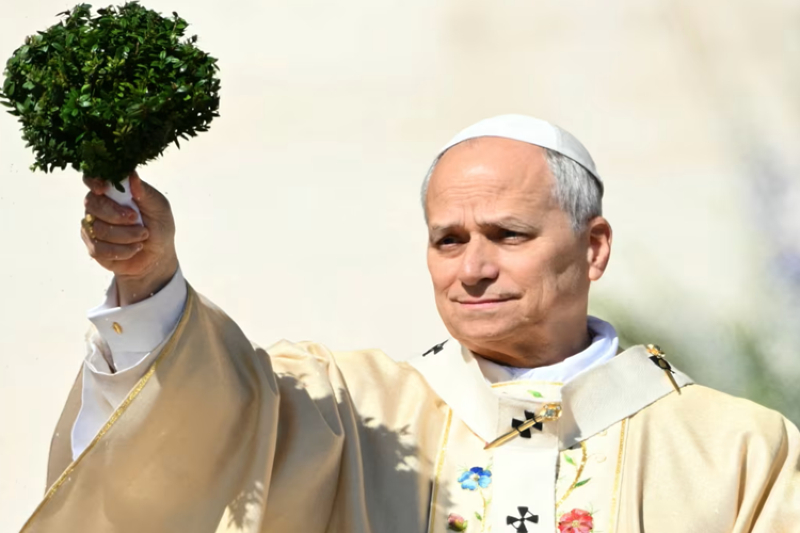
VATICAN CITY — Presiding over his first Easter Mass as head of the Catholic Church, Pope Leo XIV used his platform on Sunday to deliver a powerful plea for hope, addressing a world increasingly scarred by military conflict, economic exploitation, and environmental degradation.
Speaking to a sun-drenched St. Peter’s Square packed with thousands of the faithful, the pontiff—elected just last year—acknowledged the "cry of pain" echoing from those crushed by modern injustices.
A Call to Reject "Persistent Injustice"
During his homily, Pope Leo reflected on the difficulty of maintaining faith in a period marked by "the violence of war that kills and destroys" and "the idolatry of profit that plunders the earth’s resources."
"Often it seems that God does not exist: all around us we see persistent injustice, evil, indifference and cruelty," the Pope admitted. "But it is also true that in the midst of darkness something new always springs to life... Easter gives us this hope, as we remember that in the risen Christ a new creation is possible every day."
Diplomacy and the "King of Peace"
The Easter celebrations have been heavily influenced by the current geopolitical climate, specifically the ongoing tensions in the Middle East and Ukraine.
Urged De-escalation: Called for world leaders, including U.S. President Donald Trump, to find "off-ramps" to current hostilities.
Redefined Justification: Stated during Palm Sunday that no one can "use Jesus to justify war," asserting that God rejects the prayers of those who initiate conflict.
First US-Born Pontiff’s Holy Week
The 70-year-old Pope, formerly Cardinal Robert Prevost, demonstrated his personal commitment to the liturgical traditions of Rome.
On Good Friday, he broke with recent precedent by carrying the wooden cross for the entirety of the "Way of the Cross" procession at the Colosseum.
During that service, the liturgy emphasized modern-day struggles, including the plight of deported immigrant children and a stark warning to global authorities regarding their moral accountability.
Later on Sunday, the Pope is scheduled to deliver his traditional Urbi et Orbi ("to the city and the world") blessing from the central balcony of St. Peter’s Basilica.
He is expected to expand on his calls for humanitarian corridors and a global ceasefire, speaking to the 1.4 billion Catholics worldwide in a variety of languages.
The Resurrection: The Foundation of Christian Faith
The theological significance of Easter Sunday centers on the belief that Jesus Christ rose from the dead three days after his crucifixion on Good Friday. In Christian theology, this is not merely a historical claim but the "cornerstone" of the entire faith.
Core Theological Pillars
Victory Over Death: Easter represents the definitive triumph of life over death. It suggests that because Christ was resurrected, humanity is also offered the promise of eternal life, transforming death from a final end into a passage.
Atonement and Redemption: While Good Friday is seen as the day Jesus sacrificed himself to pay for the sins of humanity, Easter Sunday is the validation of that sacrifice. It signifies that God accepted the offering, effectively "reconciling" the world to Himself.
The "New Creation": As Pope Leo XIV highlighted in his homily, Easter is viewed as the beginning of a "new creation." It implies that the old order—defined by sin, decay, and "persistent injustice"—is being replaced by a spiritual reality where hope and renewal are possible every day.
The Living Christ: Unlike other religious figures whose lives are memorialized through their deaths, the theology of Easter emphasizes that Jesus is alive and present. This informs the Pope’s message that "God does exist" even in the midst of war and suffering.
The Symbolism of the "Empty Tomb"
In the biblical narrative, the empty tomb discovered at dawn is the primary symbol of Easter. Theologically, the absence of a body serves as proof of a divine intervention that defies the laws of nature. This "miracle" serves as the basis for the Christian hope that even the most desolate situations—be it a war-torn region or a climate crisis—can be transformed by divine power.
The "Third Day" Requirement
The timing of Easter is critical to its theological meaning. By rising on the third day, Jesus fulfilled the "signs of the prophets" (specifically the Sign of Jonah). This fulfills the scriptural promise that God’s plan cannot be thwarted by human violence or political authorities, a theme Pope Leo XIV echoed when he warned world leaders that their actions will ultimately be judged.
The Theological Significance
Easter Sunday is the most significant holy day in the Christian calendar, marking the climax of the Holy Week and the celebration of the Resurrection of Jesus Christ.
According to the New Testament, Jesus was crucified on Good Friday and rose from the dead on the third day (Easter Sunday). For Christians, this event represents:
Victory over Death: The belief that life continues beyond the physical body.
Redemption: The promise of a new beginning and the forgiveness of sins.
A New Creation: As Pope Leo XIV mentioned in his homily, it is seen as the moment a "new creation" becomes possible for humanity.
Key Traditions of the Day
Easter is celebrated with a blend of religious solemnity and festive joy:
The Easter Mass: In the Catholic tradition, the Pope delivers the Urbi et Orbi (to the City and the World) blessing from St. Peter’s Basilica, often addressing global issues.
Sunrise Services: Many denominations hold outdoor services at dawn to symbolize the moment the empty tomb was discovered.
The Paschal Candle: A large white candle is lit to represent the "Light of Christ" entering the world.
Cultural Symbols
While the core is religious, several cultural symbols have become globally recognized:
Easter Eggs: Originally a symbol of fertility and rebirth, they now represent the "empty tomb" from which Jesus emerged.
The Easter Lily: A white flower that symbolizes purity and the new life of the Resurrection.
The Date: Unlike Christmas, Easter is a "moveable feast." It is held on the first Sunday after the first full moon following the spring equinox (usually between March 22 and April 25).
Context in the Current News
In the reports you’ve been following, Easter Sunday 2026 is being framed through the lens of hope vs. conflict. Because the Pope is the first American-born pontiff, his message this year carries a specific diplomatic weight, focusing on peace in the Middle East and the humanitarian treatment of immigrants.