
Pope Leo De-escalates War of Words with Trump During African Tour
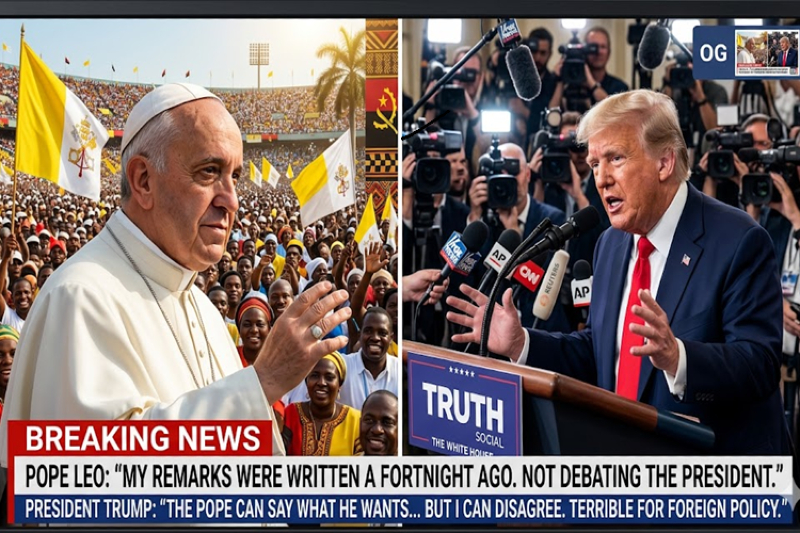
LUANDA, ANGOLA – Pope Leo has moved to clarify recent remarks regarding global "tyrants," insisting his words were not a direct swipe at U.S. President Donald Trump. Speaking to reporters aboard the papal flight to Angola on Saturday, the pontiff sought to dampen a high-profile diplomatic spat that has dominated headlines all week.
Timing vs. Tension
The controversy stems from a speech delivered by the Pope in Cameroon on Thursday, where he criticized leaders who prioritize "billions on killing and devastation" over education and healing. Given the timing—falling just days after President Trump labeled the Pope "terrible for foreign policy"—many observers interpreted the address as a pointed rebuttal.
However, the Pope clarified on Saturday that the speech was finalized weeks ago.
Prior Preparation: "The remarks were written a fortnight earlier—well before the President ever commented on myself," the Pope explained.
Avoiding Debate: He added that a "certain narrative" had developed that was inaccurate, stating, "It was looked at as if I was trying to debate the President, which is not in my interest at all."
The "Jesus-Like" Image and Foreign Policy Friction
The friction between the Vatican and the White House reached a fever pitch on Monday when Trump launched a scathing social media attack on the first American-born Pope. The President’s ire was sparked by the pontiff’s criticism of the U.S.-led military operations in Iran and the ongoing naval blockade.
The Spat Timeline:
The Warning: Pope Leo voiced concern over Trump’s rhetoric that a "whole civilization will die" if Iran does not comply with U.S. demands.
The Rebuttal: Trump responded by calling the Pope "WEAK on crime" and "terrible for foreign policy," briefly posting an AI-generated image of himself depicted as a Jesus-like figure.
The Response: Trump later told reporters, "The Pope can say what he wants... but I can disagree."
Focus on Africa’s Catholic Growth
Despite the noise from Washington, the Pope remains focused on his 11-city tour of Africa, a continent that now represents more than 20% of the global Catholic population.
In Cameroon, he shifted the focus to local suffering, condemning the "endless cycle of destabilization and death" in regions ravaged by a decade of insurgency. By continuing his tour into Angola, the pontiff is underscoring the shift of the Church's demographic center toward the global south.
Geopolitical Ripple Effects
The Pope’s push for peace coincides with a chaotic diplomatic weekend:
Hormuz Standoff: Iran has reportedly re-closed the Strait of Hormuz, accusing the U.S. of "maritime piracy" via its continued blockade.
10-Day Truce: A fragile ceasefire remains in place in Lebanon, which the Pope has urged all sides to respect as a "first step toward restoration."
Domestic Fitness Debate: In Washington, HHS Secretary RFK Jr. continues to defend the President's mental fitness against Democratic critics who cited the Pope-Trump spat as evidence of instability.