
Lebanese Prime Minister Slams Israeli Strike on Journalists as "War Crime"
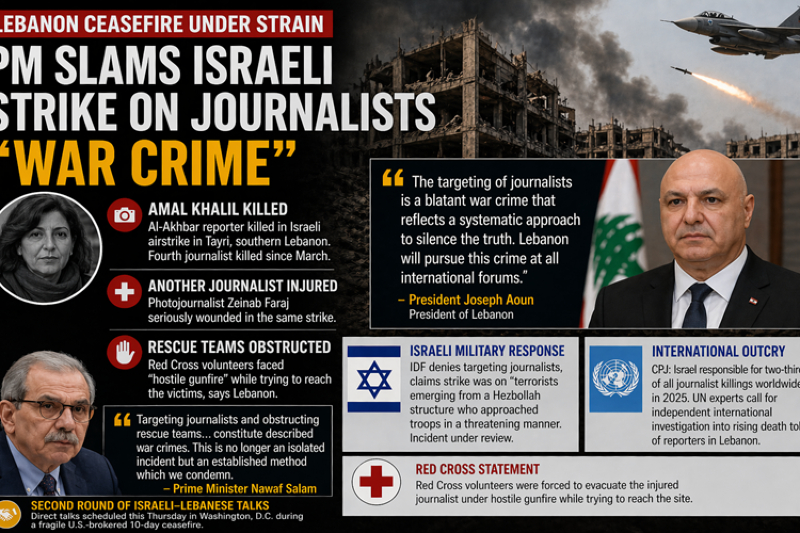
BEIRUT — Lebanese Prime Minister Nawaf Salam has launched a blistering critique of the Israeli military, accusing the nation of committing war crimes following an airstrike on Wednesday that killed a prominent journalist and left another critically injured in southern Lebanon.
Targeting of Media Workers
The fatality was identified as Amal Khalil, a reporter for the daily newspaper Al-Akhbar. According to Lebanon’s National News Agency (NNA), Khalil was killed while performing her duties in the town of Tayri. She marks the fourth media worker killed by Israeli forces in Lebanon since March 2026.
Zeinab Faraj, a freelance photojournalist, was seriously wounded in the same incident. Reports indicate the two women had sought refuge in a building during a series of aerial bombardments when the structure was directly hit.
Obstruction of Rescue Efforts
Prime Minister Salam highlighted not only the strike itself but also the alleged interference with emergency responders. Lebanese authorities claimed that Red Cross volunteers were forced to evacuate Faraj under "hostile gunfire" as they attempted to reach the site.
"Targeting journalists and obstructing rescue teams... constitute described war crimes," Salam posted on X (formerly Twitter). He further asserted that these attacks are no longer "isolated incidents" but have become an "established method" used by the Israeli military.
Israel’s Defense
The Israel Defense Forces (IDF) acknowledged that the journalists were caught in the strike but denied intentionally targeting them. In a statement, the military claimed its forces had identified two vehicles emerging from a "military structure" used by Hezbollah.
The IDF alleged that "terrorists" in the vehicles approached Israeli troops in a "threatening manner," prompting an attack on one vehicle and the building where the individuals subsequently fled. The military also disputed claims that it had prevented medical teams from accessing the area, noting that the details of the incident are currently under review.
A Fragile Ceasefire in Jeopardy
This latest escalation occurs during a precarious 10-day ceasefire brokered by U.S. President Donald Trump, which took effect on April 16. The truce was intended to halt the intensifying conflict between Israel and the Iran-backed group Hezbollah.
Despite the bloodshed, a second round of direct diplomatic talks between Israeli and Lebanese officials is still scheduled to take place this Thursday in Washington, D.C.
International Outcry
The strike has drawn sharp condemnation from global watchdogs. The Committee to Protect Journalists (CPJ) held Israeli forces directly responsible for the tragedy, noting that Israel was responsible for two-thirds of all media worker killings globally in 2025.
UN experts have previously called for an independent international investigation into the rising death toll of reporters covering the conflict in Lebanon.
CPJ Condemns Deadly Strike and Obstruction of Rescue Efforts in Lebanon
The fatality was identified as Amal Khalil, a veteran reporter for the daily newspaper Al-Akhbar. According to Lebanon’s National News Agency (NNA), Khalil was killed in the town of Tayri, becoming the fourth media worker slain by Israeli forces in Lebanon since March. Zeinab Faraj, a freelance photojournalist, sustained serious injuries in the same attack.
The Committee to Protect Journalists (CPJ) has expressed profound outrage, suggesting the strike was a deliberate act. The organization revealed that Khalil had reportedly received a direct death threat attributed to the Israeli Defense Forces (IDF) in September 2024, raising grave concerns about premeditated targeting.
Furthermore, CPJ and Lebanese authorities emphasized that the tragedy was exacerbated by the obstruction of rescue efforts. Red Cross volunteers reportedly had to navigate "hostile gunfire" to reach the victims. CPJ warned that intentionally blocking medical and rescue teams from reaching wounded journalists may constitute a war crime under international law.
Official Responses
Prime Minister Salam echoed these sentiments in a statement on X (formerly Twitter):
"Targeting journalists and obstructing the access of rescue teams to them... constitute described war crimes. This is no longer an isolated incident but an established method which we condemn."
The Israeli military acknowledged that two journalists were injured but denied intentional targeting. The IDF stated that its forces attacked a vehicle and a building after identifying "terrorists" emerging from a Hezbollah military structure who approached troops in a "threatening manner." The military added that it did not prevent rescue teams from entering the area and that the incident is under review.
Fragile Diplomacy
The strike occurs during a critical 10-day ceasefire brokered by U.S. President Donald Trump, which began on April 16. Despite the violence, a second round of high-level diplomatic talks between Israeli and Lebanese officials is still set to proceed this Thursday in Washington, D.C.
The CPJ noted that Israel was responsible for two-thirds of all journalist killings globally in 2025, leading to renewed calls from UN experts for an independent international investigation into the deaths of media workers in the region.